
After nearly three decades of Republican control of Florida, the governor’s executive office has become more powerful than ever.
So when Florida voters choose between Republican Byron Donalds and Democrat David Jolly for governor on Nov. 3, the winner will be poised to shape the direction of the state for years to come.
I’m a political scientist who has lived in Florida for nearly two decades and have seen the powers of the governor’s office grow. I’ve been watching how both candidates say they will use their authority to shape policy on health, education and self-government – and what help they might need from Parliament.
Joe Raedle/Getty Images News
Florida Health Policy on Vaccination Mandates
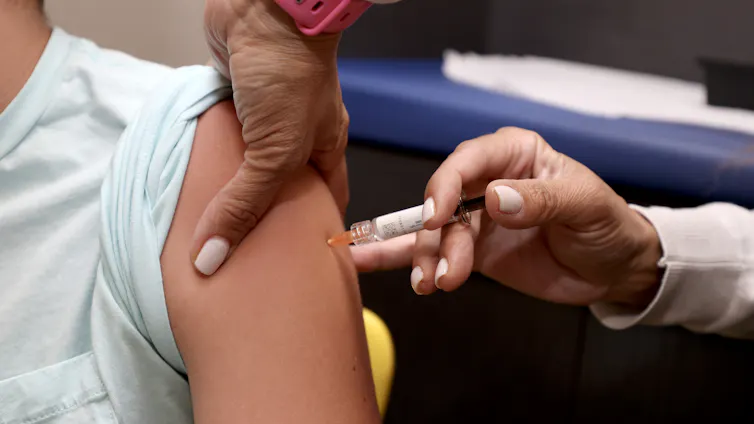
One of the first choices facing the new governor will be whether to appoint Florida’s surgeon general, a position created in 2007. The surgeon general oversees the Florida Department of Health and the state’s county health departments.
The position has the authority to declare public health emergencies, forcibly quarantine people and set vaccination mandates for diseases such as chickenpox that fall outside the framework of seven childhood vaccination mandates set by the state Legislature.
As part of his conservative overhaul of Florida’s policies, Governor Ron DeSantis appointed current Surgeon General Dr. Joseph Ladapo to the position in 2021. During the COVID-19 pandemic, Ladapo became a leading advocate for medical freedom and a vaccine skeptic.
Ladapo opposes all vaccination mandates. At the height of the COVID-19 pandemic, he recommended against COVID-19 vaccination for healthy children and ended quarantine mandates for Florida public schoolchildren exposed to COVID-19. He also said he wants mRNA vaccines “not to be available to anyone” in the state.
Ladapo also proposed new Florida health rules in October 2026 to drop mandates for four vaccines required for school attendance, including chickenpox and hepatitis B. Currently, the state only allows exemptions for approved religious or medical reasons.
The Florida chapter of the American Academy of Pediatrics opposes the rule change on public health grounds.
Donalds has long opposed vaccination mandates and says he has not personally received a COVID-19 vaccine. He supports the rule change proposed by Ladapo aimed at reducing vaccination requirements in schools and says he is open to the reappointment of Ladapo as surgeon general.
Jolly, on the other hand, supports Florida’s current school vaccination mandates and exemptions. He says he would fire Ladapo on day one in favor of someone who “adheres to science and evidence-based public health.”
Whoever is elected governor, the Florida Legislature has its hands tied on how far it can push vaccine policy. The Legislature made measles and polio vaccines mandatory for all public school students in grades K-12. Removing this requirement would therefore require a change in the law. It also stripped the surgeon general of the authority to enforce vaccination mandates during public health emergencies in November 2021, during the pandemic.
Universal school vouchers
One of the most significant developments in K-12 education in Florida in recent years has been the creation of a universal voucher system by DeSantis and the Legislature in 2023. This program allows parents, regardless of income level, to use an average of $8,000 in state money, based on county of residence, for their children’s private or home education.
The universal voucher program has created intense pressure on the state budget. It cost about $4.5 billion for fiscal year 2026. State auditors identified accountability issues in tracking funds through the system. Public schools face declining enrollment and have fewer resources to serve the neediest students than they can turn away.
Donalds strongly supports the universal voucher program, recounting how his family saved money to allow him to attend a private high school. Donalds has touted the virtues of universal vouchers in Christian nationalist circles and expressed interest in making Florida “the model state for school choice” by allowing parents to choose among private education providers competing in the marketplace.
His wife, Erika Donalds, is a former Collier County school board member who runs a network of for-profit charter schools and advocates nationally for school choice.
The only change Donalds is proposing is a universal dashboard for the voucher program so parents can compare educational data on student performance at different types of schools. Currently, only public schools are required to provide this data.
Jolly also supports the universal voucher program but wants significant changes. Jolly personally sends her two children to private faith-based schools using vouchers. It says private schools that accept vouchers should meet the same standards and requirements as public schools, including a mandate to serve students with disabilities. He also wants to limit private school tuition to the value of the voucher and restore eligibility for benefits based on financial need.
Aside from campaign promises, there is little either candidate can do to affect the universal voucher program, because it was created by the Legislature.
Democrat Jolly knows he will need the Legislature’s cooperation to advance reforms and says he has identified Republican allies to do so. Donalds would likely face a Republican majority supportive of his more modest reform proposals.
Florida’s next governor will also be able to influence the state’s education policy by appointing the seven members of the Board of Education and then recommending a candidate for commissioner of education for that board to be elected. The state commissioner and board oversee the Florida Department of Education and programs ranging from kindergarten through postsecondary education.
The commissioner position used to be elected, but in 2002 voters approved a constitutional amendment creating the current system, which gives more power to the governor.
The next governor’s appointees to the Board of Education could attempt to shape the effects of universal vouchers more indirectly. The board could approve an annual legislative budget request with new recommended funding levels for public education to offset shortfalls due to lost education voucher revenue.
They could also implement new eligibility rules for private school vouchers, as the DeSantis administration has done.
Generally speaking, Jolly says he intends to use executive power as vigorously as possible in education, as DeSantis has done, particularly to promote diversity programs.
The Washington Post via Getty News
Home Rule and executive power
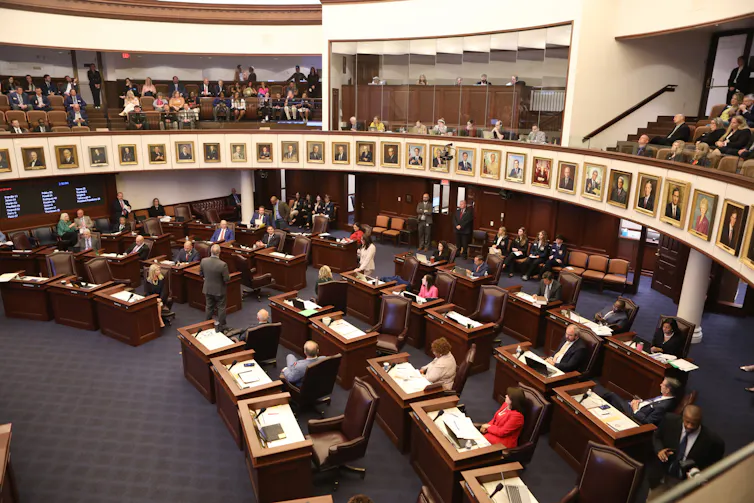
A third hot topic facing the next governor is self-government, or the principle that local governments, such as cities and counties, should be able to set policy on local issues.
The DeSantis administration has seriously eroded self-government. The governor signed a law limiting local controls over land use planning. This bill limited the ability of Manatee County, for example, to protect wetlands under the guise of emergency management legislation.
It also required counties to cooperate with federal immigration authorities and subject counties to DOGE-style audits. He even dismissed local elected officials from their positions. For example, he ousted two popular Democratic prosecutors, Hillsborough County Prosecutor Andrew Warren and Prosecutor Monique Worrell of Orange and Osceola counties, alleging dereliction of duty in both cases. As of August 2023, DeSantis had impeached 23 elected officials, a much larger number than his predecessors.
Donalds asserted that he supports the actions taken by DeSantis and plans to further expand executive power, scheduling more DOGE audits of local government and firing more elected officials if necessary.
In contrast, Jolly says he would counter DeSantis on home rule. He wants local authorities to decide budgets and policies themselves. He considers the dismissal of elected officials as an affront to the democratic process.
However, what about large-scale data centers? Donalds wants local communities to be able to decide whether or not to build data centers. But Jolly, citing concerns about the health and environmental effects of data centers, wants a one-year statewide moratorium on the construction of new data centers and is open to a permanent ban.
Voters will have their own say on local autonomy when they vote on Amendment 3, which would significantly reduce property taxes. Critics warn that if the bill passes, local governments will likely have to look to Tallahassee to make up for lost funds, and that strings will be attached.
Donalds supports Amendment 3, while Jolly opposes it.
Read more of our Florida stories.
Gn usa

