
Driving the news: During a presentation Thursday, Musk showed off a two-seat electric supercar equipped with rocket boosters and a powerful vacuum system.
- The Roadster uses high-pressure compressed air, rather than rocket fuel, to increase thrust, propel itself through the air and perform aerial gymnastics.
- An underbody fan system sucks the car toward the pavement, creating extraordinary grip when accelerating and cornering.
- Tesla claims the car can accelerate from zero to 60 mph in just 0.8 seconds – faster than any production car – and will exceed 230 mph, although Musk has said the goal is to reach “half the speed of sound”.
“This car could suck chrome on a trailer hitch,” Musk joked about his powerful fans.
- He also acknowledged that the Roadster is “not necessarily a safety-optimized car.”
- And before the protests began, he warned: “Success is not guaranteed… But if it doesn’t work, we are at a safe distance.”
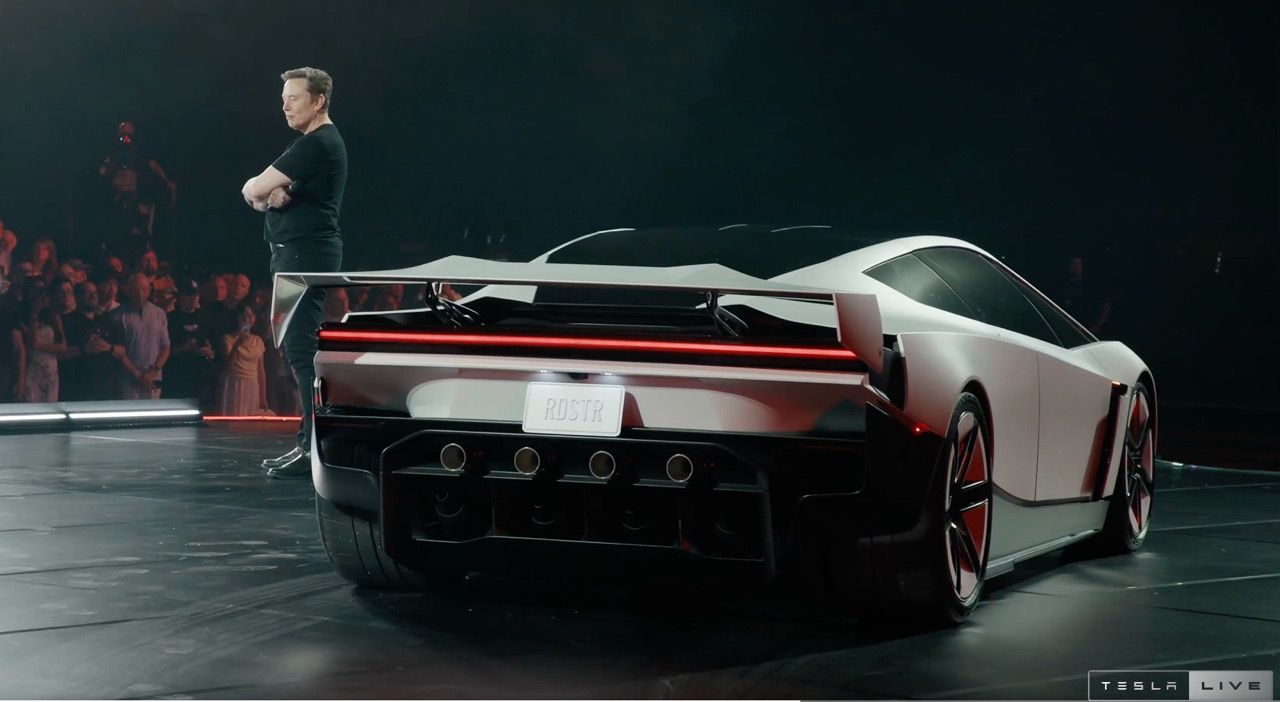
Between the lines: The Roadster is a reminder of what makes Musk such a polarizing figure: his willingness to pursue ideas that other engineers – or business lawyers – might consider crazy.
- Tesla and SpaceX have already transformed the automotive and aerospace industries by challenging conventional engineering assumptions.
- The Roadster takes this philosophy of pushing the limits to an almost comical extreme.
- But the underlying technologies, particularly its active aerodynamics and extraordinary traction system, could have applications beyond a so-called flying car.
My thought bubble: There is an irony here. Musk envisions a future in which humans no longer need to drive, but he’s building what he says will be Tesla’s last manually driven car.
- While Tesla’s robo-taxis promise to make transportation safer and more mundane, the Roadster is designed to make driving exciting — and maybe a little terrifying.
- It’s a throwback to the days when cars were objects of desire, not just devices that transported people.
Reality check: Tesla lists three models of the Roadster, and the flying version it recognizes is not approved for public roads.
- It did not disclose pricing, battery life or how long the Rocket version can stay in flight.
- And Musk has a long history of promising revolutionary products years before they arrived.
What we’re looking at: Musk says the Roadster will go into production in 2028. There are still plenty of unanswered questions, not the least of which is whether a flying car – legal or not – is even practical.
- But for one crazy evening, he made the future look like a science fiction film.
Gn headline

