
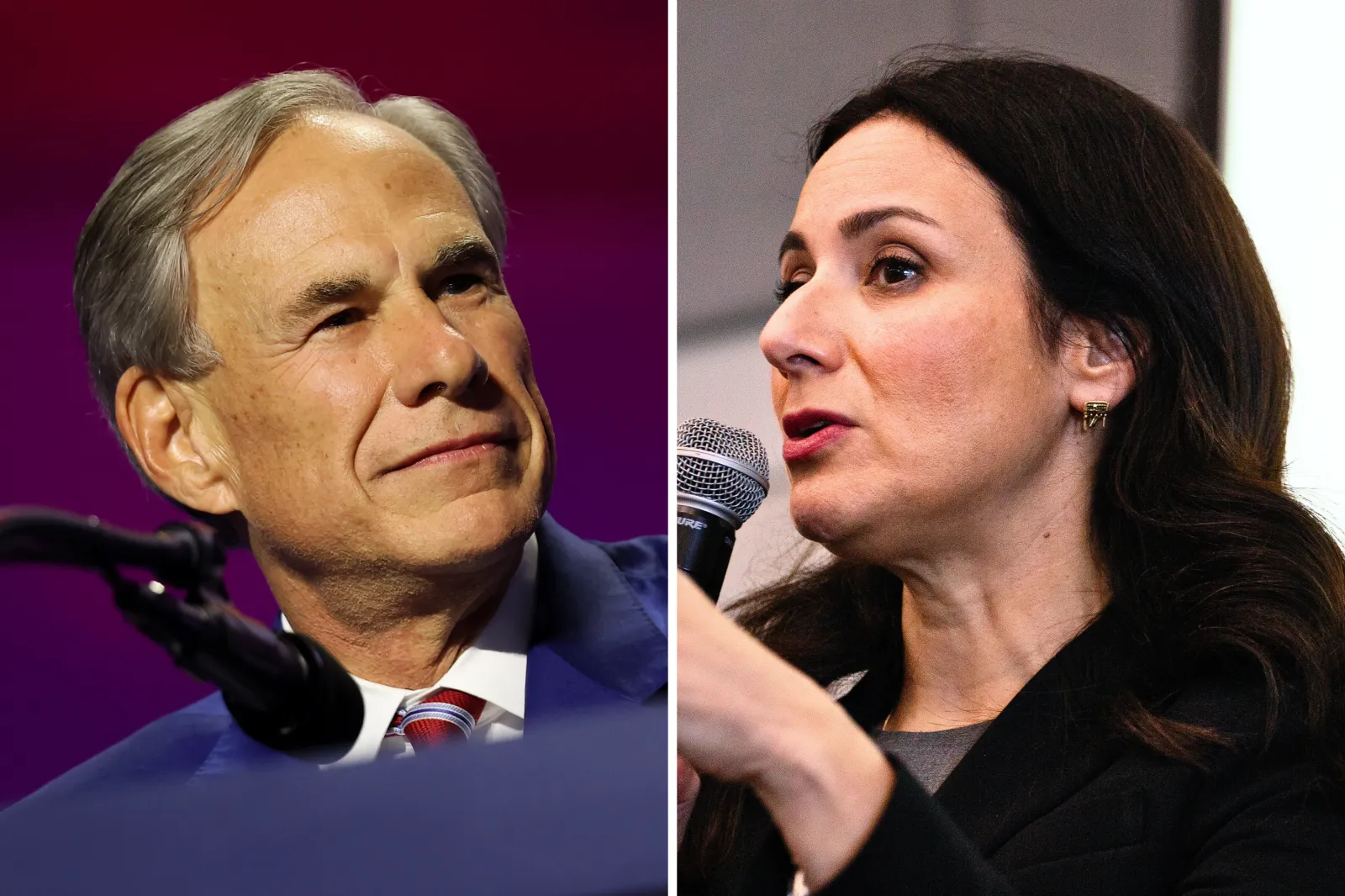
Some Texans who want to give Republican Gov. Greg Abbott a fourth term are considering splitting their votes, backing Democrat James Talarico in the U.S. Senate race, according to three statewide polls released this week.
Talarico, a state representative from the Austin area, is doing better in his Senate race against Republican Texas Attorney General Ken Paxton than Democratic state Rep. Gina Hinojosa is doing against Abbott. Paxton, in turn, is behind Abbott’s numbers at the top of the Republican field.
That divergence gives Democrats their best opening in decades in a state that last elected a Democrat to the Senate in 1988. It also highlights a particular problem in Paxton. Among the same voters, Abbott is competitive or slightly ahead at the top of the ticket while Paxton lags behind.
A Marist poll, released Wednesday, puts Talarico leading Paxton 47 percent to 45 percent among likely voters. In the gubernatorial race, those same voters favor Abbott over Hinojosa 49 percent to 45 percent, a six-point gap between the two elections on the same ballot. Marist surveyed 1,196 potential registered voters Oct. 8-11, with a margin of error of plus or minus 4.9 percentage points.

Who are Talarico-Abbott voters?
Marist has not released details of the Senate survey among Abbott supporters, but comparing the two races group by group, the poll shows Paxton trailing Abbott almost everywhere.
It is among the Republicans that the crossover appears most clearly. Talarico drew 8 percent of likely Republican voters in the Senate race, while Hinojosa drew 5 percent in the governor’s race. Paxton was 87 percent Republican, compared to 91 percent for Abbott. Republicans made up 42 percent of the likely electorate in the poll, so this slight slippage largely explains why Talarico’s numbers were higher than the Democrats’ for governor.
White women with college degrees have gone further. Talarico led Paxton 62 percent to 37 percent with the group, a margin about 9 points wider than Hinojosa over Abbott. Suburban voters also leaned toward Talarico.
Independents behaved differently. Paxton received 30 percent, 6 points below Abbott, and Talarico did not make up the difference; his 52 percent independents are close to the 53 percent Hinojosa got in the governor’s race. These voters parked elsewhere. Ten percent of independents were undecided in the Senate race, compared to 4 percent for governor, while 5 percent supported a third-party candidate.
Nonwhite voters drifted similarly, with Paxton 5 points behind Abbott while Talarico and Hinojosa each got 52 percent in their races.
Voters who support Abbott but haven’t decided on a Senate candidate could end up deciding the race.
Paxton’s image problem
Paxton’s favorable numbers largely explain this discrepancy.
Thirty-four percent of likely voters view him favorably and 56 percent unfavorably, a net rating 18 points lower than Abbott. One in five Republicans saw him in a negative light. Among independents, it stands at 22 percent favorable and 69 percent unfavorable.
His worst numbers come from Dallas-Fort Worth, which encompasses his Collin County political base. Three-quarters of likely voters there viewed Paxton unfavorably, and his share of the Senate vote in the region fell 5 points below Abbott’s.
Paxton’s support has also been weak. About a third of his voters, or 34 percent, said they only partially supported him, while 84 percent of Talarico voters and 76 percent of Abbott voters described their support as strong.
Few Republicans from Paxton seemed attracted to Talarico as only 6% of likely Republican voters viewed the Democrat favorably.
Paxton was impeached by the Texas House in 2023 and acquitted by the state Senate. After being endorsed by President Donald Trump, he beat Sen. John Cornyn for the Republican nomination this year after Cornyn and his allies argued for months that Paxton could put his seat in jeopardy in the Nov. 3 midterm elections.
Brendan Steinhauser, a Texas Republican strategist, highlighted two forces weighing on the Republican candidate. The national economic and political climate “weighs heavily on Texas Republicans, especially Ken Paxton,” he said. News weekand “Paxton’s problems and obstacles throughout his political career also weigh him down.”
Abbott, meanwhile, is posting numbers that “have been stronger over the long term,” according to Steinhauser.
Voters still expect Paxton to win. Fifty-three percent of likely voters regardless of choice said Paxton would fill the seat, while 42 percent said Talarico would.
Republican undervote
While polls are encouraging for Talarico and other Texas Democrats, many political strategists are scrutinizing whether 2026 will finally be the year the state turns blue. Steinhauser believes many Republicans will continue to vote for their party’s nominee in the gubernatorial race but leave the Senate race empty.
“There are some Abbott voters who won’t necessarily vote for Talarico, but they also won’t vote for Paxton,” Steinhauser said. “So we call that an undervote, and I think that’s probably what you see in the polls.”
He described what it might look like on the ballot.
“There are Republican voters who are going to vote for Abbott, and then they’re going to maybe skip the Senate race, and then vote against the Republicans as well,” he said. He sees “a small percentage” supporting both Abbott and Talarico, but added: “I think that Republican undervote is a bigger concern for Republican strategists.”
Steinhauser cautioned against interpreting the numbers as a realignment.
“It doesn’t necessarily mean that a bunch of Republicans have become Democrats in Texas,” he said. “It’s more that Republican voters might not be as enthusiastic about voting this year as in the past.”
He noted that Democrats outnumbered Republicans in the primaries, which he said still worries him. He nevertheless believes that the Republicans can hold the Senate seat.
“I just think it might be closer than we all expected,” he said.
What other polls show
ReconMR/Siena surveyed 617 likely voters Oct. 5-8 and had Talarico leading 48 percent to 44 percent, while Abbott trailed Hinojosa 48 percent to 47 percent. Paxton won 87 percent of Republicans in that poll, compared to Talarico’s 7 percent. Talarico spent this investigation period away from the campaign with the flu, he said.
The UT/Texas Politics Project poll, which reached 861 likely voters between September 25 and October 5, showed less separation. Talarico led 50 percent to 47 percent and Hinojosa 49 percent to 48 percent, both within the margin of error of 3.34 points. Talarico held a 54 percent to 41 percent advantage among Hispanic voters, a group that Hinojosa also carried.
The signs of split were there in August. The Texas Politics Project poll this month found that 91 percent of Democrats supported Talarico and only 79 percent of Republicans favored Paxton, and it attributed Abbott’s stronger standing to his standing with Republicans and independents.
Texas has entered “the most competitive cycle we’ve seen in the state in a long time,” Jim Henson, director of the project, told Axios.
The division has also deepened over the past month, mainly because the gubernatorial race has changed: Abbott has recovered and Paxton has stayed put.
In September, Marist had Talarico leading by 6 points among registered voters and Hinojosa by 3. Now, Talarico leads by 4 and Abbott by 1. ReconMR’s numbers have changed almost the same way: Talarico has slipped from plus 6 to plus 4, while the governor’s race has gone from a 4-point lead for Hinojosa to a one-point advantage for Abbott.
However, no single poll settles the question, since the differences between the two races are mostly within each survey’s margin of error. Early voting will begin in the coming days. The general elections will take place on November 3.
Contact Newsweek editors about this story: Jason Lemon And Dave Siminoff.
Gn headline

