
The thrusters are as effective at overturning cars as they are at chasing ballistic missiles.

Tesla’s long-delayed and still-unreleased Tesla Roadster was officially reintroduced on October 15, and aside from an angular Cybertruck-like design and the ability to go from 0 to 60 mph in less than a second, the company’s big surprise was that it could fly. The car cannot really “fly” in the tradition of Back to the Future Part IIbut even more thanks to a set of controlled falling, jumping and turning maneuvers. While certainly impressive, the concept is not unique to Tesla. Experimental missile defense systems have used boosters in a similar manner since at least the early 2000s, in a format now called Multiple Kill Vehicle, or MKV.
In the case of the Roadster, the supercar is able to perform its much-lauded kickflips thanks to two high-pressure air tanks and ten nozzles placed throughout the car that shoot compressed air to move and stabilize it. Tesla claims the Roadster can fill these tanks on its own, although the full booster setup is also only fully available on the Rocket version of the car. The Thruster version only has thrusters in the rear of the car, and the Performance version has none at all. Importantly, Tesla also states that the thrusters “are not approved for use on public roads.”
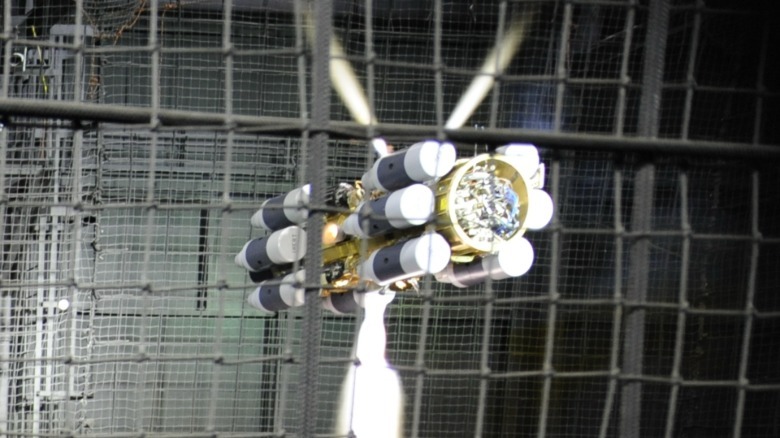 Missile Defense Agency
Lockheed Martin’s MKV project didn’t get off the ground in earnest until 2004, when the company won a $760 million contract from the U.S. Missile Defense Agency to build “the first system capable of destroying multiple ballistic missile threats and decoys in a single launch.” This system carries several smaller vehicles designed to ram missiles to destroy them, and it stays aloft using thrusters that can quickly change direction and orientation on the fly, much like the Roadster.
Finding actual footage of the MKV in action is tricky, particularly because the concept of a single missile system capable of knocking out multiple other missiles has been floated since the Reagan-era Strategic Defense Initiative (SDI), better known as the “Star Wars” program. The video below is believed to be of Lockheed Martin’s MKV, but similar footage has also been associated with SDI – and Lockheed Martin didn’t exist before 1995, so anything attributed to it before then is suspect. Regardless, this is the concept that Lockheed Martin and another contractor, Raytheon, were working on in separate areas of development until the original MKV project was abandoned in 2009 amid military budget cuts.
Besides their intended uses – carrying ultra-rich and destructive intercontinental ballistic missiles – the Roadster and MKV have another important difference: how their thrusters actually work. Tesla is pretty adamant that the Roadster uses cold gas propellants (specifically compressed air), meaning they don’t burn fuel to move whatever they’re attached to. According to a 2008 Lockheed Martin press release, its MKV was used in “hot-fire tests” suggesting that part of the system burned fuel for propulsion. Since no one currently owns one, it’s hard to say which is better, but Tesla’s is probably less combustible.
Gn headline

