
Type 2 diabetes is not necessarily a lifelong diagnosis or a condition that gets progressively worse over time.
Today, there is strong evidence to suggest that the risk of developing this metabolic disorder can be reduced by up to 58% in people with prediabetes.
Diet and exercise are a key part of this.
Researchers in the UK and Canada have now identified a way to put more than 50% of patients with early-onset type 2 diabetes into remission.
This involves a low-calorie diet and a supervised exercise program.
“Our remission rates are at the upper end of those previously reported in the literature for trials of similar duration,” write the authors, led by Kaberi Dasgupta of McGill University in Canada.
According to the team, these findings reinforce the potential of lifestyle interventions to “support clinically meaningful remission.”
They also demonstrate “for the first time that such effects can be achieved in a multi-ethnic population with early-onset type 2 diabetes through a combined low-energy diet and structured physical intervention.”
Early-onset type 2 diabetes is often defined as a diagnosis made at age 45 or younger, and it tends to progress more quickly than cases that occur later in life.
Patients with early-onset diabetes experience accelerated deterioration of their glucose levels and face an increased risk of premature health complications and death.
In some cases, however, positive changes can be made.
The randomized trial took place across three centers in Canada and the United Kingdom and included 96 ethnically diverse participants with early-onset type 2 diabetes and obesity who were not taking insulin therapy.
The average age of the group was 38 years old.
In the current trial, about half the group was randomized to continue their lives normally, while the other half began a low-energy diet and exercise.
The diet involved eating approximately 800 to 900 calories per day, and the physical intervention involved a supervised session of aerobic and resistance training twice a week, as well as independent exercise once a week.
The health of the participants was closely monitored.
After 12 weeks, participants switched to a weight maintenance diet and continued to exercise independently for an additional 12 weeks.
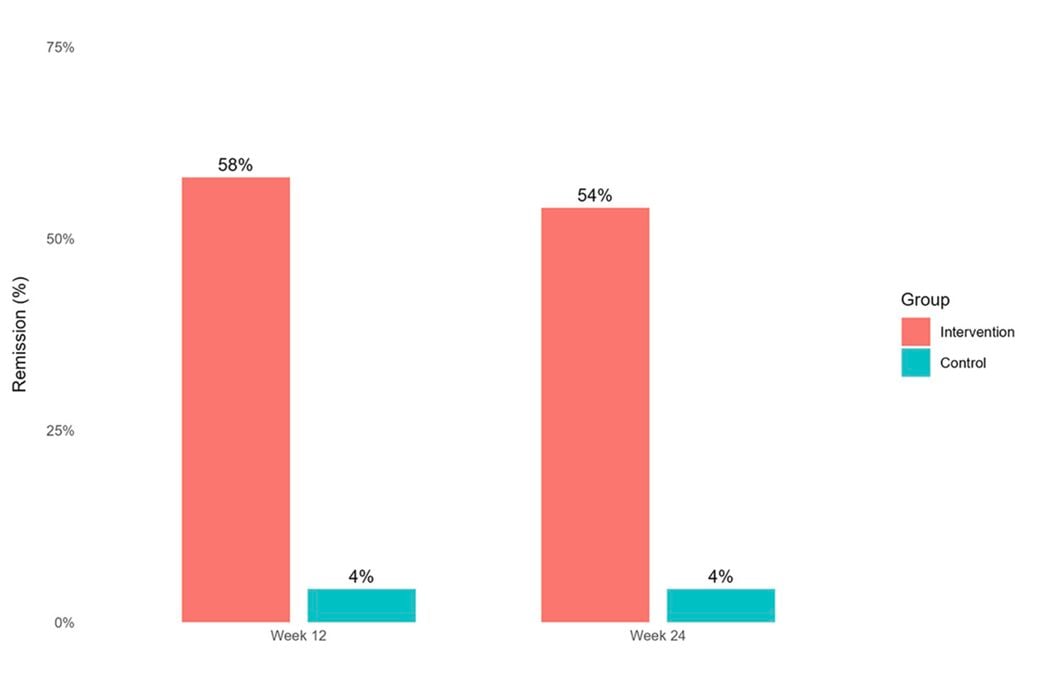
At 24 weeks, remission was achieved in 27 of 50 participants in the intervention group.
In comparison, only two participants in the control group went into remission.
That’s a difference of 50 percent, and all of this was achieved without glucose-lowering medications.
Participants in the intervention group achieved a substantial loss of fat mass compared to the control group, but importantly, they also preserved their muscle mass and strength.
At the end of the trial, their cardiovascular health showed several improvements, including a 10.3% increase in their respiratory capacity relative to body mass, as well as lower blood pressure and resting heart rate.
The left ventricles of the heart also appeared to have a healthier shape and structure compared to the control group.
In surveys, participants reported that their diabetes-related distress decreased and their quality of life improved.
“Our results demonstrate the feasibility and effectiveness of combining structured aerobic and resistance exercise with low-energy diets in early-onset type 2 diabetes,” the authors conclude, “supporting its potential to provide substantial and holistic health and well-being benefits alongside diabetes remission.”
The trial only lasted 24 weeks, so it’s unclear how long these benefits might last.
At this point, it’s also unclear whether diet or exercise played a larger role.
While other trials have looked at how a low-energy diet might lead to early remission of type 2 diabetes, focusing solely on weight loss may lead to loss of muscle mass.
Muscle is important for metabolic health. It is the primary site for glucose disposal and is also a major determinant of how the body responds to insulin.
When too much fat is deposited in muscles, some studies suggest it can impair insulin signaling.
The authors of the recent trial suggest that future studies randomize participants to receive a low-energy diet or an exercise intervention, as well as both at the same time, to see how the three outcomes compare.
“Our results indicate that fat-free mass and muscle preservation are achievable with rapid weight loss,” the team concludes.
“Muscle preservation during remission-oriented weight loss may have important implications for long-term metabolic health, physical function, and disease trajectory. This requires examination in a longer-term study.”
The research was published in The Lancet Regional Health – Americas.
This article was fact-checked by Fiona MacDonald and edited by Fiona MacDonald. Although we are proud of our process, we are only human. If you spot an error, please let us know.
Gn Health

