
Tesla has revealed its new Roadster sports car, which can propel itself through the air, among other engineering bells and whistles. But drivers shouldn’t expect to try it anytime soon.
Elon Musk’s electric car company rolled out its second-generation Roadster at an event Thursday, showcasing a set of cold gas thrusters and a “multi-mode” vacuum system that can throw the car into the air for short bursts and spin the vehicle in mid-flight.
“It turns out the future will have flying cars,” Tesla CEO Musk wrote on his social media platform X shortly after.
That future may still be a long way off, however, given the regulatory hurdles surrounding flying vehicles and the tangle of state rules that still need to be followed.
“I’m not sure all states will allow a driver in the middle of traffic to suddenly stand up and fly,” said David Vladeck, a Georgetown law professor and former director of the FTC’s Bureau of Consumer Protection. “There’s going to be a long process to leave something like that on a road.”
Thursday’s event took place at the Texas Rocket Test and Development Center for SpaceX — Musk’s publicly traded rocket company — and Tesla executives indicated they “borrowed” some SpaceX technology to get the new Roadster off the ground. Beyond quick jumps and flips, Tesla also said the car can accelerate from zero to 60 miles per hour in less than a second.
This week’s launch came after years of delays and anticipation around the new Roadster — and Tesla shares soared Friday morning before falling amid a selloff in artificial intelligence-related companies.
The wait is not completely over. Musk said consumer production wouldn’t begin until 2028. Tesla also didn’t immediately price its latest electric vehicle.
Tesla was taking reservations for “rocket” Roadster car purchases on its website Friday morning, although the fine print indicated there was no guarantee when the vehicle would be delivered — or if it would be delivered at all.
Bryant Walker Smith, former vice chair of a Department of Transportation advisory group on innovation, was not impressed — although he noted Musk’s ability to keep Tesla’s stock high.
“This was a demonstration of a unique car using technology that has been used for many years and will not be on public roads in 2028,” said Smith, a law professor at the University of South Carolina. “Tesla has been quite unique in selling itself on a future that is an order of magnitude greater than reality.”
Musk has repeatedly said that the future of driving will be autonomous — and Austin-based Tesla has focused much of its business on creating self-driving features for its vehicles and, more recently, launching its own (still limited) robotaxi business.
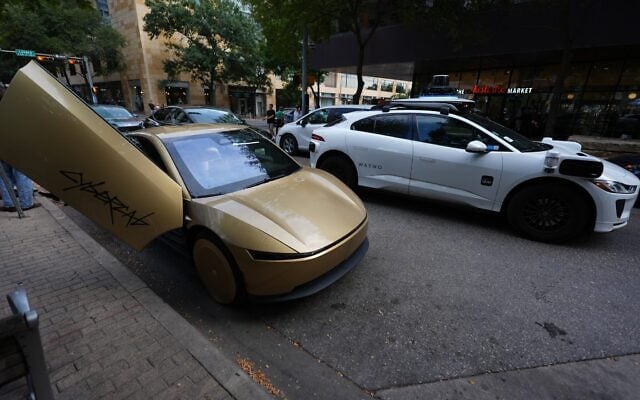
But the company maintains that the Roadster will be designed to have humans behind the wheel, calling the electric vehicle “the best of the latest human-driven cars.”
Thursday’s protest was technically self-contained “to make sure we don’t kill anyone,” Musk noted. But in the long term, he said, the new Roadster will be “the only manually driven car made by Tesla.”
“It’s not necessarily a car optimized in terms of safety,” Musk then added, greeted by laughter from the audience. But “this brings the pleasure meter to 11 out of 10”.
Tesla’s first Roadster was launched in 2008. And in 2018, Musk went so far as to put one on a rocket – with a mannequin nicknamed “Starman” in the driver’s seat – and launch it into space.
Once again, the second generation Roadster is not hitting the market immediately. And it remains to be seen whether this ambitious new vehicle will improve the company’s bottom line.
In second-quarter results released over the summer, Tesla’s profits fell as the company spent more on research and development for its robotaxi and robotics businesses – which reduced the money generated by an otherwise strong increase in vehicle sales. Net profit came in at $1.11 billion for the period, while revenue climbed to $28.24 billion.


Gn bussni

