
We list some of these cars, including the historic Chaparral 2J.

Tesla showed off the long-awaited next-generation Roadster with some crazy stunts, starting with driving the car up a C-shaped ramp and stopping in the middle of the part perpendicular to the ground. He drove quite slowly and stopped long enough to look like he was hanging upside down. After that, the Roadster jumped off the ramp, righted itself, floated a little and landed safely on the ground.
On its website, Tesla explained that the Roadster defied gravity by using a multi-mode fan and a floor sealing system that acts as a “downforce generator.” It draws air from underneath the vehicle and provides the suction needed to keep the car upside down, at any speed. The automaker claims that these motorized fans, along with the vehicle’s retractable rear spoiler, provide the necessary downforce, or the force that pushes a vehicle into the ground.
The new Roadster is not the first car to use a fan system to generate downforce, however. When Tesla revealed the Roadster, McMurtry Automotive responded with a cheeky “Welcome to the club” on Instagram, complete with video of its Spéirling hanging upside down from a platform. McMurtry’s vacuum technology called Downforce-on-Demand features two fans that draw air from underneath the car. And even before Spéirling, other vehicles used fans for support.
Chaparral 2J and Brabham BT46
In 1970, American racing drivers Jim Hall and Hap Sharp entered the Can-Am Championship series with a car that looked like a box with wheels. It was called the Chaparral 2J, a prototype powered by a modified 7.6-liter Chevrolet V8 engine. According to Revs Institute Automedia, the vehicle’s vacuum technology began as the “Suspension Test Vehicle” project at Chevrolet, until Hall asked its developer Don Gates to join his team.
The Chaparral 2J’s suction system was equipped with two fans adapted from a military tank engine. There was a “skirt” made of transparent polycarbonate sheets that created an enclosed space under the car. This allowed the fans to generate 1.25g to 1.5g of suction as they pulled air from this enclosed space. Of note, Tesla claims that the Roadster is capable of generating up to 2g of downforce.
Then there was the Brabham BT46, also known as the “Fan Car”, which was an F1 racing car designed by South African-British driver Gordon Murray for the 1978 season. The designers fitted a fan to the vehicle and claimed it was primarily for cooling to satisfy F1 regulations, but they took inspiration from the Chaparral 2J and the Tyrrell 008, another F1 car with of a fan which ultimately did not work.
Specifically, the BT46 had a series of clutches connected to a single large fan at the rear. It had skirts, just like the Chaparral 2J, which covered the spaces between the bottom of the car and the ground. This allowed the fan to extract air from underneath the car, creating suction. In the case of the BT46, the faster the vehicle, the stronger the suction effect. The Brabham BT46 only raced once at the 1978 Swedish Grand Prix and won the event.
McMurtry Speirling
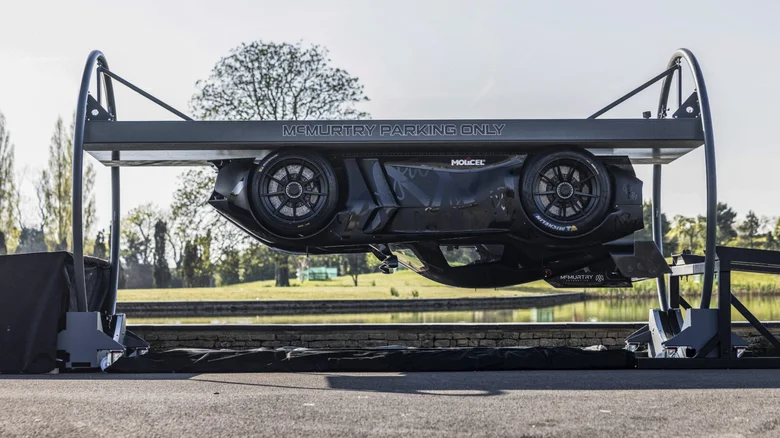
McMurtry’s Spéirling is an electric sports car that the automaker unveiled in 2025. The company demonstrated it at McMurtry’s headquarters in England, where the vehicle was shown to be able to hang upside down on a rotating platform without any support.
McMurtry Automotive revealed the final production version of the Spéirling Pure in July 2026. Like the Roadster, the Spéirling’s technology can generate enough downforce to allow it to grip a surface at any speed, even when stationary. This gives the vehicle the power to corner at over 3 g, according to the company.
The company will produce only 100 vehicles, with prices starting at $132,300, and the first customer deliveries are expected to be made before the end of this year. Meanwhile, Elon Musk has said the Roadster will go into production in 2028, with reservations now open. The base Roadster will cost you $50,000 to reserve, while the “Thrust” trim level with the vacuum system and boost boosters costs $250,000 to reserve.
Gn bussni

