
China was once the largest holder of U.S. Treasuries, but it has been shedding its massive stockpiles for years, fueling fears of dedollarization. But official data may not fully reflect Beijing’s actual portfolio.
The decline began in earnest around 2021, but as recently as April 2022, China still held $1 trillion in Treasury securities. U.S. data released Friday showed that amount was reduced to just $591 billion in August, the lowest in 18 years and down from $700 billion a year earlier.
But the data is collected primarily from U.S.-based custodians and brokers, according to the Treasury Department, which adds that U.S. securities held in overseas custodial accounts cannot be traced to the true owners.
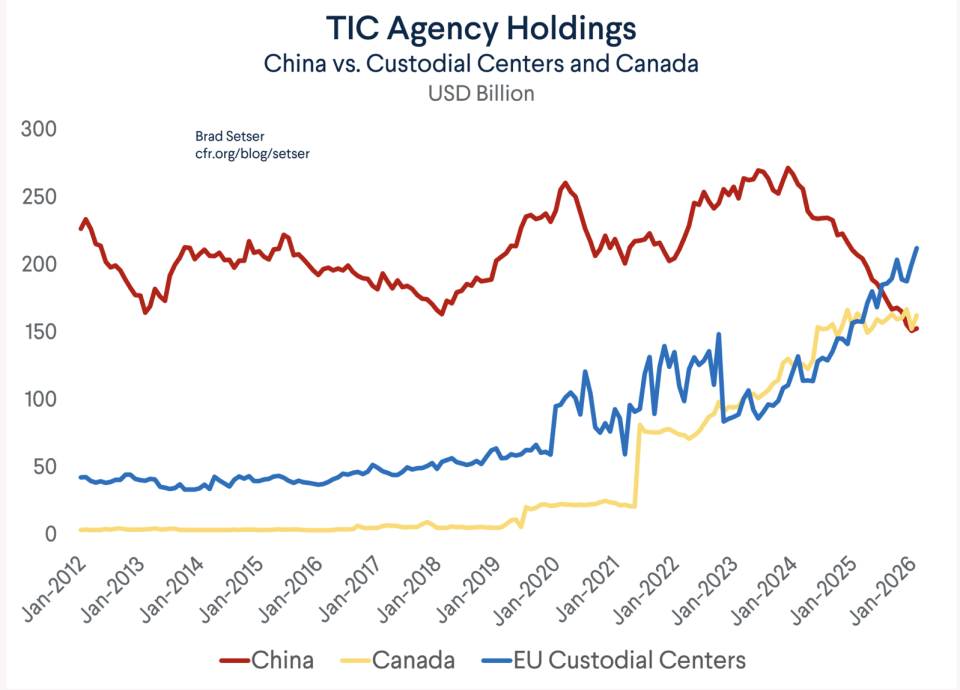
As a result, China observers have long been skeptical of massive dumping of U.S. assets, pointing to suspicious increases in Treasury holdings elsewhere that coincide with the sharp Chinese decline.
Canada’s assets soared to $465 billion in August, up from just $169 billion in the same month five years ago. Likewise, Belgium’s stocks rose to $490.5 billion from $228 billion over the same period. After including other bonds guaranteed by federal housing agencies, the numbers are even more staggering.
Certainly, China has challenged the supremacy of the United States in global finance, seeking to overthrow the dollar as the world’s leading currency.
U.S. sanctions on Russia after its 2022 invasion of Ukraine have further encouraged the People’s Bank of China and other central banks around the world to diversify away from dollar reserves and toward alternative assets like gold.
President Donald Trump’s trade war, which has focused particularly on China, has given Beijing more reason to abandon Treasuries and dissociate itself from the United States.
But at the same time, China has relied more on export-led growth in recent years as domestic demand remains stagnant amid a housing crash and debt hangover.
So, despite friction with the United States and other trading partners, China recorded a trade surplus of $1.2 trillion in 2025 – the largest in history – growing three times faster than global trade in goods.
This year we hope to break this record. For the first nine months of 2026, China’s trade surplus reached $938 billion, and there are growing expectations that it could surpass last year’s mark.
Such massive surpluses have to be recycled somewhere, perhaps leading China to shift its debt from the Treasury to non-U.S. custodian banks in other countries – and not show up as “China” in official U.S. data.
“The evidence that China is using a Canadian custodian for some of its agencies is particularly strong — note the sudden increase in Canada’s holdings and the significant impact of the detailed June investigation at times,” Brad Setser, a senior fellow at the Council on Foreign Relations and former Treasury official, said on X Wednesday, while highlighting a Bloomberg article on the subject.
Council on Foreign Relations
In May, he wrote an in-depth analysis of Chinese holdings. Since around 2020, the number of Treasury bonds held by depositories in the United Kingdom, France, Luxembourg and Belgium has increased significantly.
Adding China’s assets with those of Canada and European detention centers gives a total of up to $500 billion. Even considering just Canada, Luxembourg and France since around 2022, Chinese holdings amount to around $300 billion.
While China has reduced its reserve of long-term Treasuries and increased its short-term bonds, Setser estimates that China’s total U.S. financial holdings remain between 50% and 55% of its reserve portfolio.
“Treasury and Agency portfolios must be adjusted to account for the obligations that China keeps in Canada and Europe,” he said. “This adds uncertainty around the estimate, as it appears likely that China is now using multiple non-US custodians to mask its true holdings.”
Gn bussni

