
Cairo – Egyptian President Abdel Fattah al-Sisi has asked the country’s parliament to authorize the army to help defend Saudi Arabia after the Yemen war. Supported by Iran Houthi rebels intensified their attacks on the kingdom, targeting airports and oil infrastructure.
Al-Sisi stressed that it would be a defensive mission and only if the kingdom requested help.
“Egypt will take all measures requested by Saudi Arabia to protect and defend it,” al-Sisi said Saturday during a military graduation ceremony.
According to Egypt’s Constitution, the president must consult the National Defense Council and obtain approval from two-thirds of Parliament before deploying the armed forces on a combat mission abroad.
On Sunday, al-Sisi chaired a meeting of the National Defense Council, which examined what the Egyptian presidency described as the “ongoing serious escalation in the region” and “unacceptable attacks” against Saudi Arabia.
The council pledged to provide “all necessary and possible forms of support to the brotherly Kingdom of Saudi Arabia to defend its security and stability, and to safeguard its resources, territorial integrity and Islamic holy sites.”
Egypt has so far managed to stay away from all recent military conflicts in the region and has attempted to defuse the situation and find political solutions. For some, this is one of al-Sissi’s greatest achievements.
Ludovic Marin/AFP via Getty Images 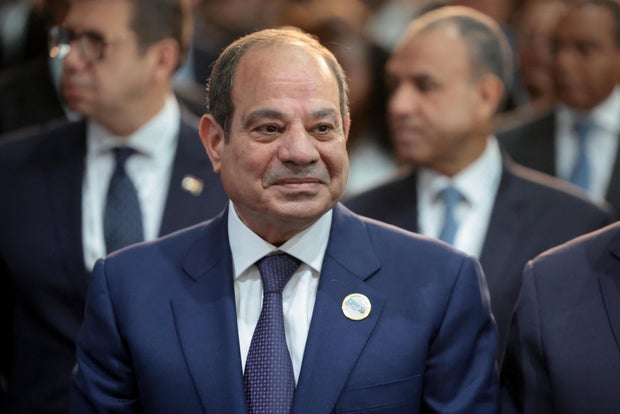
But Samir Ragheb, a retired army brigadier and political and strategic analyst, told CBS News it was time for Egypt to fulfill the commitments it had made to help secure the region.
“Egypt has repeatedly committed to supporting the security of the Gulf states and has issued numerous statements reaffirming this commitment,” Ragheb said. “However, this is a time of war, no policies or declarations. If Egypt does not keep its promises, they will lose their meaning and become nothing more than empty threats.”
“The Gulf countries have invested billions of dollars in Egypt. Morally, it is Egypt’s turn to return the favor,” he said.
Parliament called an emergency session on Sunday and was expected to approve the resolution on Tuesday, but the vote was postponed until next Monday.
Egypt’s Social Democratic Party asked its parliamentary bloc to abstain in voting on the resolution, saying in a statement that it had not received enough information on “the scope, costs and risks of the mission, as well as the arrangements in place to protect Egyptian forces.”
Ragheb is certain that the region is heading for an even more serious escalation.
“Egypt will not defend its kingdom against the Houthis,” he said. “The threat is much greater than the Houthis. This includes Iran, Iraqi militias and sleeper cells within the kingdom itself.”
However, he also believes that Egypt will lose much of its influence in the region if it does not intervene.
“If you want to be a regional player, you have to play a role,” he said. “Otherwise you will lose your place at the table.”
Ragheb argued that the United States refusal to attack the Houthis in favor of Saudi Arabia has created a vacuum that must be filled by others. He said Egypt should assume the Arab part of this role.
Other regional powers are also trying to fill the void. In August, Saudi Arabia signed a joint defense agreement with Turkey and Pakistan, known as the Mecca Accords.
“Even before Saudi Arabia sought support from Egypt, the Mecca Accords were an act of death for the idea of relying on America for any form of defense,” Ragheb said.
Gn world

