

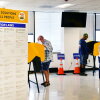
People vote at a polling place at Metro headquarters during the California state primary election in Los Angeles, California, June 2, 2026.
Frédéric J. Brown/AFP via Getty Images
hide caption
Frédéric J. Brown/AFP via Getty Images
The Justice Department is demanding that California take the unprecedented step of segregating ballots associated with 20,000 people who the department says are “probably” noncitizens. But an initial review by local authorities suggests the list is “unreliable” and that some people on it have indicated in their records that they were born in the United States and therefore could be citizens.
The new details come from documents filed Tuesday by California state and local officials, in response to a lawsuit filed by the federal government in an attempt to force the state to investigate thousands of people before their votes are counted. The state says doing what the DOJ is asking would be impractical as the election approaches and would likely violate federal and state election laws.
“At best, this litigation is a reckless political stunt,” the state wrote in its filing Tuesday. “At worst, it threatens to disenfranchise thousands of Californians in this election.”
The saga began in earnest last week when the Justice Department handed Los Angeles County a USB drive containing a list of about 20,000 people who Department of Homeland Security investigators say are “probably noncitizens” and registered to vote somewhere in California.
Initially, county officials refused to open the list, citing the security threat of inserting a USB drive of unknown origin into a government computer. The next day, the DOJ emailed a spreadsheet containing the same list.
Of the 20,000 names on the list, only 7,035 had addresses in Los Angeles County and some were duplicates, according to another court filing Tuesday by Los Angeles County Registrar Dean Logan.
In court filings, Los Angeles County officials wrote that they took a sample of 200 people to get a sense of the reliability of the federal government’s data.
“The review is preliminary and quality control continues, but it indicates that the October list is unreliable,” wrote Monica Flores, Los Angeles County deputy registrar-recorder.
Among voters whose place of birth was “significantly indicated,” Flores wrote, “38.9 percent indicate they were born in the United States, which is strong proof of citizenship.”
It is not clear how many people this represents in total or the details of the records showing place of birth. NPR reached out to the Los Angeles County Clerk’s Office for clarification on the numbers listed in court documents, but as of Tuesday evening had not yet received a response.

The California Secretary of State’s website asks for “place of birth” when people register to vote online, although this field is not required.
With few exceptions, anyone born in the United States automatically gains citizenship.
Of the 200 records reviewed by county staff, 112 were associated with people whose registrations are canceled or inactive. The filing also indicates that about 70% of those sampled had no voting history.
The Trump administration has generally defended its methodology for researching non-citizen voters, without ever fully explaining it publicly. Other figures recently released by federal officials, including President Trump, on the issue of non-citizen voting have been found to be inaccurate in other cases.
Acting Deputy Attorney General Trent McCotter acknowledged there could be errors in the federal government’s list of 20,000 names during a news conference Monday. “There may be names that at the end of the day are citizens, we’re not perfect,” McCotter said. “And that’s why we asked California to cooperate with us.”
In response to questions about Los Angeles County’s initial analysis, DOJ Deputy Press Secretary Kiersten Pels said in a statement, “California cannot facilitate the violation of federal law.” The statement continued: “We have informed California that non-citizens are likely registered voters, and we have asked the state to independently verify the citizenship of all ballots cast by individuals on a list we provided. It has refused to do so. Federal law does not permit this willful blindness.”
On Monday, the DOJ also announced criminal charges against 28 people on the list provided to the state. But even in these cases, it appears that some of those charged registered without understanding that it was illegal.
Kamlesh Shah, 68, told Sacramento television station KCRA 3 that he thought he could vote because he had a Real ID.
“I’m feeling very depressed, very anxious. I’m disabled. I have so many heart problems, my condition, so it’s going to stress me out even more,” Shah told KCRA 3. “I’m very upset. I’m trying to get a lawyer, hopefully I can get the charges dismissed.”
The 28 people charged Monday were legal permanent residents, also known as green card holders. Research has shown that in the rare cases where non-citizens vote, it is often green card holders misunderstanding the rules, not intentional fraud.
Gn headline

