
Crew-13’s 4 astronauts launch from Florida’s Space Coast on mission to International Space Station

MERRITT ISLAND, Fla. —
Crew-13 launches from Florida’s Space Coast on Thursday from Kennedy Space Center for its mission to the International Space Station.
>> WESH 2 will stream the launch in the video player above.
The crew arrived at Kennedy Space Center Saturday afternoon.
About the crew
Two NASA astronauts, Jessica Watkins and Luke Delaney, will serve as the spacecraft commander and pilot.
Watkins is the cousin of former WESH 2 reporter Christina Watkins.
Delaney grew up in DeBary and graduated from Deltona High School in 1997.
They will be joined by Joshua Kutryk, a Canadian Space Agency astronaut, and Roscosmos cosmonaut Sergey Teteryatnikov, who will serve as mission specialists.
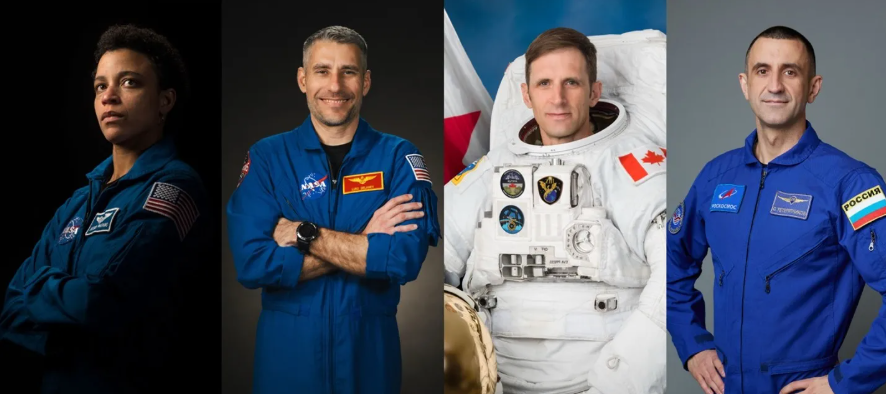
NASA
From left to right, NASA astronauts Jessica Watkins and Luke Delaney, CSA (Canadian Space Agency) astronaut Joshua Kutryk, and Roscosmos cosmonaut Sergey Teteryatnikov.
The crew landed at Kennedy Space Center Saturday just before 1 pm following a flight from Johnson Space Center in Houston, Texas.
Crew-13 crew members will spend the days leading up to launch to the International Space Station in quarantine and conducting final preflight operations at Kennedy.
About the mission
Crew-13 is expected to conduct scientific investigations and technology demonstrations.
This is to help prepare humans for future exploration missions to the Moon and Mars, according to NASA.
On Feb. 13, Crew-12 launched from Florida, replacing four crew members who cut their mission short due to a medical issue.
Research focused on longer missions
After docking with the space station, Crew-13 will join the Expedition 75 team and support station maintenance, operations, scientific research and technology demonstrations.
Much of the crew’s research will examine how people respond to extended periods in microgravity. The results could help NASA develop protections for astronauts traveling beyond low Earth orbit, including future missions to the moon and Mars.
“Everybody’s different. Everybody’s body is different,” Delaney said. “We’re still trying to characterize a lot of things.”
Delaney said he is looking forward to contributing blood samples and helping researchers document changes in the human body, even if he is less enthusiastic about the blood draws themselves.
The mission’s planned studies include Venous Haemostasis, a collaboration between NASA and the European Space Agency examining how microgravity affects circulation, blood flow and clotting risks. Crew members will provide blood samples, ultrasounds, blood pressure readings and other measurements before, during and after the mission.
Researchers hope the information will help them understand why risks vary among astronauts and develop countermeasures for future missions. The findings could also have applications on Earth.
Another study, Manual Piloting, will evaluate astronauts’ ability to complete difficult lunar-landing simulations after spending months in microgravity. It will also examine whether refresher training shortly before landing improves performance.
The B-Complex study will explore whether a daily B-vitamin supplement can reduce or prevent spaceflight-associated neuro-ocular syndrome, a condition that can affect astronauts’ eyes and vision. Participants will take supplements and complete vision testing.
Crew members will also contribute to Standard Measures, which collects consistent physiological and behavioral information from astronauts to establish baselines for future research.
The Spacecraft Occupant Risk study will measure the forces astronauts experience during their return and landing. The findings could help improve spacecraft hardware and procedures while reducing the risk of injury.
The Zero T2 study will compare the health and performance of crew members who use the station’s treadmill with those who do not. Researchers hope the results will inform exercise plans for future spacecraft that may have limited room for exercise equipment.
The broader Expedition 75 science program is expected to include investigations involving in-space manufacturing, bioprinting, augmented reality and artificial intelligence tools for monitoring crew health.
Watkins, a geologist, said the station also provides an important platform for studying Earth and preparing for lunar exploration.
“I am super excited about using the ISS as a platform for making observations of the Earth and what we can learn from that process as we take that to the moon,” Watkins said.
Watching from Kennedy Space Center
Kennedy Space Center invited the public to watch the rocket launch with live commentary from space experts, bleacher seating and access to the visitor complex’s attractions and exhibits, according to its website.
More details can be found here.