
Sheerness, England — A delicate operation to prevent an 82-year-old American shipwreck filled with tons of World War II explosives from triggering a potentially catastrophic tidal wave on London has been completed. But even though the most imminent danger has been averted, the explosives remain inside the rusting wreck of the SS Richard Montgomery on the riverbed, and experts can’t take their eyes off it.
The Montgomery, one of approximately 2,700 Liberty ships Built in the United States to support the Allied war effort, was stranded on a sandbank off the Thames Estuary town of Sheerness, just 40 miles from the British capital, in August 1944. It was carrying munitions intended to support the Allies after the landings.
The ship broke apart during salvage efforts and sank, with about 1,500 tons of explosives in its holds.
Colin Harvey 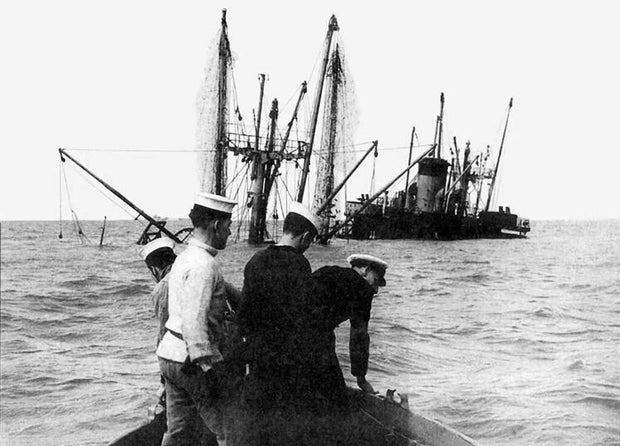
The ship’s three rusty masts protruding from the water were a familiar sight to residents and passing ships for decades. But recent investigations have revealed increasing deterioration of the structure, raising fears the masts could collapse and trigger an explosion.
“The ship was starting to lean and deteriorate, so they could see some of the structures around the mast starting to collapse,” said Nolan Conway, a naval architect with Florida-based marine salvage company Resolve Marine Group, which was hired to remove the masts.
“The fear is that the masts could have fallen on the cargo itself, causing it to explode,” he said. “Some ammo would be fusion ammo with pressure fuses, so something like an impact could potentially trigger them.”
Gareth Fuller/PA Images/Getty 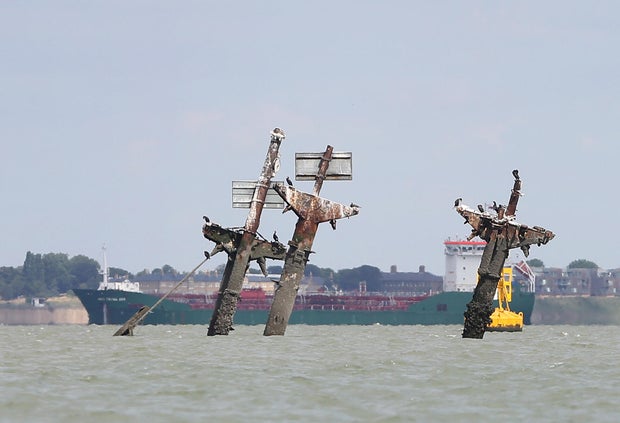
British Marine Minister Keir Mather told lawmakers in the House of Commons this week that the “complex project requiring specialist programmatic, engineering and risk management expertise” had been completed ahead of schedule and on budget, with all three masts removed at a cost of just under $13 million, according to The Guardian.
Mather told the UK Parliament the masts had imposed “a significant load on the structure and their removal has reduced this risk and supports the long-term safe management of the site”.
The government has long maintained an exclusion zone around the wreck, which lies about 1.5 miles off the coast of Sheerness.
Mather told lawmakers the wreck “will continue to be subject to continued monitoring and control through the established exclusion zone.”
Dan Kitwood/Getty 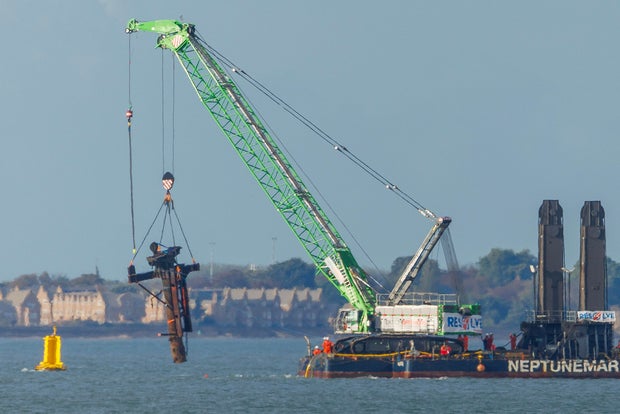
Removing the remaining explosives would carry considerable risks, and the consequences of an explosion remain a matter of debate among experts.
“The impact of detonating this wreck is unpredictable,” Conway said. “Estimates range from the impact on the coastline, to the creation of a tidal wave that could travel up the Thames, to a rather minor event that could simply close a nearby shipping channel. There are a wide range of impacts, but none of them are really good.”
Authorities continue to assess the overall explosion risk as low, but the deteriorating condition of the masts has prompted authorities to take action.
Conway said the challenge for the company was finding a way to remove the masts without disturbing the sunken ship’s hull and the perilous cargo inside, or endangering the people doing the work.
“How can we cut this mast without vibrating or impacting the wreck?” he said. “We designed a custom lifting frame to pick it up safely without the mast wobbling or swinging when we lift it from the wreckage.”
Engineers used a remote-controlled underwater diamond wire saw that clamps “around the mast with hydraulic arms and passes the saw through without putting the divers in the water,” Conway explained.
Colin Harvey 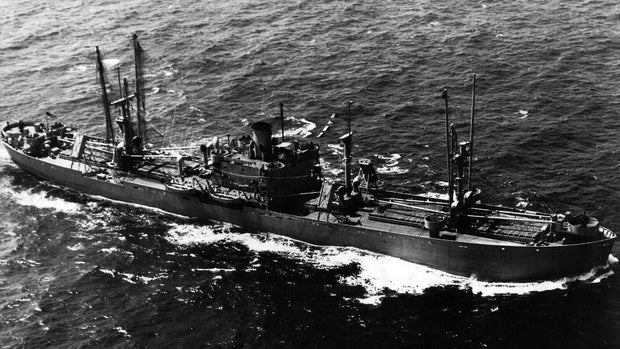
The removal of the masts marks the end of a distinctive chapter in the wreck’s history. The masts, visible above the estuary since the Second World War, should be preserved for public display.
Mather, the British naval minister, said the masts had been moved to a local museum, the Historic Dockyard Chatham, and would be displayed “in recognition of the historical significance of the SS Richard Montgomery and her role in supporting the efforts of the Allied forces during the Second World War.”
More than eight decades after the ship failed to reach the battlefields of Europe, the Montgomery and its dangerous cargo will remain where they came to rest, now entirely hidden, but far from forgotten.
Gn world

