The aging of NVIDIA GeForce RTX 30 Series (code name Ampere) GPUs apparently have considerable untapped computing potential. A new open source project called GPU Unlockdeveloped by GitHub user Zagittaallows Ampere GPUs to overcome certain artificial performance restrictions, nearly doubling their Tensor Core compute throughput in specific workloads without requiring a modified NVIDIA driver or always-on VBIOS flash.
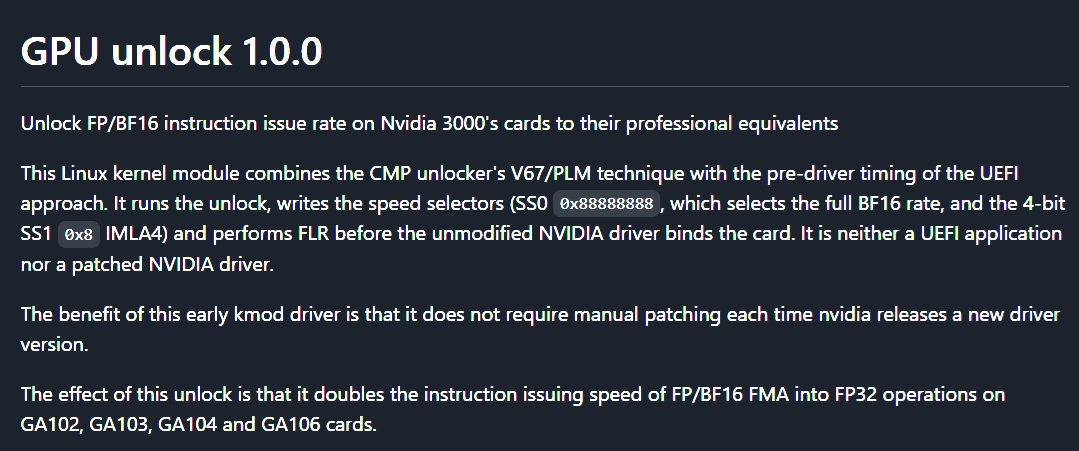
The project specifically targets Instruction issue rate limitation affecting Tensor Core FP16/BF16 operations with FP32 accumulationwhich runs at a reduced rate on consumer Ampere graphics cards compared to their professional counterparts. By removing this restriction, the tool actually allows additional computing performance that GPUs were already capable of providing.
Interestingly, GPU Unlock builds on previous research involving CMP Cryptocurrency Mining GPU. It combines firmware unlocking techniques from the CMP project with an early initialization approach, using a Linux kernel module that runs before loading the NVIDIA GPU driver. The module modifies the affected hardware speed selectors, performs a function level reset (FLR), then allows the unmodified driver to initialize the GPU normally.
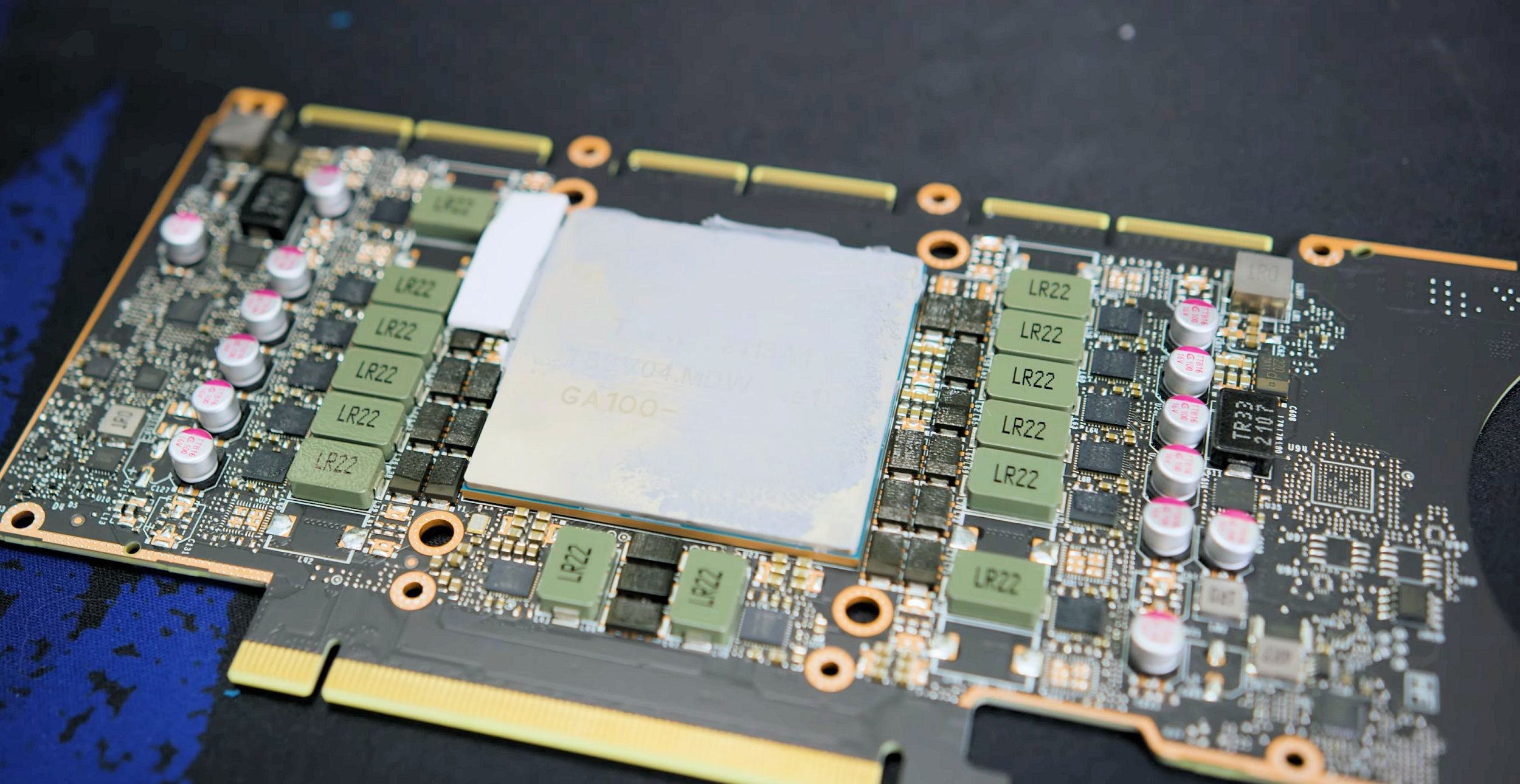
This also means that users won’t have to update their NVIDIA drivers every time a new version is released. The developer currently lists support for GA102, GA103, GA104 and GA106 GPUscovering a substantial portion of the GeForce RTX 30 Series lineup, although compatibility and performance improvements are not guaranteed on all graphics cards.
Performance improvements can be remarkable. According to benchmarks published in the project’s GitHub repository, a RTX 3090 Ti running at 450W power limit provided the following results in dense matrix multiplication (GEMM) tests with FP32 accumulation:
| Precision | Action | GPU Unlock | Improvement |
|---|---|---|---|
| PC16 | 87.46 TFLOPS | 118.39 TFLOPS | +35% |
| BF16 | 87.50 TFLOPS | 157.41 TFLOPS | +80% |
| TF32 | 42.58 TFLOPS | 82.61 TFLOPS | +94% |
These results are not exclusive to the RTX 3090 Ti either. An RTX 3080 Ti owner reported an increase in BF16 throughput of 71.59 to 113.98 TFLOPSwhile TF32 improved performance compared to 35.65 to 65.28 TFLOPSwith the GPU limited to 315W. Another RTX 3080 10GB Compatibility Report Documented FP16/BF16 performance increasing by approximately 65 TFLOPS has 110-113 TFLOPS under the original of the card 320W power limit. These improvements were also highlighted on X.
But what about real application performance? Fortunately, community members have already begun testing Unlock in real-world AI workloads, and preliminary results are encouraging.
RTX 3090 Ti User on Reddit Rated GPU Unlock in ComfyUI, Report 58.6% higher throughput with MOSS-Image SFT BF16, 57.2% with Qwen-Image 2.1 Turbo BF16And 56.1% with Z-Image Turbo BF16. In the meantime, INT8 configurations saw much more modest improvements, with Image MOSS SFT INT8 simply improve by 0.3%. The tester also reported identical decoded image output between stock and unlocked configurations.
Large Language Model (LLM) inference is another potential beneficiary, although improvements are much more workload dependent. For example, an RTX 3090 compatibility report documented a 33% improvement in vLLM prompt/inference processing throughputwhile token generation remained virtually unchanged. This is understandable, given that LLM decoding is often limited by memory bandwidth rather than the raw computational throughput of Tensor Core.

An additional development worth highlighting is an experimental Windows implementation, which uses a UEFI-based approach instead of the original Linux kernel module. Its developer documented a successful implementation of the RTX 3090, with BF16 computing throughput increasing by approximately 82.5%. However, this remains an experimental hardware-specific solution rather than a generally compatible Windows version.
There are also important limitations. GPU Unlock does not increase memory bandwidth, enable additional CUDA cores, or automatically improve each workload. At least one RTX 3080 Ti 20GB compatibility report has documented a successful unlocking procedure without the expected performance boost from the BF16, demonstrating that the results are not universal.
When it comes to gaming, NVIDIA’s DLSS technologies also use Tensor cores, but there is currently no convincing evidence that GPU Unlock improves gaming performance or DLSS runtimes. The affected instructions and accumulation modes must be used by the actual workload for any benefit to be realized. Therefore, Impressive compute benchmarks should not be confused with an equivalent increase in gaming FPS.
Nonetheless, GPU Unlock is an intriguing development for GeForce RTX 30 series owners, especially those who use their GPUs for local AI inference, image generation, and other compute-intensive applications. Although the project is still experimental, the prospect of extracting much more performance from existing hardware without permanently modifying it is certainly enticing.
Information source: GPU Unlock GitHub repository

About the author: Sebastian Castellanos is a data scientist by education and training. He is also deeply passionate about PC gaming hardware and software. He recently started writing technical articles and guides on Wccftech about PC hardware, gaming and mods.
Follow Wccftech on Google to get more of our news coverage in your feeds.
Gn tech