
Tel Aviv — After three years of war against their country on multiple fronts, Israelis will go to the polls on Tuesday in a hotly contested election that will shape their next government. Polls show that it is a incredibly close raceand as Prime Minister Benjamin Netanyahu fights to keep his job, there is no guarantee of a quick and definitive outcome for him or his political opponents.
Polls vary widely on the expected outcome. Right-wing polls give an advantage to the right-wing, religious bloc led by Netanyahu, while left-wing polls give an advantage to the so-called Change Bloc opposing the outgoing president.
Most polls show that neither party is likely to win a decisive majority of the 120 seats in Israel’s parliament, the Knesset, which would allow it to unilaterally form a new government. The tight margins mean the vote could end in deadlock, which could lead to lengthy negotiations across ideological divides, the formation of a minority government, or even a new election.
“It appears that an indecisive outcome is most likely,” said Yohanan Plesner, president of the Israel Democracy Institute.
These will be the first elections since the Hamas attacks of October 7, 2023, which the authorities recognized as being Israel’s Most Catastrophic Security Failure since the country’s founding in 1948. Israelis will go to the polls on Tuesday as their country continues to struggle in the multi-front war that has ensued in Gaza, Lebanon and Syria, and after two rounds of direct conflict with Iran and Netanyahu, they argue for a third.
Against this backdrop, a few key questions could determine the outcome of the election, even if they take days or weeks to resolve. But first, here’s a look at the two main factions vying for votes.
The Netanyahu camp
Netanyahu, Israel’s longest-serving prime minister and leader of the Likud party, is seeking to form another coalition similar to his current government, which relies on partnerships with ultranationalist and Jewish religious parties.
He presents two main arguments to voters: First, he alone can form a government without the support of Israel’s Arab parties, which he says would pose a danger to the country if they gain enough seats to influence Israel’s engagement in its myriad conflicts.
Netanyahu’s second argument to voters is that Israeli campaigns in Gaza, Lebanon and especially Iran are ongoing and he needs more time to finish what his government started.
President Trump launched into a full-throated speech support for Netanyahu last week. He reiterated his administration’s strong support for the war the two men jointly launched against Iran nearly eight months ago, and warned he may be reluctant to pursue it if Netanyahu does not retain power.
“If Israel has a bad leader, who would be anyone other than Bibi, America will have to do that job itself, and I’m not inclined to do that,” Mr. Trump said.
JACK GUEZ/AFP/Getty Images 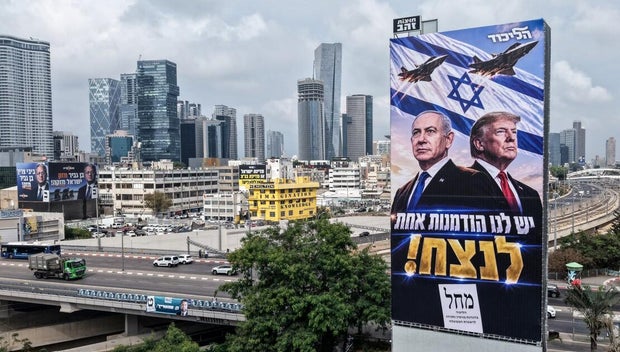
Since that endorsement, Netanyahu has asserted that only he can work with Mr. Trump to ensure that Iran does not obtain nuclear weapons, which many Israelis view as an existential threat.
Netanyahu’s campaign slogan, which rhymes in Hebrew, is: “Either the right, or Palestine, or the right, or the nuclear bomb.”
Over the weekend, Netanyahu posted an AI-generated photo of a mushroom cloud over Tel Aviv on social media, with a caption reiterating his insistence that Iran poses an existential threat to Israel.
Netanyahu’s supporters consider him a prominent world leader.
“Bibi can handle the whole world,” restaurant owner Benny Abraham told CBS News, using Netanyahu’s nickname. “Bibi is charismatic. He has a strong voice. The world loves him.”
“He is the king of Israel,” Abraham added.
The “change bloc” (anyone but Netanyahu)
Opposing Netanyahu is a diverse group of Arab parties, right, left and center, who have a clear common denominator: they all want Netanyahu to leave power.
The favorite to lead the “change bloc,” if its various parties collectively win enough seats to build a coalition, is former Israeli military leader Gadi Eisenkot, who leads the centrist Yashar party.
Eisenkot lost his son and two nephews while serving in the army in Gaza. He was part of Israel’s war cabinet for much of the first year of the Gaza war, working alongside Netanyahu. About half of his party’s candidates in Tuesday’s election are women, in stark contrast to Netanyahu’s male-dominated coalition.
Erik Marmor/photo alliance/Getty Images 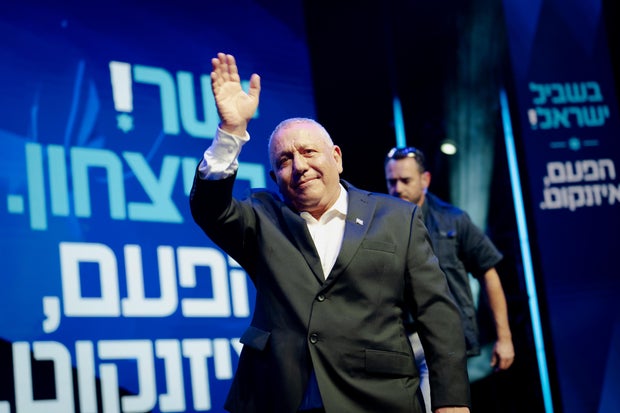
Eisenkot presents himself as a humble veteran who wants to reunify Israel after years of division that he blames on Netanyahu.
Eisenkot responded Monday to Netanyahu’s rhetoric that Iran poses a nuclear threat by accusing him of “relying on a campaign of fear-mongering, lies and threats – including images of nuclear bombs in the heart of Tel Aviv.”
“This time it won’t work for him,” he said.
Eisenkot’s main campaign promises include launching a state investigation into the failure of intelligence and security services to prevent the October 7, 2023 Hamas attack – something Netanyahu has so far blocked.
Uzi Aharoni, 73, an engineer from Tel Aviv, told CBS News that he saw Eisenkot as the only real alternative to Netanyahu.
“Eisenkot is not left-wing, he is not right. He is upright and honest. He is the kind of leader who will take care of us, the people of Israel, and not himself or his corrupt family,” Aharoni said.
The Arab vote and the ultra-Orthodox project
According to analysts, there are a few factors that could allow either side to achieve victory.
One thing polls cannot predict well in Israel is voter turnout. Previous elections have shown that voters supporting Netanyahu’s Likud party and Israeli Arab voters vary the most in their enthusiasm for turning out on election days.
Israeli Arabs, also known as Palestinian citizens of Israel, make up approximately 20% of the Israeli population.
“The higher the Arab turnout, the less likely it is that Mr. Netanyahu, within the current coalition, will be able to form another government,” said Plesner of the Israel Democracy Institute.
More Arab voters will head to the polling booths this year because of their strong desire to prevent Netanyahu from forming another government with far-right allies, who have made their lives difficult over the past four years, Jehad Abomoch, a cafe owner in the majority-Arab town of Baqa al Gharbiya, told CBS News.
“The last four years have been a real catastrophe, both socially and in terms of wars,” he said, adding that many Israeli Arabs feel that under Netanyahu they have “no hope, no future.”
Two new parties are also entering this election, and polls show each is around the support threshold required to gain Knesset seats. Whether either party ultimately crosses that threshold could also tip the scales – one way or the other – towards a new coalition government.
Both parties are working to challenge Netanyahu’s alliance with ultra-Orthodox parties by demanding that ultra-Orthodox Jewish citizens are officially included in compulsory military service in Israel.
Amir Lévy/Getty Images 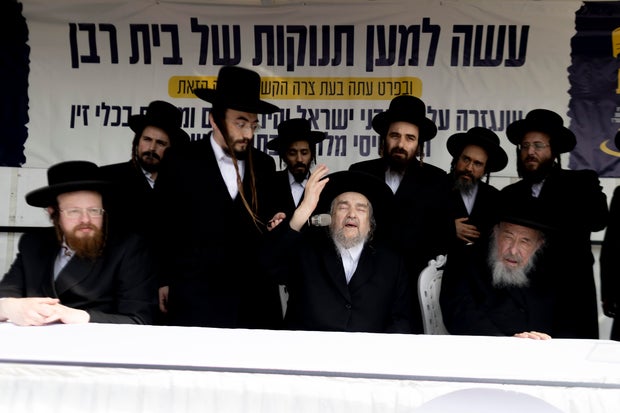
This is a key issue that directly affects Netanyahu’s traditional support base and his coalition partners.
Not all election results are neat and tidy
In the event that neither bloc obtains a clear majority in Parliament, several paths are available to us to achieve a new Israeli government.
One option is that parties or individual lawmakers could break their election promises and switch sides, which has many precedents in Israeli politics. It could take weeks of negotiations before a coalition is found.
Another possibility is that the change bloc, if it wins a significant share of the vote but not an absolute majority, seeks to form a minority government. To achieve this, parties simply need to collectively win more seats than the other camp, even if it is not more than 50% of the 120 available. Arab parties could give the change bloc this plurality either by voting in favor of a minority government or simply by abstaining and not voting against its formation.
If there is a deadlock and neither party manages to form a coalition government, the country will have to hold new elections. There are also many precedents for this scenario.
Between 2019 and 2022, Israel held five elections due to electoral impasse.
Plesner told CBS News that if all politicians running actually stick to their campaign promises and refuse to switch sides in the event of a deadlock, “we’re headed to another election.”
“I’m sure most politicians don’t care about that,” he added.
Gn world

