
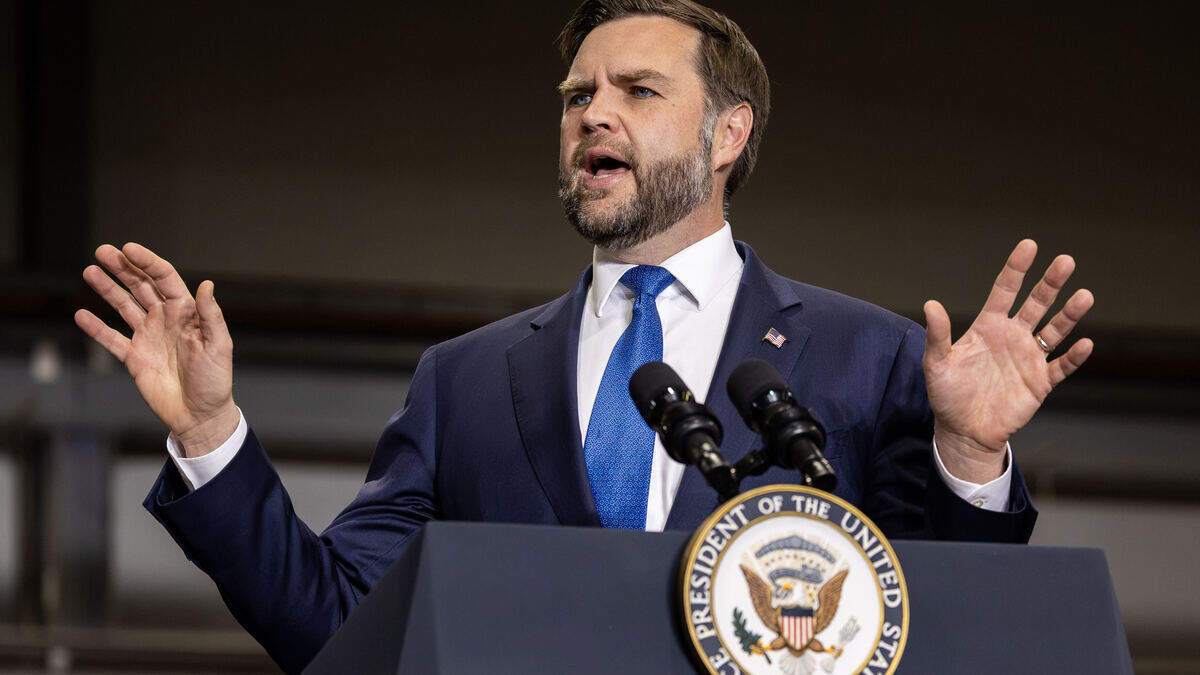
Vice President JD Vance speaks during a midterm rally at HME Inc. in Topeka, Monday, Oct. 26.
The star
About a week before the midterm elections, Republican Vice President JD Vance made another visit to Kansas, amid a tight race between Republican U.S. Senator Roger Marshall and his Democratic challenger Adam Hamilton.
Marshall faces a tough re-election campaign in a reliably conservative state, leading national Republican politicians to come to his aid. Vance’s rally in Topeka came just a week after President Donald Trump campaigned for Republican candidates in Wichita.
The Star fact-checked some of Vance’s claims during the rally.
Lower taxes, higher wages
Vance argued that Marshall helped the Trump administration cut taxes and raise wages for Kansans.
“Kansans are seeing their taxes go down and their wages go up. »
Verdict: True, but requires context
Marshall supported the Trump administration’s One Big Beautiful Bill Act, which made permanent provisions of the 2017 Tax Cuts and Jobs Act and lowered the federal income tax rate. Meanwhile, national data shows that wages have increased nationally in recent years.
The Associated Press reported that median household income rose 2.6% in 2025, to $87,460, a record high. That surpassed the previous high of $85,360 in 2019, according to the Census Bureau.
However, incomes have only increased 2.5% since 2019, compared to a 19% increase between 2013 and 2019. However, wage increases have also not translated into optimism among voters, and Democratic messaging ahead of the midterm elections has focused on affordability.
About 44% of U.S. adults rate current economic conditions as “poor,” compared to 19% who rate them as “good” or “excellent,” according to Gallup’s July Economic Confidence Index.
Gasoline prices
Vance acknowledged that gasoline prices are high, but argued that Democratic politicians are to blame because their handling of foreign relations makes the United States more vulnerable to actions by Middle Eastern leaders that affect the market.
“You’ll hear a lot of people say gas prices are too high, and I understand that,” Vance said. “That’s true, but it’s also true that the price of gas goes up every time a foreign leader in the Middle East throws a tantrum.”
Verdict: Requires context.
Gasoline prices in the United States have risen sharply this year, mainly because of the U.S.-Israeli war against Iran. The conflict has led to a blockade of the Strait of Hormuz, a major Persian Gulf sea passage for crude oil.
Meanwhile, Marshall says Ukrainian attacks on Russian oil refineries have led to an increase in the cost of diesel fuel, while Hamilton says the war in Iran is the main driver of rising prices at the pump.
A BBC analysis found that the war with Iran caused a bigger drop in diesel exports than Ukraine’s attacks on Russia.
Sexual abuse at Hamilton church camp
Vance referenced a controversy involving Hamilton and his handling of a sexual abuse case at a summer camp affiliated with his church.
Vance criticized Hamilton, arguing that he is a pastor “who refuses to call the police on predators targeting children at summer camps.”
Verdict: false.
In November 2005, church volunteer Scott Preston Moore entered a bedroom at night and inappropriately touched two teenage boys. The boys reported their experience to camp counselors, who dismissed their complaints, according to court records reviewed by The Star.
Court documents do not identify Hamilton as being directly involved in the report. The Church conducted an internal investigation in 2005, but was unable to conclusively identify the perpetrator, according to a court filing.
The church did not report the incident to law enforcement or social services in 2005. Moore returned as a camp counselor the following year and was accused of entering campers’ rooms at night, although court documents do not indicate he engaged in sexual abuse in 2006.
After the allegations, Church officials notified the Linn County Sheriff’s Office about the 2006 incident and the allegations from the previous year. Linn County prosecutors declined to file criminal charges, but the Church barred Moore from working with children, youth and vulnerable adults.
Moore was convicted in 2013 of inappropriately touching a 16-year-old boy. In an interview with CNN, Hamilton said the church should have called the police immediately.
Hamilton ‘repents’ eating beef
Vance referenced a sermon Hamilton delivered on climate change, saying the pastor told his congregation to “repent” of eating beef.
“This is your Senate seat,” Vance told the crowd. “Should we put the blame on a career leftist who says we need to repent of being white and eating meat?
Verdict: requires context
Hamilton noted that “cattle end up producing more carbon dioxide” in a 2020 sermon focused largely on climate change. He urged his parishioners to find ways to minimize their carbon footprint.
“You need to do everything you can to reduce your own consumption of fossil fuels, and maybe change your diet so that the things you eat require less production that creates methane and carbon dioxide and everything else,” Hamilton said during the sermon.
Opponents seized on the issue to portray Hamilton as anti-beef in selectively edited ads. In a campaign video, Hamilton grilled and ate steak while criticizing Marshall’s record.
Ty Masterson cut taxes on groceries
Vance touted Republican Ty Masterson’s gubernatorial run, highlighting his efforts to cut taxes. He specifically credited Masterson for reducing state sales taxes on groceries.
“Ty abolished the sales tax on groceries and the state income tax on Social Security, so our working families and seniors can afford better lives,” Vance said.
Verdict: requires context
Reducing state food taxes was a bipartisan effort, led by Democratic Gov. Laura Kelly. The bill phased out state taxes on groceries over two years.
Masterson supported the bill while serving as president of the Kansas Senate. It was approved in 2022. The state’s share of sales tax on groceries was entirely eliminated on January 1, 2025.
This story was originally published October 26, 2026 at 5:42 p.m..
Gn usa

