
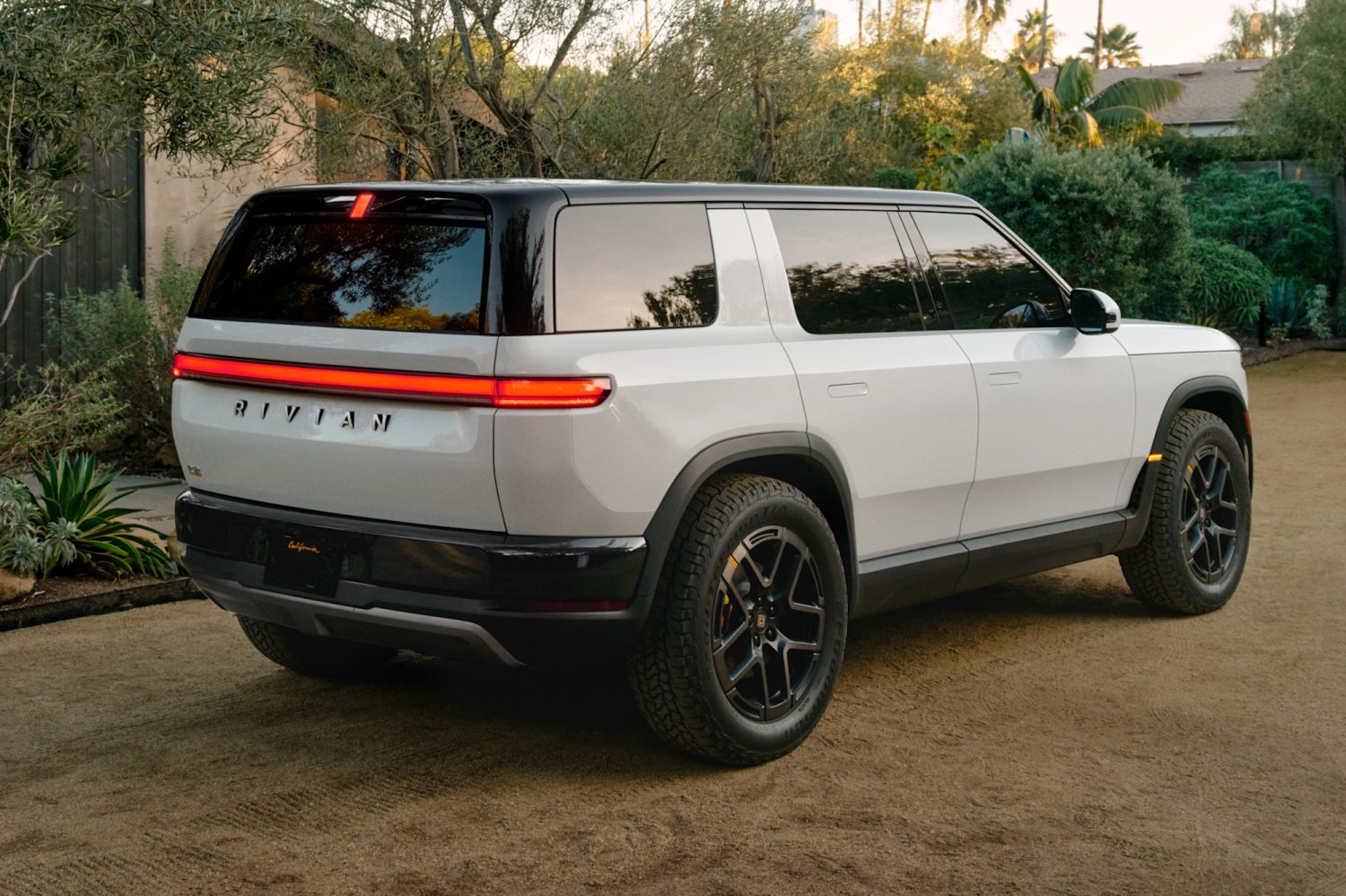
Rivian (RIVN) just released its third-quarter 2026 results, with revenue up 38% year-over-year to $2.155 billion. The R2, for its first full quarter of deliveries, is already the company’s best-selling vehicle, ahead of the R1 and the Amazon van.
The results exceeded Wall Street’s expectations and Rivian raises its forecast for 2026 on every indicator. But the auto sector continues to lose money and the R2 ramp has worsened the auto margin this quarter.
Rivian Q3 2026 in numbers
We already had the volume side. Rivian announced earlier this month that it built 19,751 vehicles and delivered 19,248 during the quarter, both records. Shipments increased 46% from a year ago and 58% from the second quarter.
Here is the rest of the quarter:
- Turnover: $2.155 billion (+38% year-on-year)
- Automotive turnover: $1.550 billion (+36%)
- Software and services revenue: $605 million (+45%)
- Gross profit: $176 million (8% margin)
- Adjusted EBITDA: -$435 million (vs. -$602 million a year ago)
- Net loss: -$913 million
- Adjusted EPS: -$0.48
- Free cash flow: -$1.124 billion
- Cash and short-term investments: $5.502 billion
Analysts had expected revenue of about $2.02 billion, an adjusted loss of $0.61 per share and an adjusted EBITDA loss of about $576 million, according to the Bloomberg consensus. Rivian beat all three.
The R2 is selling, but cars are still losing money
Demand signals for R2 are good. Rivian says reservations for the launch version remained above its expectations, it added a second R2 production shift in Normal, Illinois, and demo orders climbed to more than 103,000 in the quarter, up from 57,000 in the second quarter.
The problem is the automotive gross margin. Rivian’s automotive segment reported a gross loss of $80 million in the third quarter, a margin of -5%. That’s better than the $130 million loss a year ago, but worse than the $36 million (-3%) loss recorded in the second quarter.
Rivian charges approximately $120 million in additional revenue costs to the R2 ramp, compared to production at “more normalized levels.” And the quarter benefited from help that won’t be repeated on demand: $81 million in regulatory credit revenue and an IEEPA rate refund receivable.
By removing credits, the automotive segment lost approximately $161 million gross, or approximately $8,400 per vehicle delivered. Not great.
But there is real progress in this area. Rivian says unit cost of goods sold in the automotive sector decreased by more than $12,000 quarter-over-quarter thanks to higher R2 mix and better fixed cost leverage. Our own calculations from the filing put it at about $84,700 per vehicle in the third quarter, compared to $96,700 in the second quarter. Revenue per vehicle is also falling, which is the point of a cheaper car: about $76,300 excluding credits, down from $85,000 in the second quarter.
Volkswagen makes gross profit
The only reason Rivian posted a consolidated gross profit was its software and services segment, which generated $605 million in revenue and $256 million in gross profit, a margin of 42%.
Of that segment revenue, $354 million (59%) came from the joint venture with the Volkswagen Group, which pays Rivian for electrical architecture and software development work. Rivian says it expects to recognize this revenue until approximately mid-2028. Autonomy+, the paid driver assistance package launched in April, is also here, and Rivian says take rates are “ahead of our expectations.”
Forecasts increase, investments decrease
Rivian updated its 2026 outlook:
- Deliveries: 67,000 to 70,000 (from 65,000 to 70,000)
- Adjusted EBITDA: -$1.85 billion to -$1.75 billion (improved by $100 million at midpoint)
- Capital spending: $1.40 billion to $1.50 billion (down $300 million at midpoint)
With 41,807 deliveries through September, Rivian needs between 25,193 and 28,193 in the fourth quarter to land in the new range. This would be another record by far. Rivian provides this guidance a month into the quarter, providing strong confidence that it will hit at least the lower end of this target.
Reducing investments is about “timing of spending” and not about savings. Phase 1 of the Georgia plant, expected to add 300,000 units of annual capacity for R2 and R3, is still under construction.
In cash, Rivian ended the quarter with $5.502 billion, or $7.095 billion in total liquidity once you add in its credit facility and the $1 billion term loan Volkswagen funded in October. This is after the $1.5 billion stock sale in July. Free cash flow was -$1.124 billion in the third quarter alone.
As for Autonomy, Rivian still plans a limited rollout of Point-to-Point via an invite-only early access program later this year, with a general release for Autonomy+ subscribers in 2027. It also says an expected Uber milestone by the end of the year would unlock an additional $250 million in equity investment. More details are promised during Autonomy and AI Day on December 9.
Electrek’s point of view
It’s a good quarter for Rivian, and the R2 is clearly performing. Becoming the best-selling Rivian in a full quarter, while the ramp is still early, is about as good a start as you could ask for. We saw the R2 go out of production in April, and demand has held up ever since.
But be careful with the pacing of the title. Much of that came from outside the auto industry: checks from Volkswagen, regulatory credits and a one-time fare reimbursement. The thing that Rivian actually builds and sells lost more money on a gross basis than it did last quarter.
The number we’re most interested in is the $12,000 drop in cost per vehicle. If this continues while the second shift fills out and the $120 million in ramp costs fade, the auto segment can break even on its own. If the project stops, Rivian becomes a software supplier for VW to which a loss-making car manufacturer is attached.
I’m betting on the first. With a change added just before the start of the quarter, production will likely increase significantly in the fourth quarter, and Rivian already has strong visibility on demand a month into the quarter.
If anything, I’m impressed by the demand Rivian is seeing for the more expensive launch edition of the R2. This bodes well for the cheaper version, provided it manages to reduce its cost over the coming months.
If you buy an electric vehicle like the R2, powering it with home solar can reduce your fuel costs to almost zero. With electricity rates up nearly 10% in the last year and expected to continue to rise, turning to solar power is one of the best ways to protect against rising costs. And with leasing and PPA options, you can do it without any upfront costs and start saving immediately. If you want to find the best deal, check out EnergySage. It’s a free service with hundreds of pre-screened installers competing for your business, so you save 20-30% compared to a stand-alone solution. No sales calls until you choose an installer. Get your free quotes here.


FTC: We use automatic, revenue-generating affiliate links. More.
Gn bussni

