
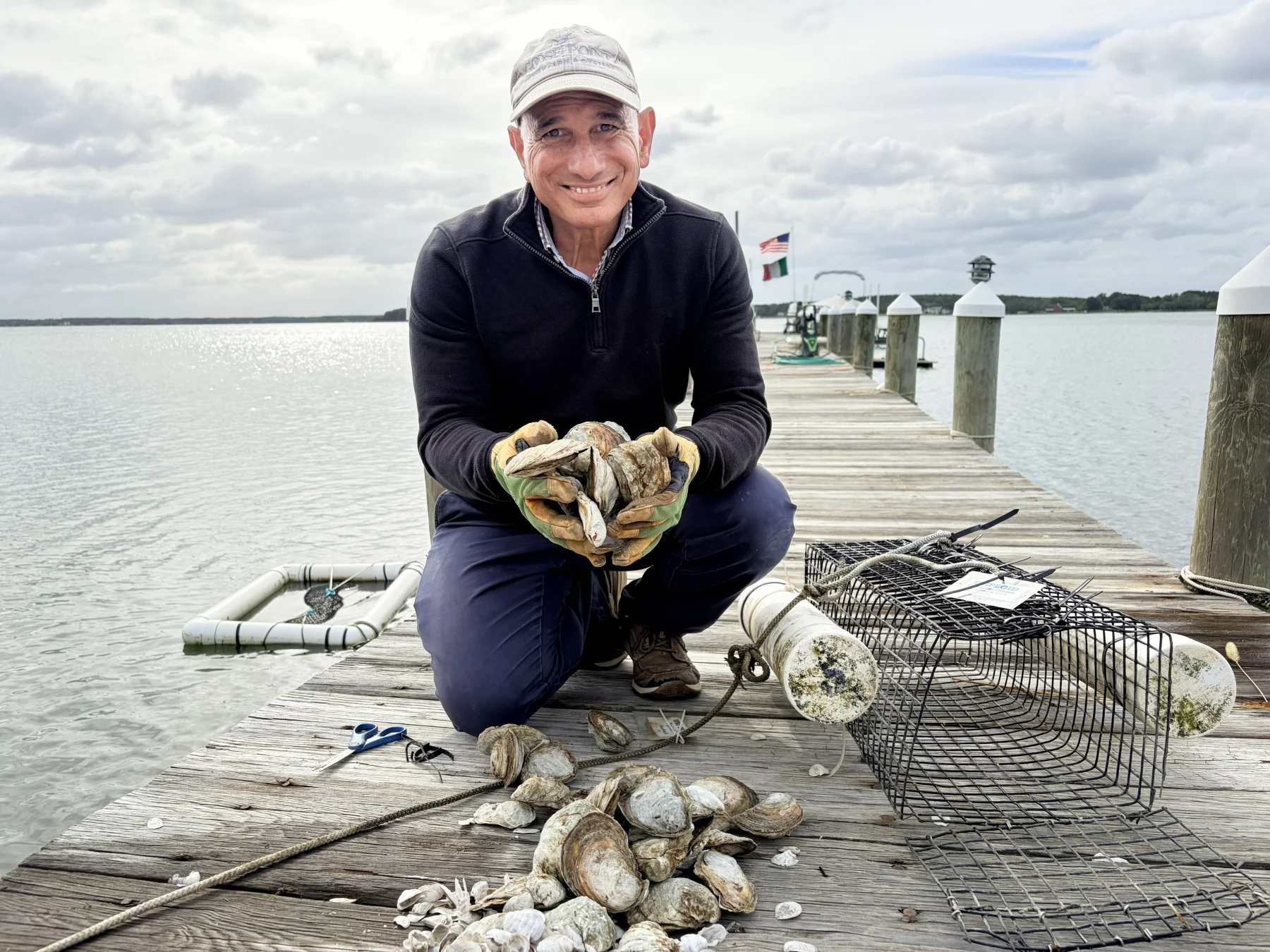
John Consoli marvels at the oysters. “I think I’m more excited about something that looks like a rock than anyone else could be,” he says.
Ari Daniel/NPR
hide caption
Ari Daniel/NPR
John Consoli stands at the edge of his pier, which juts from the southern tip of Kent Island, Maryland, to the Chesapeake Bay. He bends down and hoists a mesh the size and shape of a pillowcase out of the water.

It’s full of oysters. He manages to get him onto the pier. “These are brand new oysters from this year,” he says. “When I received them, they weighed nothing. And it’s only been three months of growth. The net is bursting at the seams, I can barely bring it up.”
Once he catches his breath, Consoli marvels at these molluscs. “I think I’m more excited about something that looks like a rock than anyone else could be,” he says with a big smile. “I really can’t think of many more creatures that do the same good as oysters.”

Oysters are the foundation of the Chesapeake coastal and estuarine ecosystem. Each adult filters up to 50 gallons of water per day. Cleaner water leads to a healthier bay and more seagrass. “It helps crabs and other organisms,” Consoli says.
Additionally, oyster shells are a habitat in themselves. “Because of all the nooks and crannies,” he explains, “lots of small fish and crabs live, feed and hide among them, which creates an environment rich in biodiversity. I even found a seahorse, which was amazing. I’ve never seen a seahorse in my life!”
Robots searching for oysters
Oyster reefs once abounded in the Chesapeake, but overharvesting has decimated their ranks — by more than 99 percent in 2011, according to one estimate. This monumental change in the bay has contributed to poorer water quality and a decrease in habitat for other species.

Oyster farming in the Chesapeake has grown in recent years, despite environmental and health challenges, says Ryan Carnegie, a biologist at the Virginia Institute of Marine Science. He adds that wild oysters have also made a partial comeback, helped by better management and investments in restoration. But, says Elizabeth North, a fisheries oceanographer at the University of Maryland Center for Environmental Sciences, “current oyster populations are probably still only a fraction of these historical populations.”
Consoli’s goal is therefore to be a sort of guardian, supplying the bay with more and more oysters and ensuring their well-being. He floats them just below the surface, where he says nutrients are concentrated to help them grow quickly. And even though its oysters aren’t intended for consumption, a cleaner bay means a better habitat for those that are harvested commercially.
Consoli approached oyster conservation in a roundabout way: He’s a professional photographer at the University of Maryland, and he was doing a photo shoot involving the campus’s oyster research, namely efforts to understand and support oyster reefs.

“Seeing great minds coming together to solve problems showed me that there is a real need here,” he says.
Miao Yu is one of the great minds who inspired Consoli that day. She is a mechanical engineer at the University of Maryland and has observed that despite recent modest gains in oyster abundance, farmers continue to face two daunting tasks, both hampered by the bay’s murky waters.
The first is knowing where to plant the babies. A young oyster needs to settle on a hard substrate. But finding the perfect place is easier said than done. “Sometimes it falls into the mud,” she explains, where the young oyster suffocates and dies.
The second task is to determine where and when to harvest the adult oysters. “That’s the biggest challenge,” she says. “We can’t see a few feet away.”
This means that oyster recovery, often by dredging, tends to be inefficient or even damaging: it can damage the seabed or pull up oysters that are not yet ready to be harvested.
Fishermen, she says, “don’t have a complete idea of what’s going on. So our goal is to turn that guesswork into precision.”
Yu tries to do it with the help of robots. She and her team frequently work at the campus’ Neutral Buoyancy Research Center, which houses a giant cylindrical tank.

Mechanical engineer Miao Yu uses robots and AI to inform oyster farmers when and where to plant and harvest.
Ari Daniel/NPR
hide caption
Ari Daniel/NPR
On a recent fall morning, one of Yu’s doctoral students, Michael Xu, uses a joystick to steer a raft-like robot called Oysterbot. Oysterbot, which the team built in-house, consists of a collection of electronics and cables installed atop a few pontoons. A sonar is mounted underneath.
“We’re able to do a large-scale analysis to get a general view of what’s going on there,” Xu says.
The team can also deploy a smaller, commercially available robot, known as a BlueROV, to take a closer look at something underwater through a live video feed. Together, the two robots paint a portrait of the seabed.
The lab then uses AI to stitch together the visuals and analyze them “to determine if oysters are present, how many of them are alive or dead, and how big they are,” says Xu.
They’re still refining the algorithms, but Yu says the end goal is to “turn this sonar image map into an oyster information map.” In other words, she wants to provide farmers with actionable intelligence on when and where to plant and harvest their oysters.
Beyond the Chesapeake, his team conducted field work along the Washington state coastline and Gulf Coast. Yu hopes that within a decade, the technology can be modified and extended to the nation’s shores, “so we can help oysters across the United States.”
Pair to pier
This interest in helping oysters elsewhere also appeals to Consoli. Since becoming hooked, he can’t help but spread the good word to a growing number of neighbors with access to the bay.
“Every time I meet a new person, I ask them, ‘Hey, do you like oysters?’ he said. “And even if they say no, I say, ‘Well, someone in your family likes oysters. They have to! You have a brother, an uncle, a brother-in-law.'” Once he makes such a connection, he tells them, “Hey, can you grow them? It’s not that hard.”
And most of the time, Consoli finds people to be pretty receptive. That includes some of his octogenarian neighbors on Kent Island.
“I’m really impressed that oysters are cleaning the bay,” Earl Collins says.
On one occasion, Ann Ziegler, who lives a short walk from Consoli, said she took her oysters out of the water with her family to eat them raw. “And then, at Thanksgiving, since no one had died, we still ate them,” she says.
Consoli also met new neighbors through this work, like John Patrick. “It’s just amazing how much marine life I’ve seen around the pier since I’ve had these oysters in the water,” he says. “I had croakers, crabs and eels here this morning.”
Even Consoli’s dental hygienist got involved.
Perhaps most ambitiously, Consoli worked with a local restaurant called Libbey’s Coastal Kitchen in August to place a million baby oysters around their dock pilings.
“We had eight people in wetsuits and life jackets,” he said. “There were jellyfish everywhere. It was probably the most difficult installation we’ve ever done.”
Restaurateur Andrew Westlin says he was immediately drawn to the idea.
“Honestly, it was a no-brainer for us,” he says. “We thought it was a good way for us to give back and just be part of the community.” Soon, there will be a sign next to the pier explaining the oyster project to restaurant customers and passersby.
Consoli’s wife, Kathy, says all this oyster work is “the hardest hobby there is. I now call it the Pied Piper of Oysters because I think it can accommodate up to 80 people.”
She’s right. Consoli calls it its Peer to Pier network.
“We’re just trying to make sure we can restore as much of the bay as possible,” he says, “whether it’s with robots or other techniques… It teaches me how much of a difference something that seems so insignificant can make.”
Gn headline

