
Michael Savage, psychiatric nurse practitioner and longtime Steamboat Springs local, has a mission: to lift people out of depression.
In Steamboat, there are currently a range of modalities to treat depression and related mental health issues: psychotherapy, psychiatric medication management, and even ketamine-assisted therapy.
But at Rising PsychiatrySteamboat’s newest psychiatric clinic, Savage has introduced a new form of interventional, non-invasive treatment to the Yampa Valley: accelerated transcranial magnetic stimulation, or TMS.
After working as a nurse for 10 years, Savage saw a “need” in the local community to expand mental health treatment. He then returned to school to become a psychiatric nurse practitioner.
A Yampa Valley Behavioral Health survey presented to the Steamboat Springs City Council in early September showed that despite strong awareness of local resources and a reputation for community support, many residents still face loneliness, high levels of substance use and persistent barriers to getting care when they need it.
“About a year ago, I was at a pharmaceutical conference and in one of the presentations someone was talking about TMS and how effective it was and how quickly it could treat people, and then they immediately went back to the topic of medications,” he said. “And I thought, ‘I need to know more about this.'”
TMS, he explained, is an FDA-approved treatment that uses brief magnetic pulses, similar in strength to an MRI, to gently stimulate targeted areas of the brain without surgery or anesthesia.
Savage said that with traditional TMS, patients are seen four to five days a week for six to nine weeks, with sessions lasting about 20 to 40 minutes per visit. Savage said traditional TMS can be covered by insurance if the patient meets the requirements.
What Savage is proposing is what he describes as the “most modern” approach to the treatment form: doing the entire treatment in a single 11-hour day consisting of 20 three-minute sessions, called “one-day TMS.”
Although there are several providers throughout Colorado offering traditional TMS treatment, Rising Psychiatry, which opened in early September, is the only clinic outside of Denver offering accelerated TMS treatment.
In bringing this intensive form of treatment to Northwest Colorado, Savage’s goal is simple: to make it more accessible and convenient for potential depression patients in the mountain region.
“It’s a lot less travel, it’s a lot less hassle,” he said. “I’m just trying to make it accessible and treat as many people as possible.”
Savage charges a flat rate of $3,000 for treatment and does not accept insurance.
TMS is not for everyone. People with depression who have benefited greatly from psychiatric medications, for example, are less likely to be suitable candidates for TMS.
“The further you go in your depression journey, your treatment journey and things haven’t worked for you – the harder it is to treat, the more likely TMS will work for you and the more benefit it can provide you,” Savage said.
One of his main obstacles, he explained, is public education. He said most people haven’t even heard of TMS, let alone considered it for possible psychiatric treatment.
Savage said he believes TMS represents a “new paradigm in psychiatry.”
He traced the history of psychiatric paradigms, from the founding of psychoanalysis and talk therapy by Sigmund Freud in the late 19th century, to the advent of psychiatric medications in the 1960s and 1970s, to today’s neuromodulation treatments like TMS.
“TMS is the one that I think is the most accessible and affordable,” Savage said. “It has the best safety profile, the fewest side effects, and it’s something that we can easily get out to the population very quickly.”
Although the technology has been around for decades — TMS treatment was officially approved by the FDA in 2008 — recent advances have resulted in what Savage called an “inflection point” in the technology’s use.
Rising Psychiatry’s TMS patients arrive at the clinic at 7 a.m. and are given a drug called d-cycloserine, which Savage says makes the treatment more effective by unlocking the “key receptors that we’re trying to change in the brain with TMS” and making them “more malleable, more active.”
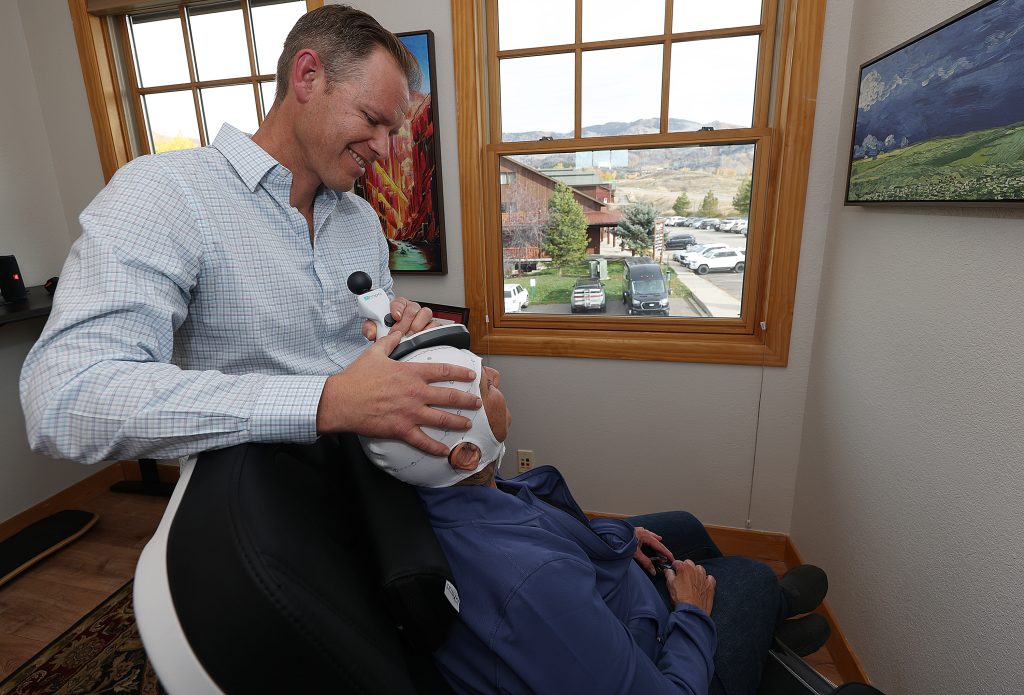
The medicine takes about an hour to take effect. During this time, Savage conducts a “mapping session” or calibrates the treatment by discovering “the exact amount of energy needed to activate your brain,” with each patient differing at least slightly.
“For the next 10 hours, we’re going to do very short treatments,” said Savage, who added that he’s offering lunch to patients. “They’re three minutes each, and we do them every half hour. So that’s a total of 20 very short sessions.”
During treatment, patients wear a special cap with markings that tell Savage the treatment points. Once the device is started, the patient will feel pulses of light on the head, which can potentially cause temporary twitching of the patient’s face depending on the power and position of the equipment.
In the 27 minutes between each session, patients can do virtually anything — work from their laptop, take a walk, listen to music — although Savage said he asks his patients to avoid scrolling on their phones to alleviate negative thoughts during treatment.
“Other than that, it’s a passive thing,” he said. “You don’t have to do anything special. You don’t have to be in a certain mental state. You don’t necessarily need to think about anything during treatment. You can, but you just really need to relax.”
After treatment, Savage said, patients will likely feel tired, as if they had studied in a library all day.
Savage said patients who see success with the one-day TMS should notice positive results within two weeks. In studies of accelerated TMS, he said 70% of patients can say within a week of treatment that they are responding positively to it.
“Your brain doesn’t just change on the day of treatment. It continues to adapt over a period of time,” he said. “This positive response develops for weeks after treatment because your brain makes new connections, it adapts and gets used to the frontal cortex being active again, whereas in depression it is often really dormant.”
Beyond 1-day TMS, Rising Psychiatry also offers traditional medication-based psychiatric treatment and therapy to provide comprehensive options for anyone seeking mental health care.
Ultimately, TMS, unlike medications, addresses an individual’s underlying psychology, or the “root cause” of their depression, Savage said.
“The medications are great, but in some cases it’s a bit like hitting a screw with a hammer,” he said. “With TMS, I retrain your brain so it’s not depressed.”
Savage, who has lived in Steamboat for 15 years, is currently working on opening a branch of the clinic in Boulder, also focused on one-day TMS.
Rising Psychiatry is located at 1205 Hilltop Parkway, Suite 202 in Steamboat Springs. To learn more, visit RisingPsychiatry.com.
Gn Health

