Financial influencer Taylor Price joins “Varney & Co.” to explain how changing your mindset can help Americans grow their wealth and achieve the American dream.
American households have faced higher energy prices this year, and as colder weather approaches this winter, they could face higher heating bills for their homes depending on the type of fuel used.
The Energy Information Administration (EIA), the Department of Energy’s primary analysis agency, released its Winter Fuels Outlook on Tuesday, which states that the agency’s “expectations for this winter vary due to divergent energy price trends across fuels and regional variations in forecast temperatures.”
“We expect that households using natural gas and propane as their primary heating fuels – collectively, about half of all U.S. households – will have lower energy costs this winter, primarily due to lower fuel costs,” the EIA wrote.

The Energy Information Administration (EIA), the Energy Department’s primary analysis agency, released its outlook on winter fuels on Tuesday. (Anibal Martel/Anadolu via Getty Images)
“We expect higher energy costs for households whose primary heating fuel is electricity or oil due to higher prices for these fuels,” the agency added.
STRONG NATURAL GAS PRODUCTION AND SUPPLY COULD ease pressure on winter heating bills
EIA data showed that homes primarily heated with natural gas would see spending decrease by 9% compared to last year, with a range of forecasted uncertainties in weather cases all showing a decrease in spending.
The West is expected to see a 7% increase in natural gas spending compared to last winter, while other regions are expected to see declines in the 10 to 15% range.

EIA data showed that homes heated primarily with natural gas would see a 9% decrease in spending compared to last year. (Rebecca Droke/AFP via Getty Images)
Homes heated with propane would spend 3% less according to the forecast, with a range from a 10% decrease to an increase of about 8%. Spending is expected to be flat in the South compared to last winter, while the Midwest and Northeast would see declines of 4% and 15%, respectively.
TRUMP ENERGY CHIEF SAYS TRUCKS COULD SEE DIESEL RELIEF WITHIN A FEW DAYS AFTER EXECUTIVE ORDER
Fuel oil spending is expected to increase 21% nationally according to the EIA outlook, with an uncertainty range of about 15% to 35%.
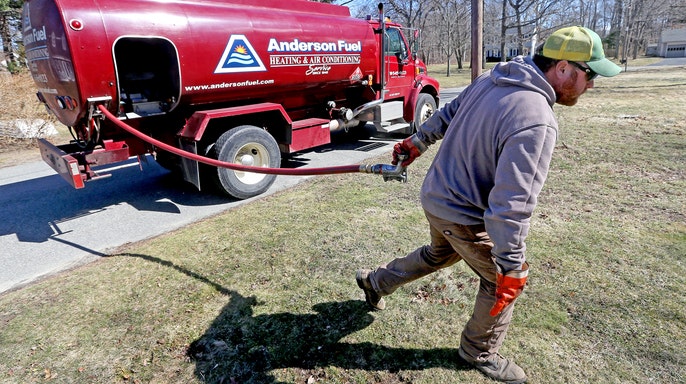
Fuel oil spending is expected to increase 21% nationally according to the EIA outlook. (Matt Stone/MediaNews Group/Boston Herald via Getty Images)
Spending on electrically heated homes is expected to rise 4% this winter, with the uncertainty range reflecting single-digit increases.
The West is expected to see a 9% increase from last winter, while the South and Midwest would each see a 3% increase and the Northeast would see a 3% decline, according to the outlook.
ENERGY CEO SAYS AMERICANS ARE NOT BENEFITTING FROM LOW PRICES BECAUSE OF MAJOR ROAD CUT
The EIA said that while it expects national average temperatures to be similar to last year, its forecast assumes warmer temperatures in the Northeast after the region experienced a relatively cold winter last year, with much colder temperatures in the West after experiencing an unusually warm winter a year ago.
The forecast also assumes that the Midwest and South will experience temperatures similar to last year.
CLICK HERE TO DOWNLOAD THE FOX NEWS APP
The agency noted that the National Oceanic and Atmospheric Administration (NOAA) has “identified a strong El Niño this winter, which could result in significant temperature variations from our forecasts.”
Gn bussni