
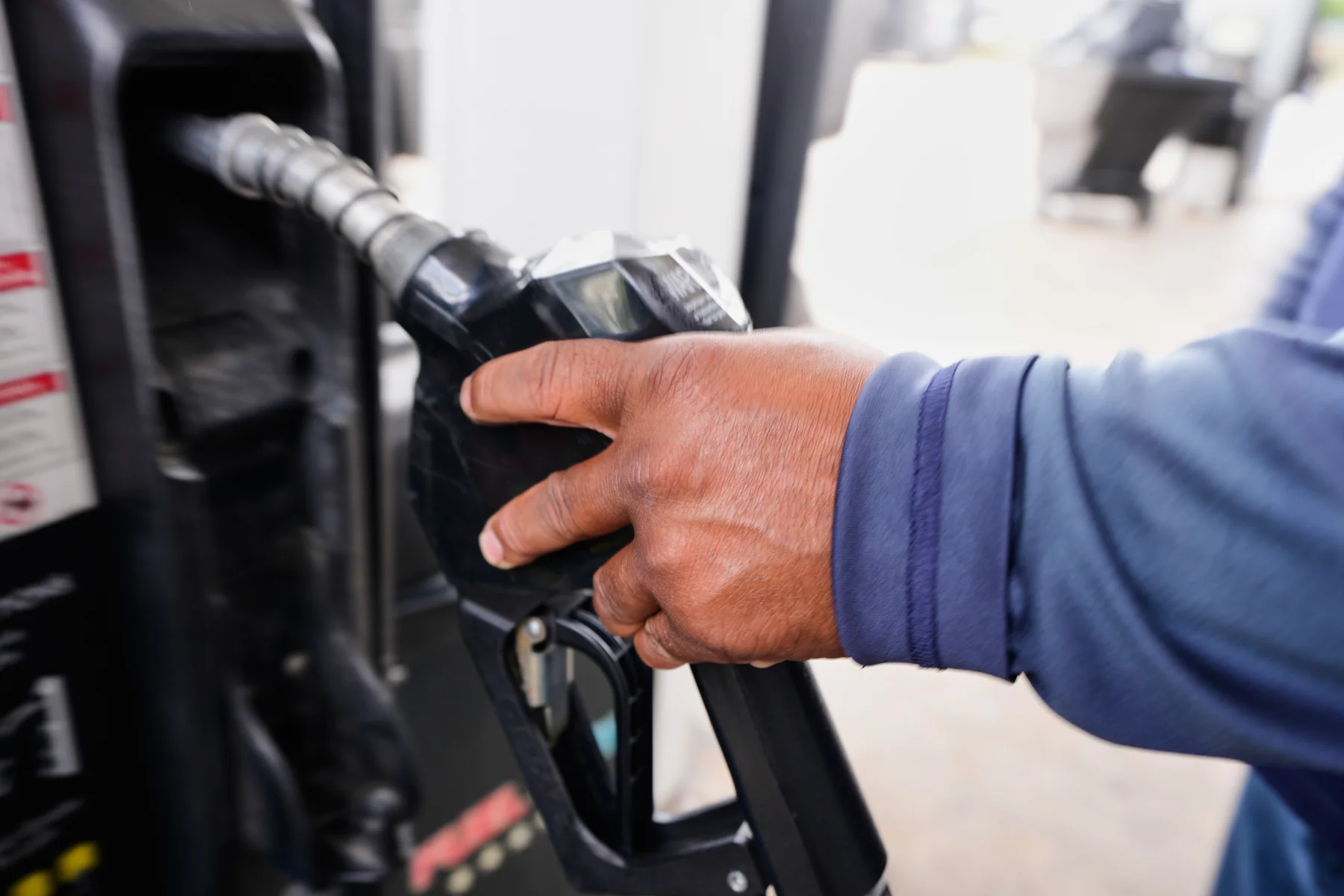
A customer replaces the nozzle of a gas pump after making a purchase at the Fuel City gas station Friday, April 17, 2026, in Dallas.
Tony Gutiérrez/AP
hide caption
Tony Gutiérrez/AP
Subscribe to the Planet Money newsletter. The world is confused. The economy can help
Democrats are now poised to take control of Congress by a wide margin — and a key factor in their success has been voters’ fury over how the war in Iran has driven up the price of fuel.
Before the war, about a fifth of the world’s oil passed through the Strait of Hormuz. As the war strangled this waterway, the price of oil rose: a barrel of Brent cost around $70 in late February, spent months around the $110 mark and is now near $95.
This has driven up the price of anything refined from crude. A gallon of gas costs an average of $4.12, about $1 more than a year ago. The price of diesel reached a record level in September at $6.52, and although it has fallen a bit since then, a gallon is still about $2.50 more than this time last year, according to AAA.

This price surge helped big oil companies reap profits huge profits during the past two quarterswhile making the cost of fuel at the pump uncomfortably high for drivers and raising the price of almost everything in a country that is heavily dependent on trucking.
So, now that the mid-term results are in, could drivers soon see a drop in petrol and diesel prices?
Not so fast, experts say. Here’s why.
What could Democrats do?
Nothing for the moment: the members of the new Congress will not be sworn in until January.


And once seated, U.S. lawmakers have limited powers to directly influence the price of oil, dictated by a complex global market.
As the election approaches, most of the federal government’s actions to reduce fuel prices have come from the White House, not Congress. Hoping to avoid losses for his party, President Trump attempted to reduce the cost of diesel by relaxing federal diesel rules. dyed dieselwhich is normally used for agriculture. He also announced an agreement that would bring more Russian diesel to global markets, including the United States, by temporarily lifting sanctions. Neither has done much to move the needle.
But the new Democrats in Congress will They have the power to push the president to end the war in Iran, in part by making it harder to authorize new war spending. Senate Minority Leader Chuck Schumer (D.-NY) told reporters Wednesday that Democrats intend to end the war and lower the cost of living, saying “relief is on the way.”
“What a unified Democratic Congress can do is make escalation significantly more costly: both chambers can pass resolutions, attach conditions to war spending, and withhold confirmation of key officials,” Claudio Galimberti, Rystad Energy’s chief economist, wrote in a market note to the media.

However, the president has veto power over legislation, as well as executive powers. “President Trump still retains full discretion over military strikes, over blockades and sanctions, licensing, etc.,” Jorge León, head of geopolitical analysis at Rystad Energy, said in an interview with NPR.
Trump has sent mixed messages about whether he wants to end the war or escalate the war. In recent weeks, he has warned Gulf Arab countries to prepare For a new military campaign after the mid-term elections. US strikes Qeshman island in the Strait of Hormuz that Iran uses to launch its own strikes, on November 2.
But on election night, Trump said The New York Times that he knew that the voters were unhappy with gas prices. And the next day, as the scale of the electoral rout became clear, Vice President J.D. Vance job on social media: “The reason we lost was the war.”
If the war ends, when will prices fall?
Jaime Brito, executive director of refining and oil markets at Dow Jones Energy, says if there was a deal to end the war, traders could be very excited. Brito said they could wait for official announcements from Iran and the United States announcing the reopening of the strait and for both sides to withdraw their military presence in the region.
If market traders are convinced that peace will last? “If this scenario happens, then personally I see crude prices falling by $15 to $20 (per barrel) immediately, within two or three days of the announcement,” he said.
But for gasoline and diesel prices to also fall, oil would have to start circulating again. Ships that have long taken alternative routes to avoid passing through the Strait of Hormuz are expected to return to their point of origin and then resume their old routes through the Strait. León stressed that this could lead to traffic jams.
From there, this crude will still need to be refined and come to market.
In the most optimistic scenario, Brito said, it could take three months after the announcement of a ceasefire or agreement for gasoline and diesel prices to reach their pre-war levels.
León thinks it would take about six months for the price of crude oil to reach its pre-war level, and then another month or two for gasoline and diesel to follow. But that’s assuming everything goes well. And, they both said, there could be hiccups along the way that would extend the recovery deadline up to a year after a deal is announced.
“I don’t want to say this, but you know, high gas prices could become a new normal,” Brito said.
The X factors

First big X factor: the war in Ukraine.
If Ukraine continues to attack Russian refineries, the price of diesel may not fall as precipitously as that of gasoline. This is because Russian refineries normally transport a large portion of the world’s diesel to global markets. The resumption of traffic through the Strait of Hormuz will help bring down the price of diesel – but it may take longer to reach its pre-war level, León said.
Other scenarios might paint a less rosy picture, León said. American refineries are operating at more than 90% capacity. What would happen if they needed emergency maintenance just when there was more oil ready to hit the market? What if hostilities resumed, despite an agreement?
Britto agreed. Before the end of the year, there could theoretically be further cross-Strait attacks, he wrote, “if the current administration sees this as a ‘window’ to complete unfinished business before the new configuration of Congress takes office in January.”
And there is also another factor at play: the war has increased the price of transporting oil around the world.
Since the Strait of Hormuz has been blocked for so long, transportation costs have increased; ships carrying oil had to go around around the strait, take longer routes and consume more fuel. Additionally, the price of insuring these ships has increased, as transit around the strait has become much riskier.
This means that even the oil industry is paying more to get into the oil business. And if hostilities persist and transportation costs remain high, that could keep the price of Brent crude elevated for longer.
“Ultimately,” wrote Brito, to hope for a return to normal prices, “one must see a definitive end to the conflict.”
Gn headline

