
Constellation Research founder R. Ray Wang joins “Making Money” to analyze the post-election market rally, potential policy implications for AI data centers, and investment opportunities in tech stocks and hyperscalers.
The midterm elections ushered in Democratic majorities in the House and Senate for the next two years, as well as advances at the state level that could upend artificial intelligence (AI) oversight.
The AI sector has faced political scrutiny in a variety of areas, including the amount of electricity consumed by data centers and its impact on consumers, as well as impacts on cybersecurity and the workforce.
President Donald Trump has made the development of artificial intelligence – which he has renamed “superintelligence” in official White House policies – a priority of his administration and has the power to veto legislation passed by the Democratic Congress, while retaining control of executive branch regulatory agencies.
As AI development advances at a rapid pace, Democratic policymakers at the federal and state levels could take steps that will affect how companies approach these investments in the face of oversight and political pressure.
BUSINESS LEADERS AND INVESTORS ASSESS THE IMPACT OF DEMOCRATS’ MEDIUM-TERM SWEEP ON MARKETS, AI AND TRAVEL

Democratic candidates like Abdul El-Sayed, who won a U.S. Senate seat in Michigan, won the midterm elections and expressed skepticism about data centers. (Sarah Rice/Bloomberg via Getty Images)
Elliot Hentov, chief macroeconomic policy strategist at State Street Investment Management, and Christine Norton, investment strategist, wrote that “Democratic gains could create additional headwinds for…and increase oversight of AI providers and data center development, particularly the impact of electricity demand on local communities.”
“These concerns are reinforced by some results from state governors,” Hentov and Norton added. “Yet at the federal level, congressional oversight alone would not be enough to restrict the construction of AI-related data centers in the face of a presidential veto.”
“AI also remains a strategic priority for both parties, suggesting that further policy review should not automatically be equated with the end of the capital spending cycle in AI. Investments in AI will likely continue to be robust in 2027, although tempered by supply chain strains and tighter credit,” they added.
TRUMP REBRANDS AI AND REJECTS “GLOBALIST SCHEME” TO CONTROL TECHNOLOGY

House Minority Leader Hakeem Jeffries, D-N.Y., and Senate Minority Leader Chuck Schumer, D-N.Y., will have their party’s majority in the next Congress. However, they are limited by President Trump’s veto. (Nathan Posner/Anadolu/Getty Images)
Dallas Dolen, head of technology, media and telecommunications at PwC, told FOX Business that with Democratic control of Congress, “we will likely see greater scrutiny of AI safety, bias, labor, copyright and transparency, but more oversight does not necessarily mean more certainty.”
“Companies will always face an evolving patchwork of state requirements, and they cannot pause major investments in AI while the rules take shape,” Dolen said. “They need a strong governance foundation that allows them to continue to invest, develop and scale AI responsibly.”
WHAT THE MIDTERM ELECTIONS COULD MEAN FOR MARKETS AND DEBT
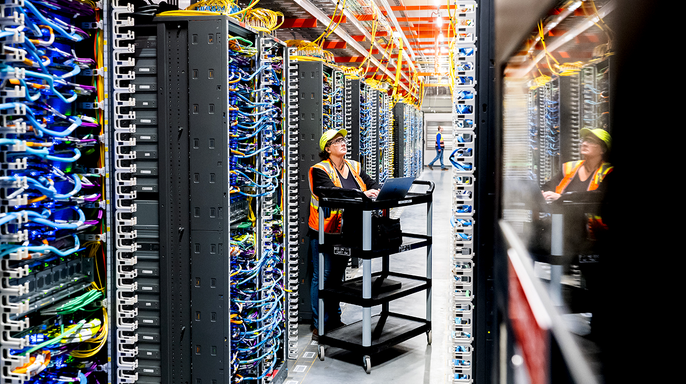
Investments in AI data centers and other infrastructure have increased significantly in recent years. (Noé Berger)
UBS strategists noted that possible pauses in data center construction in states like Texas, where Democrats flipped the governorship and the House of Representatives, could affect the outlook for AI infrastructure and cloud computing companies.
“Data center pauses will slow the pace of construction through 2028, with about 30% of planned 2028 additions now at risk of being affected, and Texas alone accounts for 18 GW of that. Congress is less likely to go beyond the states, in our view, with data centers now more likely to pay for network upgrades, which could potentially increase costs,” the strategists wrote of UBS.
CLICK HERE TO DOWNLOAD THE FOX NEWS APP
“The slowdown is negative for semiconductors and AI infrastructure, but much of it is already priced into semiconductors with valuations near multi-year lows. Additionally, semiconductor positioning has been heavily discounted,” they added.
Gn usa

