
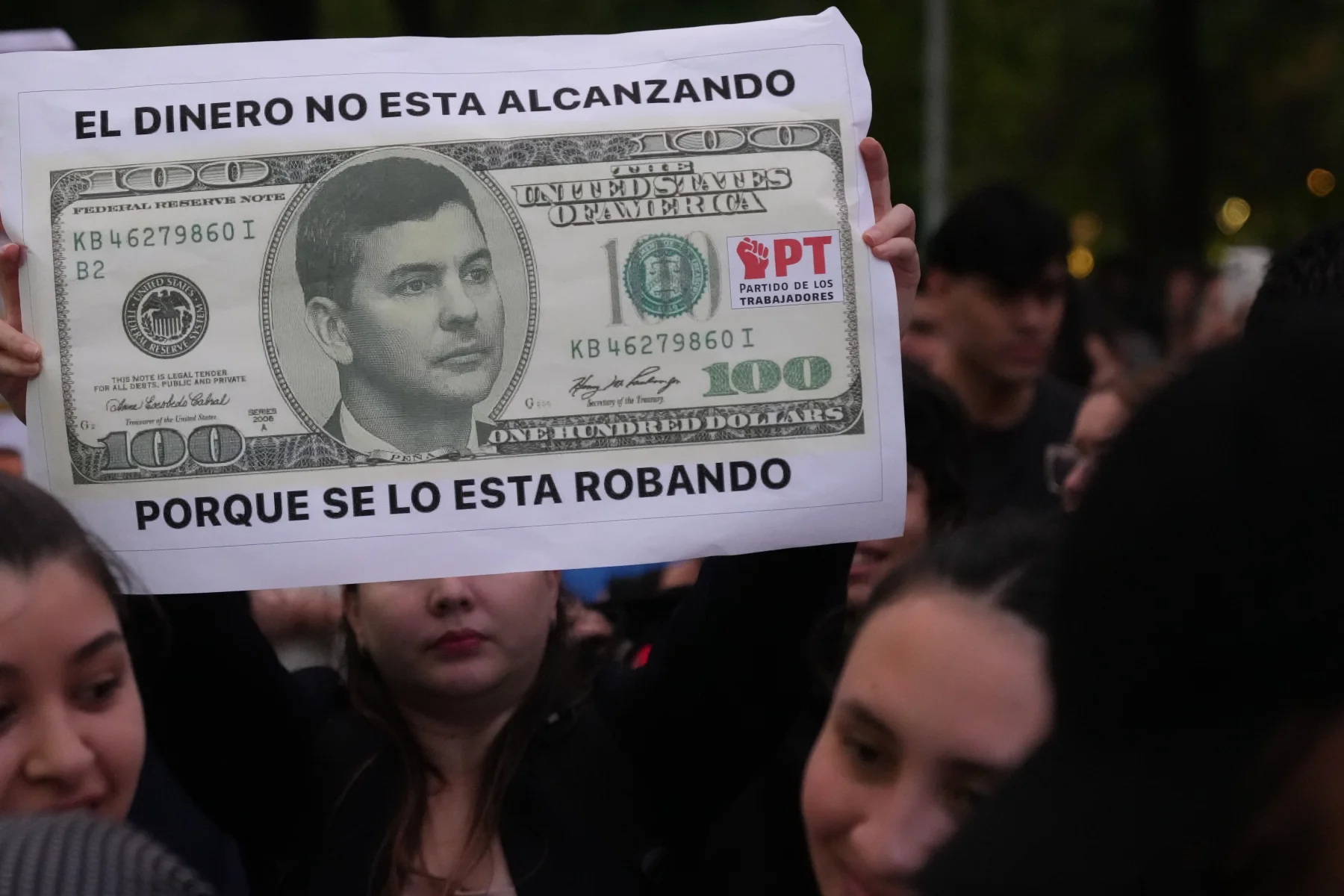
A protester holds a counterfeit US dollar bill depicting Paraguayan President Santiago Peña during a demonstration against the government and Ueno Bank, which Paraguay’s central bank seized amid a solvency crisis, in Asunción, Paraguay, on Wednesday.
Jorge Sáenz/AP
hide caption
Jorge Sáenz/AP
ASUNCIÓN, Paraguay — Paraguay’s lower house voted unanimously Thursday to impeach President Santiago Peña just minutes after announcing his resignation, as the collapse of a major digital bank linked to his government froze the savings of millions, sent protesters into the streets and turned his own party against him.
The 78-0 vote marked a resounding rejection of Peña by lawmakers from his long-ruling Colorado Party, who joined the opposition in supporting his impeachment after three days of protests that rocked the capital, Asunción. The vote sends the charges to the Senate, where a two-thirds majority is required to convict the president and formally remove him from office.
The dismissal comes as thousands of people protest for a third day, as they try to recover lost savings, wages and pensions from Ueno Bank, a major digital lender.
Peña, a close ally of U.S. President Donald Trump, announced his decision in a video posted on X as lawmakers debated his impeachment, saying he was resigning in the interest of “the stability of our country, social peace and the need to preserve our democratic institutions.”
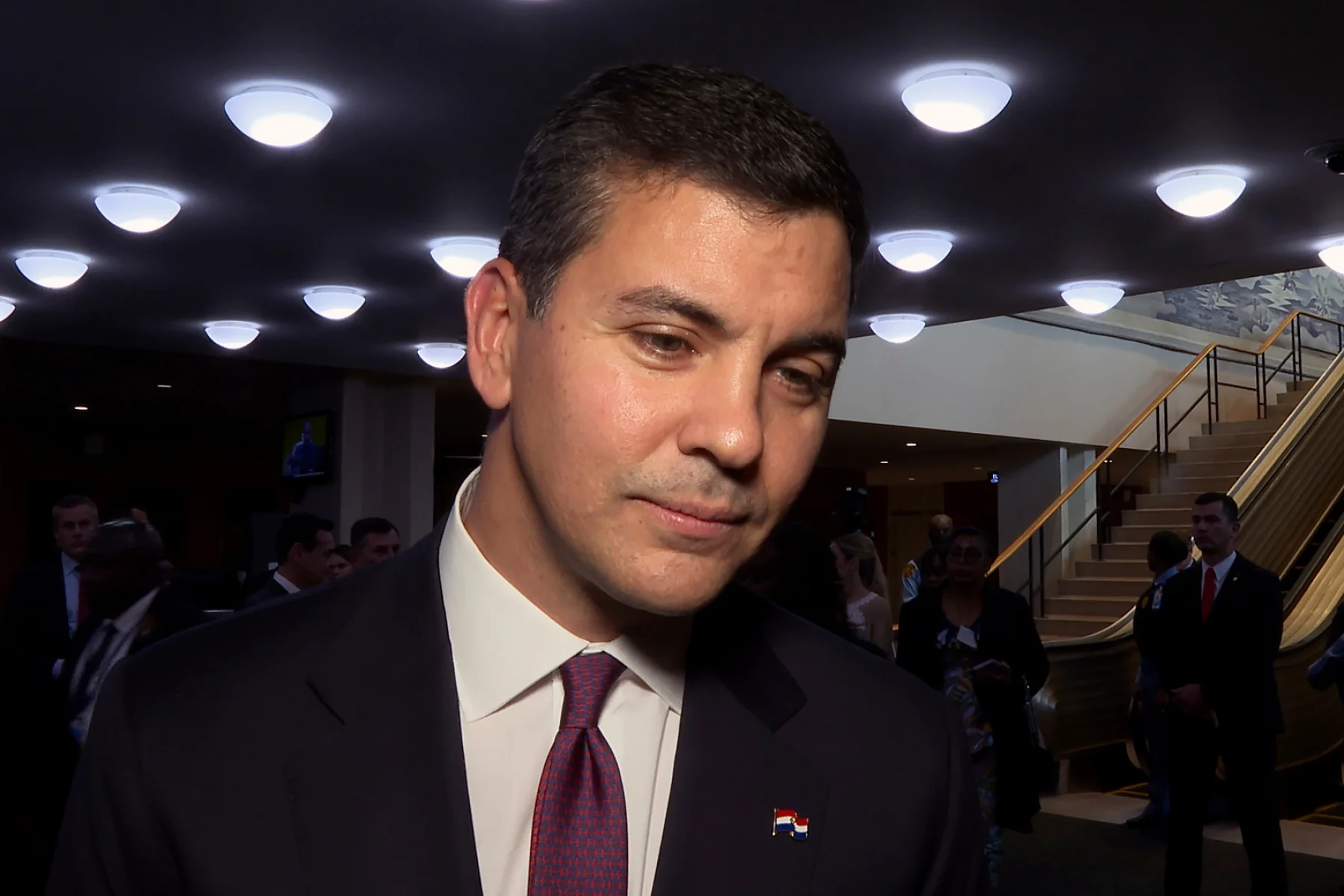
Paraguayan President Santiago Peña speaks to the media at United Nations headquarters, September 19, 2023.
Ted Shaffrey/AP
hide caption
Ted Shaffrey/AP
The president, who until last year held a stake in a company linked to Ueno Bank, expressed contrition but did not accept responsibility for the banking crisis which plunged a South American country long prized by foreign investors for its stability into financial and political turmoil.
“I also want to apologize to the people if I failed to do so at any point,” he said. “I never intended to betray the trust they placed in me.”
The extraordinary turn of events paved the way for a transfer of power later on Thursday. Congress was expected to formally accept Peña’s resignation at 5 p.m., paving the way for the inauguration of Vice President Pedro Alliana as president an hour later. Alliana would serve Peña’s term until August 2028, with lawmakers expected to choose a new vice president.
From star lender to foreclosed bank
Bank Ueno, which grew from an obscure financial company to a household name in less than five years, counted more than 60 percent of Paraguay’s adults as customers. They must now scramble to recover their savings, their government pensions and, for the 7,000 employees affected by the bank’s closure, their unpaid salaries.
Many Paraguayans are wondering how a bank linked to the president, which until last year had a stake in Ueno’s holding company, was able to grow so quickly in size and importance despite repeated warnings about its questionable lending practices.
The answer lies in the uneasy proximity of Peña’s long-ruling Colorado Party to regulators and the country’s business elite, a weakness that persists even as stable economic management and rapid growth have made Paraguay a darling of international investors in recent years.
“Santiago Peña and the Colorado Party stole all our savings,” said Luis Pineda, one of the protesters who marched toward Congress on Wednesday. “We have had enough of 70 years of looting.”
Shortly after obtaining his banking license in 2023, Ueno seemed to be everywhere in Paraguay. The digital lender, a rebranded version of a decades-old financial company, lured customers with generous cash-back offers on groceries, expanded into more than 70 locations, sponsored Paraguay’s national soccer team and put its name on the country’s main stadium.
Government money flowed into Ueno’s coffers under Peña. He also named Carlos Carvallo, president of Financiera Ueno, the predecessor of Ueno Bank, to head the central bank, the agency responsible for overseeing the digital lender.
Last month, Ueno said he held about $800 million in public deposits, about a quarter of his total, including money from the state pension and health fund and the operators of Paraguay’s giant hydroelectric dams.
Even as pensioners’ savings and other public funds piled up in Ueno, concerns grew within the central bank. In June, its inspectors discovered a pattern of granting risky loans to insiders, ABC Color, one of Paraguay’s main newspapers, reported. Ueno had granted large sums to companies linked to its owners, beyond what the law allows and without sufficient security to cover the debts in the event of bankruptcy. In a single day in September 2025, nearly $39 million was paid to three of these companies.
Peña repeatedly ignored the warnings. As recently as last month, he defended Ueno and central bank oversight, calling the concerns a smear campaign that frightened the public.
Long queues outside branches but customers are stuck
But on Monday, everything fell apart. Regulators investigating Ueno’s loans to companies linked to its owners found poorly documented loans, the central bank said, as well as expenses the bank had wrongly considered assets.
Once the accounts were corrected, Ueno’s capital, which banks must retain to absorb losses, fell to less than half the legal minimum. The central bank seized the lender on Tuesday and announced plans to transfer customer accounts, as well as any assets that still have value, to other banks before liquidating what remains.
Ueno’s app, cards and transfers became inaccessible and its branches locked their doors, leaving desperate depositors to queue outside, with no way to cash out their savings. On Wednesday, the rush to open new accounts elsewhere crashed other banks’ mobile apps, fueling public panic.
Officials appealed for calm and said they had started repaying depositors, opening new accounts elsewhere for about 280,000 people who had only banked with Ueno.
“The banking system is healthy,” insisted Pedro Acosta Bernal, named interim president of the Central Bank on Wednesday after Carvallo’s resignation at Peña’s request.
Authorities arrested eight top Ueno executives, including founder Miguel Vázquez and bank president Juan Manuel Gustale. Prosecutors also charged 27 bank officials and business associates with crimes including breach of trust and attempted fraud. Lawyers for several of those detained said they needed time to review the allegations before they could comment.
Protesters in the streets
Hundreds of employees of Ueno Bank and other companies belonging to Grupo Vázquez, the bank’s parent conglomerate, protested in front of the Labor Ministry on Thursday, demanding severance packages and unpaid wages, with their jobs in limbo and their salaries frozen at the bankrupt bank. The day before, hundreds of retirees, savers, students and workers took to the streets of Asunción, the capital.
“We want your head, Peña!” they shouted. Their signs demanded Peña’s removal, called him an “enemy of savers” and implored “Give us back our money.” Riot police fired pepper spray and rubber bullets to push back the crowds.
Many protesters saw Ueno’s collapse not only as the result of risky banking but also as a case study in official corruption. Only Venezuela ranks lower in South America on the latest perceived corruption index from Transparency International, a global watchdog.
“This is another attack on honest and hardworking citizens, people whose small savings are the result of years of work,” said protester Belarmino Balbuena.
At the national stadium which formerly bore the name Ueno, the bank’s logo had already been erased. But across the capital, new graffiti denounced politicians as thieves.
Gn world

