

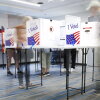
A general view of voting machines at the Franklin County Board of Elections on October 6, 2026 in Columbus, Ohio.
Jeff Dean/Getty Images
hide caption
Jeff Dean/Getty Images
Stay informed with our Politics newsletter, sent every week.
With just under a month until Election Day, the financial decisions made by both parties seem to suggest that the question at hand is not whether Democrats will take control of the House, but how big the majority will be.
Currently, Republicans hold a slight advantage of 218 to 214 seats. In February 2025, the Cook Political Report’s initial assessments for the midterm elections found that a small slice of 39 races were classified as competitive, of which 18 were classified as “toss-ups.”
That headline number has changed, with Cook currently listing 43 districts as competitive, including 22 toss-ups. But beyond that, behind the scenes, Democratic and Republican groups are mobilizing hundreds of millions of dollars to influence a much broader electoral landscape.
An NPR analysis of both parties’ campaign goals, future ad bookings and outside spending by Trump-aligned super PACs finds that more than 90 districts were committed to resources in the final weeks of the midterm elections.
Here’s a look at the types of races that will decide who controls the House in 2027.
Competitive races on paper
If the political environment remained unchanged from the 2024 presidential election, a small group of House races would be competitive no matter what, such as the 10 districts that voted for one party’s presidential nominee and the other party’s House nominee. (Not counting those changed by redistricting in the last 18 months, but more on that below)
This includes seats held by New York Republican Rep. Mike Lawler (NY-17), Pennsylvania Republican Rep. Brian Fitzpatrick (PA-01), and Washington State Democratic Rep. Marie Gluesenkamp Perez (WA-03). Another group of seats had very tight margins in 2024, such as Democratic Rep. Adam Gray’s victory by fewer than 200 votes in California’s 13th Congressional District and a 799-vote victory for Republican Rep. Mariannette. Miller-Meeks in Iowa’s 1st Congressional District.
But the political environment is not the same as it will be in 2024. President Trump’s unpopularity with voters has reached record levels, with the share of voters who strongly disapprove of his job performance higher than ever before during either of his terms.
Voters are unhappy with the ongoing war in Iran, rising gas prices, tariffs and immigration controls, and a wave of anti-incumbent sentiment has led to a record number of congressional departure announcements and a number of sitting lawmakers losing their primaries this year.
Other races to watch: CO-08, NY-03, PA-08, PA-10
Electoral redistricting
Further blurring the map: a redistricting arms race that resulted in new district boundaries for about 1 in 10 registered voters in several states.
Republican-led state legislatures, at Trump’s urging and, in some cases, threats, attempted to draw new House maps that would give them several additional seats in states like Texas and Florida, while Democrats countered in California.
But many of the new district lines were drawn based on assumptions about which voters supported President Trump in 2024 and what they would do in 2026, and in some cases, could turn against them.
According to Strength in Numbers/Verasight polling data shared with NPR, Trump has a lower-than-average job approval rating in communities that make up newly redrawn districts in South Florida and along the Texas-Mexico border, like TX-28 and FL-25.
In North Carolina’s 1st Congressional District, Democratic Rep. Don Davis has seen his district that Trump narrowly won in 2024 become even more conservative. But the national environment — and a U.S. Senate race where polls have former Democratic Gov. Roy Cooper in the lead — have made the contest more competitive. More than $20 million in ad reservations are expected between now and Election Day in the rural and coastal district, making it one of the costliest House races in the country.
Other races to watch: AL-02, OH-09, FL-22,TX-35
Track money and messages
As the final election sprint approaches, sixty districts are listed as priorities for both the Democratic Congressional Campaign Committee and the National Republican Congressional Committee, as well as Trump-aligned super PACs like No Going Back.
On average, these districts voted for Trump by an 8% margin in 2024, underscoring how deeply competitive races have moved into conservative areas.
The DCCC has more than 90 districts on its battleground map, including 46 targets for flipping in its “Red to Blue” scheme, 26 “Frontline” incumbents in potentially close races and 19 others it considers “In-Play Districts.”
The NRCC has 17 districts on its “Patriots” list of vulnerable incumbents to support and 27 other candidates in open races or challenging Democratic incumbents under the “MAGA Majority” program.
Not every race will end up close or see control of the party change hands. Many of the DCCC’s “In Play Districts” gave Trump more than 60% of the vote in 2024 and saw little to no ad spending from either party.
Then there are races like Kentucky’s 6th Congressional District, where millions of dollars in spending poured in from both parties — including the Trump-aligned super PACS — in a district that Trump won by 15 points.
In Arkansas’ 2nd Congressional District, which Trump also won by 15 points, six-figure outside spending targeting Democratic candidate Chris Jones and boosting incumbent Rep. French Hill helped the DCCC add that race to its “red to blue” goal.

According to Ballotpedia tracking, the target lists compiled by the DCCC and NRCC generally have a broader scope and limited success. From 2012 to 2024, Democrats won a total of 34% of target districts and Republicans 29%.
In some races and locations, Republicans and Democrats are starting to pull back their ad bookings for the rest of the year, according to data from ad tracking firm AdImpact, but for different reasons. The most high-profile example for Republicans is stopping the flow of money in the North Carolina Senate race and redirecting funds to Kansas.
Some House races have also seen similar cancellations, such as the open race in Nebraska’s 2nd District which is both a DCCC Red To Blue and NRCC MAGA majority focus.
Yet this data shows that nearly half a billion dollars in ad bookings have been placed between now and Election Day, showing that in these midterm elections, neither party is taking anything for granted.
Other races to watch: FL-13, NC-11, OH-10, OH-15
Gn headline