
Jay Rockefeller, the last member of his family’s political dynasty that served as governor of West Virginia and then longtime U.S. senator, has died. He was 89 years old. Rockefeller died Thursday evening at his home in Washington. His death was confirmed by Mary Stewart, vice president of external affairs for WETA, the public broadcasting station where Rockefeller’s wife, Sharon, is president and CEO.
Rockefeller came from one of the nation’s richest families and spent half a century in public service in one of the nation’s poorest states. He arrived in 1964 as an aide to an anti-poverty program, was elected governor a dozen years later and served two terms, then spent 30 years as a U.S. senator.
From VISTA volunteer to five-time U.S. Senator, John D. Rockefeller IV, known as Jay, has served West Virginia since the 1960s.
Rockefeller was born in New York on June 18, 1937, just weeks after the death of his great-grandfather, business magnate John D. Rockefeller.
He first came to West Virginia as a Volunteers In Service To America (VISTA) volunteer in 1964.
In 1966, he gained national attention by changing his party affiliation from Republican to Democratic. He was elected to the West Virginia House of Delegates in 1966 and secretary of state two years later.
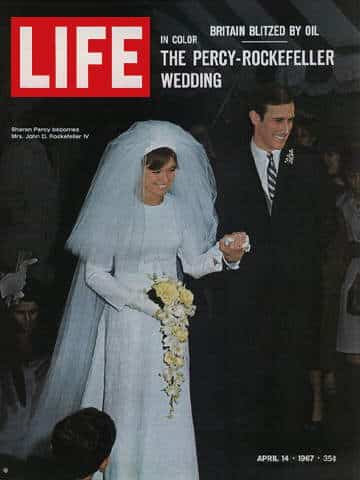
In 1967, Rockefeller married Sharon Lee Percy, daughter of U.S. Senator Charles Percy of Illinois. Their Chicago wedding was featured on the cover of LIFE magazine. They had four children: John Davison “Jamie” V, Valerie, Charles and Justin Aldrich.
After losing to Arch Moore for governor in 1972 by 72,000 votes, Rockefeller served as president of West Virginia Wesleyan College.
According to the John D. Rockefeller Library at West Virginia University (WVU), “Rockefeller’s second campaign for governor was successful: he defeated Republican candidate Cecil Underwood by more than 242,000 votes, the largest majority in state history. Natural disasters, strikes, and a deteriorating economy posed serious challenges during his years as governor. In the spring of 1977, Significant spring flooding in McDowell, Wayne, Logan, and Mingo counties in southern West Virginia ravaged entire towns and made safe housing above flood plains a goal of the Rockefeller administration.
“The same year saw the start of the 111-day national bituminous coal strike of 1977-1978, led by the UMWA (United Mine Workers of America) and the AFL-CIO. Rockefeller refused to call in the National Guard to quell the miners’ strike. In the end, President Jimmy Carter appointed Rockefeller to lead the first major federal study of coal mining in America in three decades. Rockefeller was chairman of the President’s Commission on Coal and He also pushed for a national energy strategy that included Appalachian coal. He also created the West Virginia Coal Mine Health and Safety Council, reorganized state agencies, and created senior centers throughout the state.
In 1984, Rockefeller defeated Republican John Raese for the U.S. Senate. He won five consecutive terms in this seat where he defended workers’ rights and health. health care issues and pushed to diversify West Virginia’s economy. He left the Senate in 2015, ending nearly 50 years of public service.
Toyota Support in W.Va.
Rockefeller was criticized when he recommended a West Virginia trade office to Nagoya, Japan. The office was then opened in 1990 during the administration of Governor Gaston Caperton, and Toyota Manufacturing announced it would build a plant in Putnam County in 1996. It opened in 1998 and continued to expand.
Rockefeller later received Japan’s highest foreign honor, the Grand Cordon of the Order of the Rising Sun, for strengthening economic and cultural ties between Japan and West Virginia.
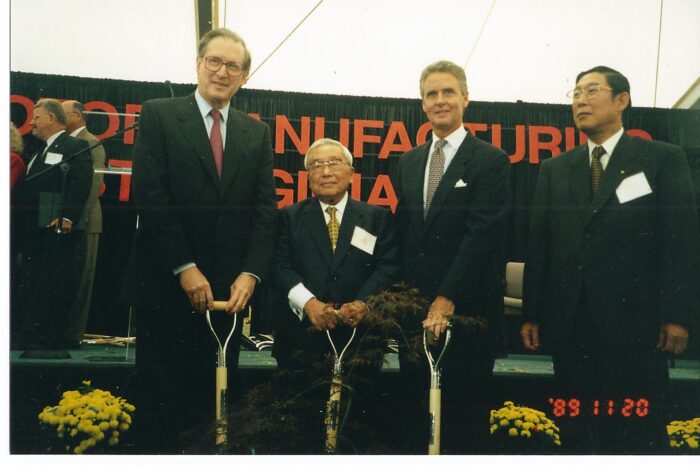
Photo credit: Business Wire/AP
Advocating for children’s health care
Rockefeller was a lead author of the Children’s Health Insurance Program (CHIP) in 1997, a federal program providing low-cost health coverage to millions of children from families with incomes too high for Medicaid.
According to the West Virginia Press Association, in 2013, Rockefeller called CHIP one of the most significant accomplishments of his political career while speaking to a group of advocates at a rally at the Schoenbaum Center in Charleston when the program was up for reauthorization.
“Quite simply, fully funding CHIP is a moral imperative,” Rockefeller said. “This program is something I deeply and truly believe in, and I am as deeply proud of CHIP as anything I have done in my nearly 50 years of public service. That’s why I will never stop fighting to ensure that West Virginia’s children receive the care they rightfully need and deserve.”
The senator said parents should not have to deny their child necessary medical care because of a lack of insurance or fear of high health care costs.
“Health care should be considered a right, not a privilege. Period,” Rockefeller said. “And nothing is more important than ensuring that children get the start they need in life. That was my goal when we decided to create CHIP in 1997. And it’s the same today, as we address a crucial debate about maintaining and strengthening this essential program.”
Alzheimer’s disease research
Rockefeller founded the Blanchette Rockefeller Neuroscience Institute in Morgantown in 1999, to honor his late mother, who died after a 10-year battle with Alzheimer’s disease.
The institute evolved into the Rockefeller Neurosciences Institute. The institute has made critical advances in studies of Alzheimer’s disease, Parkinson’s disease and traumatic brain injury.
WVPB Documentary: Jay: A Rockefeller’s Journey
West Virginia Public Broadcasting won the 2016 NETA Award for Best Documentary for Jay: A Rockefeller’s Journey a two-hour program tracing Rockefeller’s 50-year career in public service, capturing much of the political history of West Virginia, his adopted home.
As a historian says in the film, the Rockefeller name was notorious and despised for more than the first half of the 20th century, and the great-grandson of industrial titan John Davison Rockefeller devoted his professional career to rehabilitating that name.
The documentary explores Jay Rockefeller’s influences and motivation, his successes and failures, from his early childhood to his arrival in West Virginia to chairing some of the most influential committees in the United States Senate.
“A Legacy of Leadership”
After his retirement from the Senate, Rockefeller donated many of his papers and documents to the West Virginia and Regional History Center at West Virginia University and to “Jay Rockefeller: A Legacy of Leadership,” located in the Rockefeller Gallery of the Wise Library on the Morgantown campus of West Virginia University, which opened in 2016. Much of the content is also available online.
The exhibit includes memorabilia from Rockefeller’s early years in West Virginia, his election to the U.S. Senate, and some of his accomplishments during his long career as a U.S. Senator.
Also available are the Rockefeller Legacy Memos, a collection of 12 memos detailing the senator’s work in health care. healthcare reform; West Virginia’s Jobs, Economy and Industry; children, families and education; and veterans affairs.
The university also has a school called the John D. Rockefeller IV School of Policy and Politics.
Gn headline

