
Tensions flared Sunday in Philadelphia’s Rittenhouse Square as protesters clashed amid a contentious bike ride organized to boycott several Jewish-owned restaurants.
NBC10 was on scene as protesters waving Palestinian and Israeli flags stood next to each other, with several verbal confrontations breaking out between the opposing groups.
A line of Philadelphia police officers worked to keep the groups separated as tensions continued to rise even before the bike ride began.
At least one physical altercation occurred, with NBC10 seeing police pull one protester away from another. It is unclear if anyone has been arrested in connection with this incident.
However, at least one person was arrested among the crowd. The circumstances of this arrest were not immediately known.
A Philadelphia police spokesperson said three people were arrested during the event:
- A woman for assault
- A man for disorderly conduct
- 17-year-old man for assault on police
Two Philadelphia police officers were slightly injured while arresting a person.
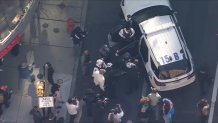
Police arrested one person Sunday amid protests in Philadelphia’s Rittenhouse Square during a bike ride organized to boycott Jewish-owned restaurants.
Meanwhile, some of the restaurants targeted by the boycott were seeing long lines of customers supporting them.
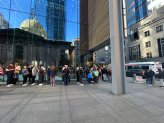
A long line of customers formed outside Mac Mart in Philadelphia on Sunday to support the restaurant, one of six businesses targeted by a controversial bicycle boycott.
Philadelphia police said about 500 people gathered in Rittenhouse for the protest. There were around 300 pro-Palestinian demonstrators, including 200 on bicycles as well as 200 pro-Israeli counter-protesters.
Officers remained in the area until approximately 3 p.m. and no damage was reported to surrounding properties.
Why did the bicycle boycott take place?
The protest was organized by Philly Bike On Your Left, a group that describes itself as an “anti-fascist, anti-Zionist social cycling collective.”
On October 31, the group announced its intention to boycott what it calls “Zionist establishments” in Rittenhouse Square, in solidarity with the Palestinian community.
Restaurants targeted by the boycott include Mac Mart, K’Far Café, Huda, Goldie, Schlesinger’s and Dizengoff.
The planned event has drawn widespread criticism, including from Philadelphia Mayor Cherelle Parker and Pennsylvania Attorney General Dave Sunday, who condemned the boycott on social media.
The Anti-Defamation League also encouraged people to show their support by dining at targeted restaurants and other Jewish-owned businesses.
“This protest is an attempt to intimidate a Jewish community that has faced generations of violence, exclusion and anti-Semitism. It is the latest in a series of incidents that hold Jewish businesses responsible for events in the Middle East,” the ADL wrote. “It’s anti-Semitic, plain and simple. But we refuse to let hatred win.”
Billboards Urge Philadelphians to ‘Boycott the Boycott’
In response to the planned race, the nonprofit JewBelong installed billboards in 14 locations across Philadelphia, urging people to support Jewish-owned businesses.
The billboards read, “crushing Jewish businesses is not a peace plan” and encouraged residents to “boycott the boycott.”
The protest also falls on the eve of the anniversary of Kristallnacht, or “Night of Broken Glass,” when Nazi-organized anti-Semitic attacks targeted Jewish communities in Germany, Austria and the Sudetenland on November 9 and 10, 1938.
A pro-Palestinian group’s planned boycott of Jewish restaurants in Philadelphia has drawn backlash and condemnation from city leaders as well as community support for affected businesses. NBC10’s Kelsey Kushner has the details.
In a statement posted to Instagram, Philly Bike On Your Left said the ride was “grossly misrepresented.”
“We strongly oppose racism and oppression in all its forms, including fascism, anti-Semitism, Islamophobia and colonialism.”
In a statement shared with NBC10 on November 8, the CEO and president of B’nai B’rith International wrote that they condemned the boycott:
“B’nai B’rith International condemns the so-called “boycott ride” in Philadelphia, in which activists rode bicycles through downtown to target Jewish-owned restaurants and businesses. Organizers called the owners “disgusting humans” and said: “These Zionist establishments must disappear.” This was not a political protest. This was a public campaign to intimidate Jews and drive them from their livelihoods because of their identity. If businesses in another community had been singled out and paraded by a group demanding they leave, people would be screaming from the rooftops, and rightly so. Why are Jews particularly acceptable targets? We’ve seen this before. On November 9, 1938, 88 years ago tomorrow, mobs smashed the windows of Jewish stores across Germany and Austria during Kristallnacht. The persecution that led to it began with boycotts and targeting of Jewish businesses. We cannot ignore the echoes. We thank Governor Josh Shapiro, Mayor Cherelle Parker and Pennsylvania Attorney General Dave Sunday for condemning this ride. U.S. Senator John Fetterman and U.S. Representative Brendan Boyle also spoke out. But the condemnation cannot fall solely on a handful of officials and the Jewish community. Where are the civic leaders, cultural institutions, and allies who quickly speak out when other communities are targeted? Silence also sends a message. B’nai B’rith stands with Philadelphia’s Jewish business owners and their employees. We urge everyone who believes everyone should be able to live and work without fear to support them and make it clear: this is unacceptable.“
The Israeli American Council (IAC) also shared a statement with NBC10 after the protest saying: “When we learned that a ride was taking place on the eve of the anniversary of Kristallnacht, we couldn’t help but think about history and say to ourselves: we won’t let this happen again. Today, we stand together and we will not let anyone threaten our community. This walk is not aimed at a government or a policy. Its stated goal is to drive Zionist-owned businesses out of town, as if being a Zionist were criminal or illegitimate. It targets six businesses whose owners are Jewish. When people publish a list of Jewish businesses and organize to run them out of a town, history teaches us what that’s like.“.
Gn usa

