
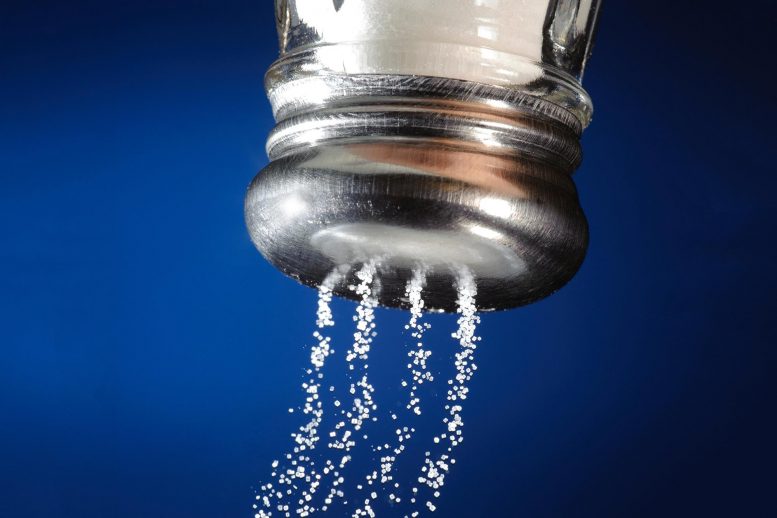
A global study of 193 countries suggests that a simple change in daily salt intake could prevent millions of deaths and cases of cardiovascular and kidney diseases each year.
Replacing regular salt with a potassium-fortified alternative could prevent nearly three million deaths worldwide each year, according to a new study covering 193 countries. Researchers estimate that global change could also prevent more than ten million new cases of cardiovascular and kidney disease per year, providing a potentially powerful way to reduce the health burden of high blood pressure.
The analysis, led by the George Institute for Global Health, looked at how different levels of salt replacement could affect the world’s 4.6 billion adults. The findings suggest that even limited changes, particularly in people already diagnosed with high blood pressure, could produce substantial health gains.
How a simple salt substitute could protect health
Potassium-fortified salt replaces some of the sodium chloride found in regular table salt with potassium chloride. It looks, tastes, and performs similar to conventional table salt, but contains less sodium and provides additional potassium, two changes that may help lower blood pressure.
“Consuming too much sodium and not enough potassium are well-established causes of high blood pressure, a major risk factor for life-threatening illnesses like stroke, heart attack and kidney disease. Switching to potassium-enriched salt addresses both of these dietary problems at the same time, with substantial health benefits,” said Bruce Neal, senior professor at the George Institute.
High blood pressure (hypertension) affects approximately 1.4 billion adults aged 30 to 79 worldwide, or about one in three people in this age group. Cardiovascular diseases (CVD) caused 19.2 million deaths in 2023, almost 50 percent more than thirty years earlier. In 2025, the World Health Organization (WHO) approved potassium-fortified salt as a way to reduce blood pressure and cardiovascular risk.
Major health benefits without a complete change
The researchers modeled several scenarios, including replacing all salt consumed at home, in restaurants and in processed foods. Replacing household table salt alone could prevent an estimated 1.85 million deaths and 6.19 million new cases of cardiovascular and chronic kidney disease each year. Replacing salt exclusively in processed and restaurant foods could prevent 1.56 million additional deaths and 5.46 million new cases of illness each year under this separate scenario.
More targeted approaches have also shown considerable potential. If 80 percent of people with diagnosed hypertension changed their household salt, the model predicted about 590,000 fewer deaths per year. Among those who receive treatment for hypertension, a comparable level of uptake could prevent approximately 480,000 deaths each year.
“While a global shift from regular salt to a potassium-fortified substitute is an ambitious goal, it is a starting point to get countries thinking about this opportunity, with much greater potential and at a much lower cost than many drug treatments,” Neal said.
Which countries could benefit the most?
The expected benefits varied considerably from country to country. In a full replacement scenario, China could avoid about 1.08 million deaths and 3.61 million new cases of cardiovascular and kidney diseases per year. India could avoid nearly 400,000 deaths and 1.53 million new cases, while the United States could avoid about 105,000 deaths and 492,000 new cases.
Achieving these reductions would require strategies tailored to the way people consume salt. In many countries, home cooking accounts for a substantial portion of sodium intake. In Europe and North America, however, processed and restaurant foods account for more than 70 percent, making cooperation between food manufacturers and restaurants essential.
“To reap the maximum benefits from switching to potassium-enriched salt, we need to see the food industry in Europe and North America, where more than 70 percent of salt intake comes from processed foods and restaurants, get involved. This would also require studying ways to increase potassium chloride production to meet demand,” Neal said.
What about the risks associated with excess potassium?
Although potassium-fortified salt can help lower blood pressure, it may pose risks for people whose kidneys cannot effectively remove excess potassium from the bloodstream. This can lead to hyperkalemia, a potentially dangerous condition that can disrupt the electrical activity of the heart. People with advanced kidney disease and those taking certain medications that increase blood potassium levels require special caution.
The study’s modeling suggests that the overall health benefits could outweigh the risks, even in people with advanced kidney disease. However, these population-level results do not mean that potassium-enriched salt is safe for every individual.
“People with severe kidney disease and those taking medications that significantly increase blood potassium levels should take precautions. The risks for this group can be managed effectively through patient education, product labeling and clinical monitoring,” said Professor Vivek Jha, a nephrologist and senior professor at the George Institute in India.
Reference: “Global Health Outcomes of Replacing Dietary Sodium Chloride with Potassium-Enriched Salt” by Liping Huang, Xiaoyue Xu, Kunihiro Matsushita, Tammy M. Brady, Lawrence J. Appel, Ewout J. Hoorn, Aletta E. Schutte, Jason HY Wu, Maoyi Tian, Leopold N. Aminde, Kathy Trieu, Bruce Neal, and Matti Marklund, November 4, 2026, Nature Health.
DOI: 10.1038/s44360-026-00216-9
Never miss a major breakthrough: join the SciTechDaily newsletter.
Follow us on Google and Google News.
Gn Health

