
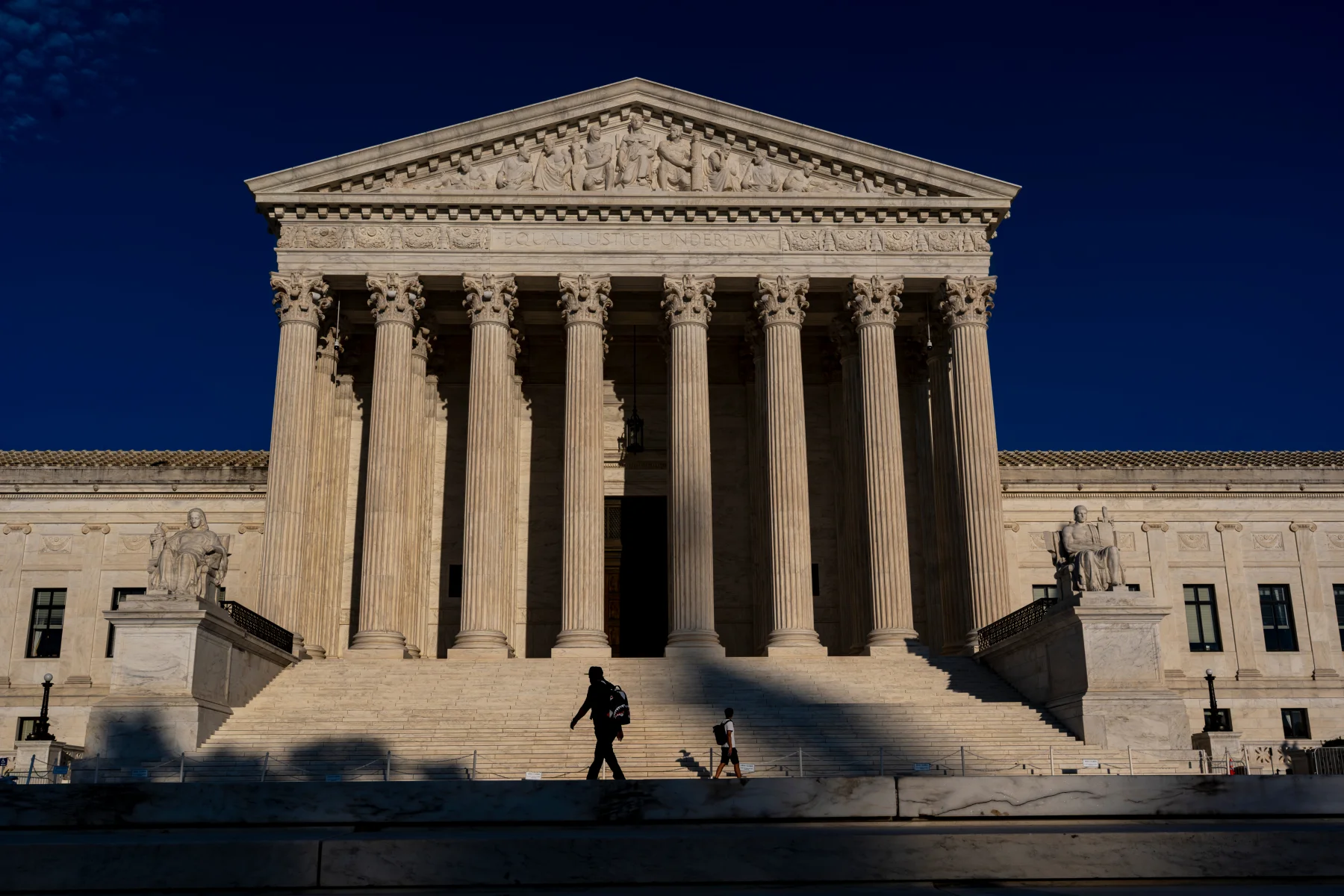
The Supreme Court meets October 1 in Washington, D.C.
J. Scott Applewhite/AP
hide caption
J. Scott Applewhite/AP
Five years ago, a gang riot broke out at a federal prison in Hawaii.
Kekai Watanabe was beaten with a makeshift weapon known as a “lock in a sock.”
When he complained of severe back pain, a nurse told him to “stop being a cry baby.”
Seven months later, doctors diagnosed Watanabe with a fractured tailbone, and he sued the nurse for violating his Eighth Amendment right against cruel and unusual punishment.

On Monday, the Supreme Court will hear his case, which could determine whether federal law enforcement officers can be held accountable when they violate constitutional rights. The claims of Watanabe, now 40, resonate far beyond prison walls – and on American streets where immigration agents have been accused of beating and running over migrants.
“What is at stake here is whether we as a country are going to hold federal law enforcement officers accountable when they violate clearly established constitutional rights,” said Steve Vladeck, a law professor at Georgetown who filed a “friend of the court” brief in the case. “I mean, it really is, I think, so brutal.”
It is already difficult to pursue these claims because the court requires people to demonstrate that the facts of their case are identical to previous ones. In federal prisons, the landmark case dates back to 1980. The prisoner involved in this trial died of untreated asthma. The nurse’s lawyers say Watanabe, the Hawaii inmate, survived the 2021 gang attack, so his case is different enough that it should be thrown out.

Mary Hampton Mason worked at the Justice Department for nearly 35 years, in an office that evaluated these types of legal claims. Mason said rogue officers are rare and the problems are usually systemic.
“It’s a result of the agency culture, it’s a result of training, it’s a result of all sorts of things, but these failures are really institutional,” Mason said.
The Supreme Court created the right to sue federal agents for wrongdoing in a 1971 case known as Bivens. But Mason said that precedent has been rendered meaningless for years and the court should ultimately overturn it because it gives plaintiffs false hope.
“In fact, over the last 20 years, I have only been aware of one Bivens case that resulted in a judgment for the plaintiffs that…was not overturned on appeal, and that represents thousands and thousands and thousands of cases filed,” she said.

But the prisoner’s supporters say that figure doesn’t take into account regulations or how such prosecutions can deter other bad behavior. If individual federal officers and agents can find themselves in financial trouble, the argument goes, they might think twice before breaking the law.
“That’s why damages are so important,” said Gregory Cui, an attorney at the MacArthur Justice Center, a civil rights legal organization. “Because it’s a way to try to make things right, to give a person the means to pay for medical care or rebuild their life.”
In a “friend of the court” brief, Cui reported that the grievance process for people incarcerated in federal prisons almost never works for inmates, who succeed only 1 percent of the time in changing things like access to medical care or better conditions behind bars.

Cui and other legal experts said the Supreme Court agreed to hear the case at a time when abuses by federal immigration agents and others are in the spotlight. According to them, this is not the time for the court to eliminate one of the few avenues of accountability for these erring agents.
“A world without Bivens “We live in a world in which federal law enforcement officers have absolute immunity, in which no matter how serious their conduct, no one can hold them accountable,” said Vladeck, of the Georgetown Law Center. “As alarming as this may have been five years ago, it should be particularly terrifying today, and it should be a prospect that even this Supreme Court is reluctant to endorse.” »
Both sides agree that Congress has the power to step in and give people whose rights have been violated by federal agents a clear path to pursue justice. But so far, lawmakers have not proposed legislation to hold these people accountable.
Gn headline

