It all started on November 3, 2026, when millions of Paraguayans trying to access the Ueno banking app found they could no longer get their money back. Within days, the financial situation escalated into a political crisis, during which the country’s president was ousted, placed under house arrest and charged with several corruption-related crimes.
The political and financial crisis reveals a central contradiction in Paraguay’s recent economic development. Ueno, a bank renowned for expanding financial access to ordinary Paraguayans, grew through unusually close relationships with political elites and public institutions. And although the Ueno crisis was a shock, there were clear warning signs.
As scholars with expertise in various aspects of Paraguay’s contemporary political, economic, and environmental development, we believe this collapse raises troubling questions about who benefits from financial modernization, who controls it, and who bears the risks if it fails. The political relationships through which financial institutions develop, regulators exercise authority, and public resources are entrusted to private companies are crucial national concerns, particularly in a country that has held itself up internationally as a model of economic stability.
A bank that grew faster than scrutiny
Founded as a digital lender in 2021, Ueno attracted customers with mobile banking and cashback offerings. Its expansion has brought useful services to people underserved by conventional banks, including rural customers. Ueno also expanded the credit card market to low-income customers, an unprecedented move compared to previously restricted banking practices.
As Ueno grew, Paraguay attracted more and more investors attracted by its low taxes, economic stability, and business-friendly policies. Touted by some as the “Dubai of South America,” the country also became a magnet for conservative influencers, particularly from Brazil, who contrasted Paraguay’s economic model with the alleged mismanagement of left-wing governments elsewhere in the region. Indeed, under the presidency of Santiago Peña, Paraguay has been one of the most enthusiastic allies of the Trump administration and its expansive regional vision in Latin America.
But beyond his financial stability, Ueno found himself on the precipice of a much deeper problem.
AP Photo/Jorge Saenz
The central bank finally acted after accounting adjustments left Ueno’s solvency ratio below half the legal minimum. But problems had arisen earlier. This included a supervisory report released by banking regulators in June 2026 that outlined approximately $146 million in loans to three companies linked to Grupo Vázquez, Ueno’s majority shareholder. Some companies were transferred to group employees; supervisors questioned the guarantee and final use of the funds.
The failure to heed these warning signs raises a related question: Why didn’t regulators get a better handle on the situation and be better able to contain the exposure?
Regardless, Ueno’s problems were dramatically revealed on November 2, when the central bank placed Ueno in resolution, a process similar to bankruptcy but managed directly by Paraguay’s central bank. The lender, which says it has nearly 3 million customers – about half the country’s population – has halted its transactions.
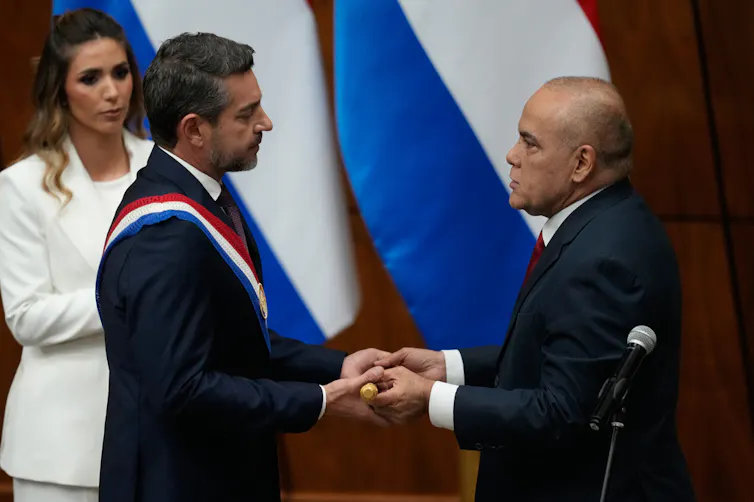
The crisis quickly trapped the ruling party. Peña, an economist by training, elected president in 2023 and with close ties to the bank, resigned on November 5. The Senate then unanimously voted to impeach him, thereby stripping Peña of his parliamentary immunity. He was quickly placed under house arrest, accused of corruption and replaced by his vice-president Pedro Alliana, who was sworn in until 2028.
At the same time, the crisis has given rise to numerous protests, including in front of Congress, with citizens accusing Peña and the ruling Colorado Party of “stealing” their savings.
When the regulator knows the regulations
Part of the history of Ueno is the story of the closeness between Paraguay’s political and financial elites.
Carlos Carvallo chaired Ueno’s predecessor bank before Peña named him president of Paraguay’s central bank in 2023. Carvallo resigned on November 3 and has since been charged with the same corruption crimes as Peña. For its part, Paraguay’s central bank says Carvallo recused himself from any decision by Ueno.
Yet the potential conflicts of interest ran much deeper. Peña previously headed Banco Basa, linked to Colorado party leader and former president Horacio Cartes, who retains considerable influence and was instrumental in Peña’s fall from power. Finance Minister Carlos Fernández Valdovinos also served on Basa’s board of directors. Local journalists documented these revolving-door relationships early in Peña’s term.
Peña reportedly held a 1.58% stake in Ueno Holding, which shared its largest shareholder, Grupo Vázquez, with Ueno Bank. His brother Francisco held shares in the Luxembourg company U Holdings, an indirect shareholder of the bank. Another shareholder was Juan Carlos López Moreira, Cartes’ former chief of staff. Both brothers were released in 2025.
Peña has denied any wrongdoing, while prosecutors examine allegations about his former business interests and financial oversight of his administration.
The inclusion of significant reserves of public funds made these links particularly important. Ueno held approximately $850 million in public funds, including $355 million from the country’s social security system, IPS, including health and pension funds. This represented approximately 9% of IPS’ investment portfolio.
Under the leadership of Jorge Brítez, appointed president by Peña, IPS relaxed eligibility requirements for bank deposits in 2023 and removed a capital-based exposure limit in 2024. During the same period, its deposits in Ueno increased sharply. Grupo Vázquez’s tech company ITTI won at least $2.3 million in state contracts after Peña took office, up from $675,000. ITTI attributed the increase to the company’s expansion and denied the existence of a conflict of interest.
Together, these regulatory connections and changes raise important questions about regulatory capture and other potential conflicts of interest.
What the growth figures forget
Paraguay’s economic gains are real. In August, the International Monetary Fund forecast growth of 4.4% in 2026, up from 6.6% in 2025. Moody’s granted the country investment grade debt status in 2024, and S&P followed in 2025. Hydroelectric power exports, agriculture and new infrastructure continue to support the economy.

AP Photo/Jorge Saenz
Washington is also associating Paraguay more firmly with its regional economic strategy. On October 23, the country became the 26th signatory of the Pax Silica Declaration, an initiative involving critical minerals, hydropower and advanced IT infrastructure. Although the announcement does not specify financial commitments, it shows how Paraguay’s resources and perceived political predictability are positioned as strategic assets.
But growth figures and credit ratings say little about who determines financial oversight or who bears the costs of bank failures. Paraguay’s legacy of political patronage makes it necessary to examine political and commercial ties as well as changes to rules for investing public funds.
The social report and the Colorado question
Paraguay has been here before. Between 1995 and 1998, 13 banks and 35 financial companies closed their doors, with direct costs estimated by the IMF at between 10 and 13% of the country’s GDP. This preceded a smaller banking crisis in the early 2000s. Both events exposed weak supervision and connected lending.
Paraguay’s deposit guarantee, which covers balances of up to about $38,000, is intended to limit depositors’ losses, and Paraguay’s Central Bank insists the failure is isolated in the latest case. However, account transfers have already put a strain on the system, causing outages at several banking institutions.
Yet for most Paraguayans, the crisis was not experienced through technical, financial or macroeconomic indicators, but at the brutal level of seeing from their phone that they could not access their money. Salaries, pensions and savings were frozen simultaneously. Young Ueno employees burned their company cards in front of the Ministry of Labor, demanding payment of their unpaid salaries.
Riot police used pepper spray and rubber bullets against filers protesting in front of Congress. For small businesses that banked and paid their staff through Ueno, the real economy came to a halt.
This widespread anger calls into question the ruling party’s claims about the economic vision it cites as driving future growth. Whether this leads to institutional change or a shakeup within the Colorado party remains an open question. The test is how Paraguayan lawmakers and regulators will move forward and whether they separate banking supervision and public deposits from partisan and commercial networks.
Either way, the myth of the “Dubai of South America” is seriously challenged. Although the protests have been remarkable, the Colorado Party has so far managed to resolve its own internal crisis by quickly sacrificing key political elites, including the president.
Marco Castillo Ph.D., a recent Paraguayan sociologist and former research director at the Center for Latin American, Latin-Caribbean Studies at the CUNY Graduate Center, and Sheyla Rios Galeano, a Ph.D. Human Dimensions of Natural Resources student, Colorado State University, contributed to this article.
Gn world