
EDITOR’S NOTE: This story has been updated with a statement from the CMA (see bottom).
It was December 2012, and a GAC History The episode featuring Blake Shelton surprised the then-country superstar by saying: “Nobody wants to listen to their grandfather’s music. And I don’t care how many of these old bastards in Nashville say, ‘God, that’s not country!’ Well that’s because you don’t buy records anymore, dummy. The kids do…”
On January 23, 2013, when Saving Country Music reposted and refuted these comments, it ignited a firestorm of epic proportions. Country legend Ray Price took the lead in condemning Blake’s comments. Dozens of other people joined us. Pretty soon, everywhere you went in country music, it was all people wanted to talk about. Dale Watson used the energy and anger over the comments to launch his Ameripolitan Awards as an alternative to the CMAs. Even today, the ripples of that moment are felt throughout country music.
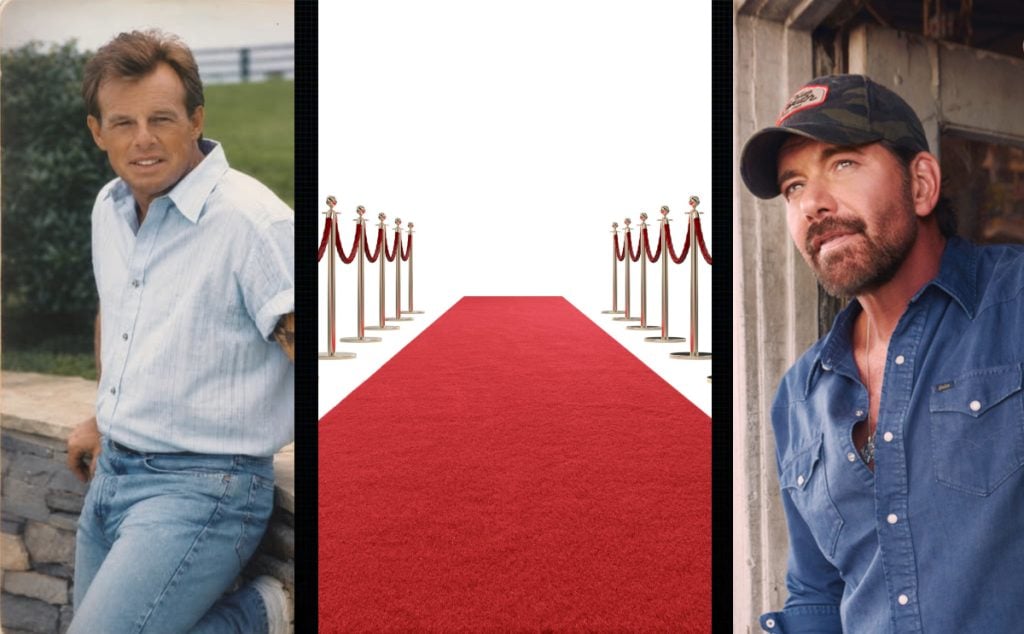
It wasn’t just about the specific comments Blake Shelton made. This is how they touched a nerve and spoke to a very specific feeling that many true country fans knew existed, but remained unspoken. Blake Shelton gave him a voice and made him real. This is the same nerve that was touched and the same check that was made when Sammy Kershaw publicly stated that he was denied access to the red carpet for the 2026 CMAs which will take place on November 18.
Sammy Kershaw was still unlikely to be alone. There are probably dozens or hundreds of country legends, members of the Grand Ole Opry, not to mention the producers, songwriters, and supporting players who contribute so significantly to the music whose requests have also been denied, or who would never even make those requests because they know they don’t have a chance. Meanwhile, TikTok influencers, actors, online celebrities, athletes, and who knows others are invited, much less endorsed.
Subsequently, many artists rallied around Sammy Kershaw. And now Rodney Adkins has said he suffered the same fate when he asked to walk the red carpet as well.
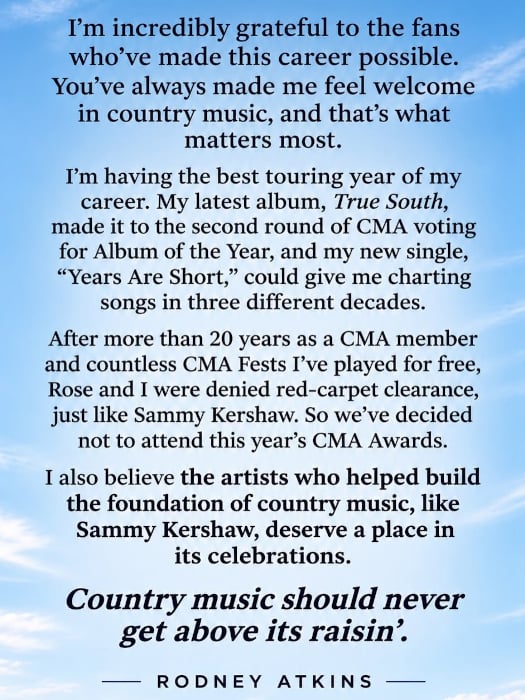
Now, viral memes are circulating from fans declaring that they will boycott the presentation. There is a call to hold an alternative awards ceremony or other type of presentation for Sammy Kershaw, Rodney Atkins and others to attend and possibly perform.
We have to imagine that at some point, the CMAs will address this situation in a meaningful way. This is by far the biggest country rock music scandal of the last year, if not the last five years. Yet even if corrective measures are taken, the curse has already been cast. So much ill will has been able to fester towards the CMAs. This energy will be invested in alternatives and opposition to organization and rewards. Make no mistake, regardless of how this matter resolves (or doesn’t), the CMA’s decision not to resolve it quickly was a major mistake.
Even country talk and syndicated DJ Bobby Bones said it Saturday (11-7), calling it “PR disaster for CMAs… It’s going to get worse until someone fixes this. » But Sunday came, and still no resolution, with dozens of articles and thousands of social media posts, memes, viral videos, and more, all propelling the situation to the top of the country music zeitgeist and beyond. Today, Monday morning came, and still nothing.
In January, Sarah Trahern, CEO of the Country Music Association, announced that she would retire at the end of 2026. While there are likely more people cheering her departure now than before, the truth is that her tenure at the CMA was rather unremarkable. However, what she has continued to preside over is a level of exclusivity at both the CMAs and the Country Music Hall of Fame induction ceremony (also the CMA’s domain) where only a select few can participate in the process.
Brittany Schaffer, former dean of Belmont University’s Mike Curb College of Entertainment & Music Business, has been named to replace Sarah Trahern as CEO of CMA. She started her professional training on September 1st. Schaffer will officially take office on January 1, 2027. It is in the midst of this change in leadership that the red carpet fiasco is unfolding. This perhaps partly explains the slow response from the CMA.
People can dream big of destroying the RMR or launching an alternative or rival. The Academy of Country Music and the ACM Awards were originally launched precisely after West Coast country artists felt excluded from the process in Nashville. This initial requirement to feature primarily West Coast artists was abandoned a few years later. But even though the ACM Awards somewhat rival the CMAs, the CMA remains the overarching organization that continues to govern country music as much as any organization.
The Americana Music Association was founded in 1999, largely due to the neglect of aging and more independent artists in the industry. Ironically, the AMA now attracts a lot of criticism every year for not being inclusive enough.
People who really know the history of country music will also remember ACE. In 1974, after Olivia Newton-John won a CMA award, a host of more traditional country artists came together at George Jones and Tammy Wynette and formed their own organization called “ACE,” or Association of Country Entertainers. Others involved were Porter Wagoner, Jim Ed Brown, Dottie West, Brenda Lee, Faron Young, Conway Twitty, Hank Snow, Mel Tillis and Dolly Parton. The organization did not last very long.
You’ve seen some say that the same sentiment behind Sammy Kershaw didn’t or wouldn’t exist in previous generations. But it’s the reason Waylon Jennings wrote “Are You Sure Hank Done It This Way” and had a No. 1 hit in 1975. It’s the reason George Strait and Alan Jackson recorded “Murder On Music Row” and won CMA Vocal Event of the Year in 2000 and Song of the Year in 2001. It’s the reason why, in 1999, George Jones was told scheduled to sing a shortened version of his song “Choices” at the CMA Awards, Alan Jackson stopped his own song and launched into “Choices” in protest.
Ironically, one of the special features announced by the CMA for the 2026 awards ceremony is a “tribute to the ’90s,” which makes Sammy Kershaw’s snobbery even more ironic and illustrates how the organization wants to capitalize on the current popularity of the era, but doesn’t want to do the actual work of honoring many of the artists who made the era so popular and important. Most of the planned tributes would be contemporary stars performing hits from the 90s.
Perhaps the CMAs’ homage to the ’90s will now be expanded to include actual ’90s country stars, including Sammy Kershaw. But even if corrective action were taken now, it took a massive outcry to make it happen, the event could still face a serious boycott from fans.
Ensuring that aging artists, independent artists, mainstream artists, and emerging artists have equal opportunities is the only reason a media outlet like Saving Country Music was founded. It was following quotes from Blake’s Shelton “Old Farts and Jackasses” that the medium became part of a larger national conversation. It was also around this time that we saw the rise of Sturgill Simpson, Cody Jinks and eventually Chris Stapleton as Bro-Country, who began to anger the public and listeners were looking for something more.
What effects will the massive outcry over Sammy Kershaw’s denial have on the music itself? Only time will tell. This comes at a time when classic twang and country sounds are already enjoying a resurgence, including among the general public, and especially among younger listeners. It’s not about “old bastards” anymore, as Blake Shelton once said. This also comes at a time when music from back catalogs is more popular than current music being released today. Listeners, young and old, prefer to hear music from the past rather than today.
But instead of just channeling all the energy created by the Sammy Kershaw situation into hatred against the CMAs, artists and active grassroots fans should make sure they also use this moment to pool resources, make important connections, find solutions to the issues that plague aging and independent artists, including eliminating the built-in bias against aging artists at places like the CMA.
The red carpet is a silly tradition based on prestige and fashion that, under conventional circumstances, probably isn’t even worth discussing. But in this case, it revealed a deeper bias toward certain artists that many informed fans know have always been there and never left. The next question should be: “What do we do about it?” » Should we just clench our little fists, leverage them to gain traction or visibility on social media, or do the hard work of deconstructing the systems and attitudes that have kept country legends on the back burner and out to pasture for too long?
Since the genre’s inception over 100 years ago, country music has always been about honoring the past and paying it forward. The moment that ceases to be a priority within the genre, country music itself as we know it ceases to exist.
– – – – – – – – – –
UPDATE (12:40 p.m. CST): Finally, on Monday at 12:25 p.m. Central Time (11-9 a.m.), the CMA Awards released a statement somewhat addressing the situation.
In recent days, several artists and their fans have spoken out about the red carpet guidelines for this year’s CMA Awards. Like any major televised event, the red carpet has criteria that exist to help manage limited space and safety…

