
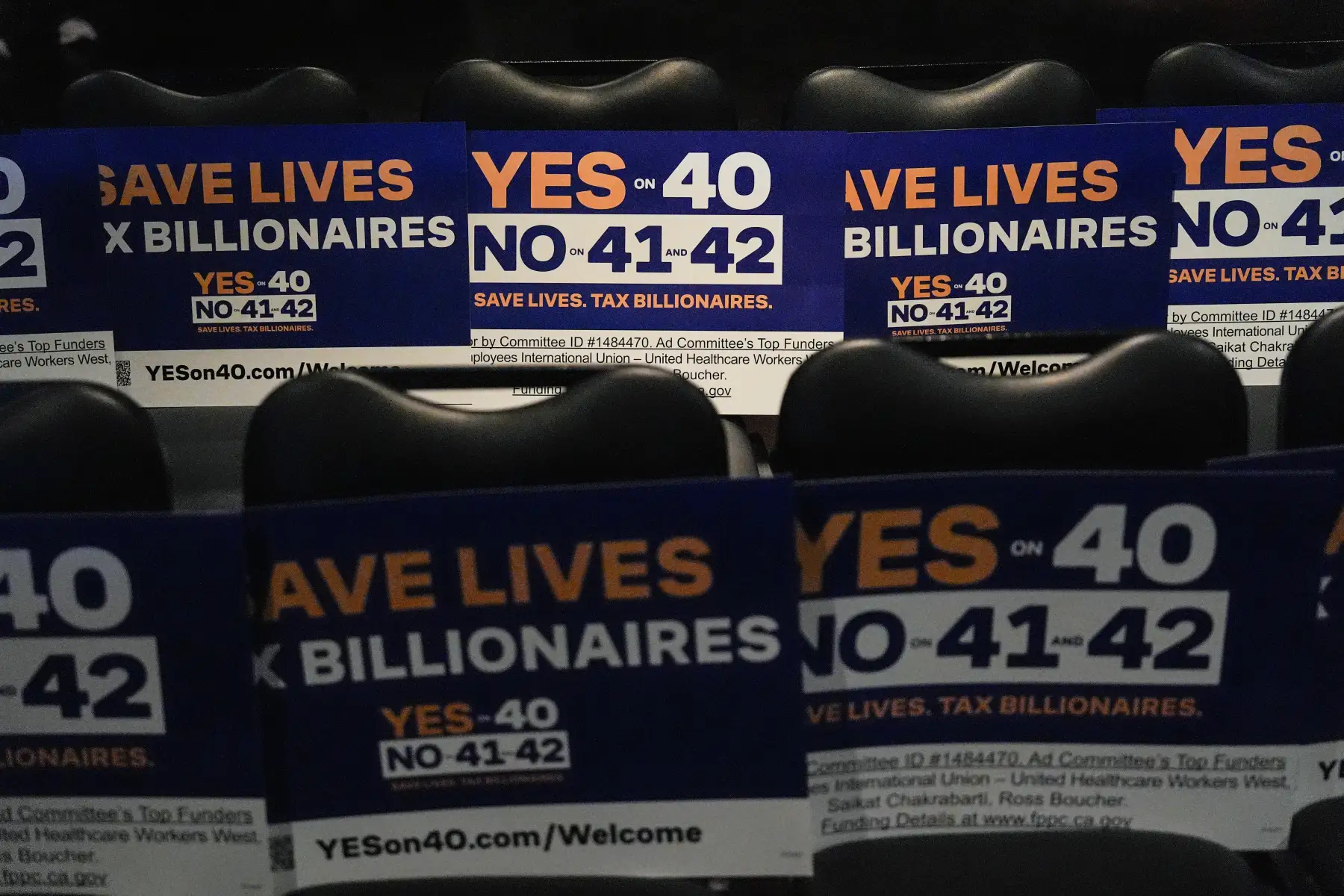
California voters rejected Proposition 40, the billionaire tax, which had divided Democrats and opponents, saying it would drive the wealthy out of the state.
Jae C. Hong/AP
hide caption
Jae C. Hong/AP
Midterm coverage: Live results | Stories from across the country
Stay connected: NPR Politics Podcast | NPR Politics Newsletter | NPR app
California voters rejected a proposal to impose a one-time 5% tax on most of their wealth on billionaires, according to an Associated Press race call.
Supporters have said the tax could raise $100 billion for health care. Led by a union that represents health care workers, SEIU-UHW, supporters of the tax said the Republican-controlled Congress had cut health care programs to give tax breaks to the wealthy, and so it was time for California’s wealthy to fill the void. The state is home to more than 200 billionaires, according to estimates, with some putting the number in the hundreds.
Opponents argued that the proposal, known as Prop 40, would only drive the wealthy out of California, costing the state revenue and harming its economy.
But the measure has divided Democrats in a state where they far outnumber Republicans.
The state Democratic Party favored Proposition 40, as did Rep. Ro Khanna, D-Calif., and Sen. Bernie Sanders, I-Vt., who traveled to the state to campaign for it. But Democratic Gov. Gavin Newsom opposed the tax, saying it would be better to have a national tax on the wealthy. Democratic gubernatorial candidate Xavier Becerra also opposed it.
A prominent teachers union also opposed the proposal, which would have set aside only a small portion of the resulting revenue for schools. And Google co-founder Sergey Brin led other wealthy Californians in a campaign spending spree against the measure. At least five times more money was spent opposing the measure than supporting it.
Brin also led a campaign that put two other proposals on the ballot aimed at preventing the billionaires tax from going into effect, had it been approved by voters.
Gn headline

