
General Atomics says it could shrink its Vektrex howitzer-launched glide munitions to a size small enough that several of them could be stored in the nose of a missile. The company has already proposed a more precise concept involving an AIM-174B air-to-air missile transformed into a strike weapon carrying seven Vektrex-derived submunitions. Being able to load existing and future air and ground missiles with multiple glide submunitions could open new operational possibilities and create additional challenges for defenders.
Naval News was the first to report on the submunition-laden AIM-174B concept after seeing a rendering, below, on display at the General Atomics booth at the Euronaval 2026 show in Paris, France, last week. General Atomics Electromagnetic Systems (GA-EMS) has now provided additional information directly to TWZ.

“We are exploring a concept for deploying Vektrex-derived maneuver submunitions from air- and ground-launched missiles to meet emerging long-range precision fire requirements,” Mike Rucker, GA-EMS vice president of weapons programs, told us in a statement. “Our investments in advanced weapons, precision machining, automation and assembly provide a manufacturing base to support production as designs qualify and customers engage.”
To take a step back, General Atomics first unveiled the Vektrex in 2023, at which time it was called the Long Range Maneuvering Projectile (LRMP). It is a non-powered, precision-guided munition with retractable wings that deploy after launch. Development so far, carried out with support from the US Army and US Navy, has initially focused on a version of the Vektrex that can be fired from standard 155mm howitzers. A concept configuration that could be launched via 5-inch naval guns was also presented.

Vektrex – The Next King of Battle
General Atomics has previously described Vektrex as having “advanced redundant guidance systems” that allow it to hit static or moving targets. The navigation system allows several types of approaches to the target area. In the terminal phase, it can execute a steep dive on a fixed set of coordinates or follow a differently shaped flight path to that impact point, if desired. It can also switch to an onboard seeker to find moving targets. Circling vectors and maneuvers in the later stages of flight can also improve survivability.
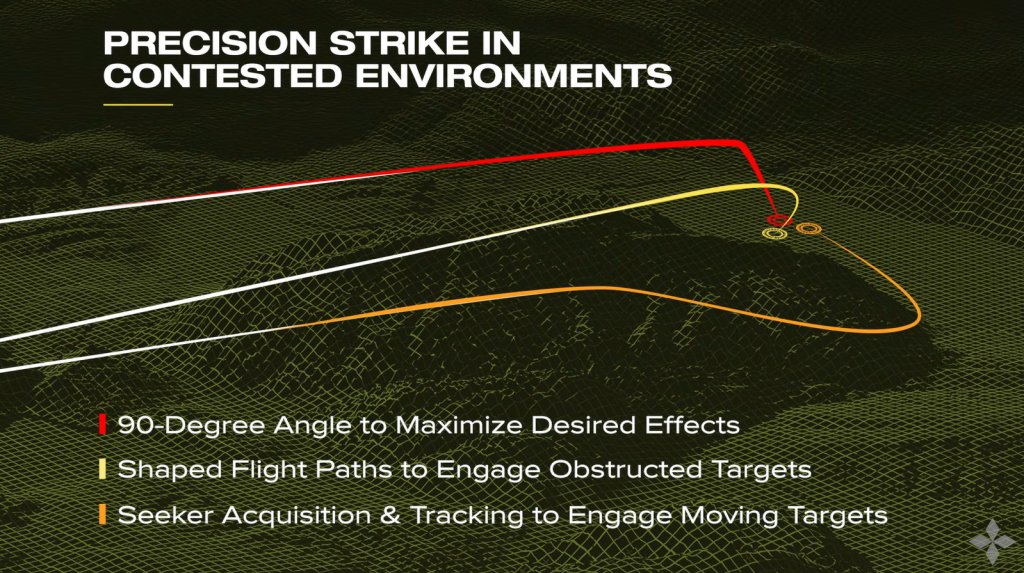
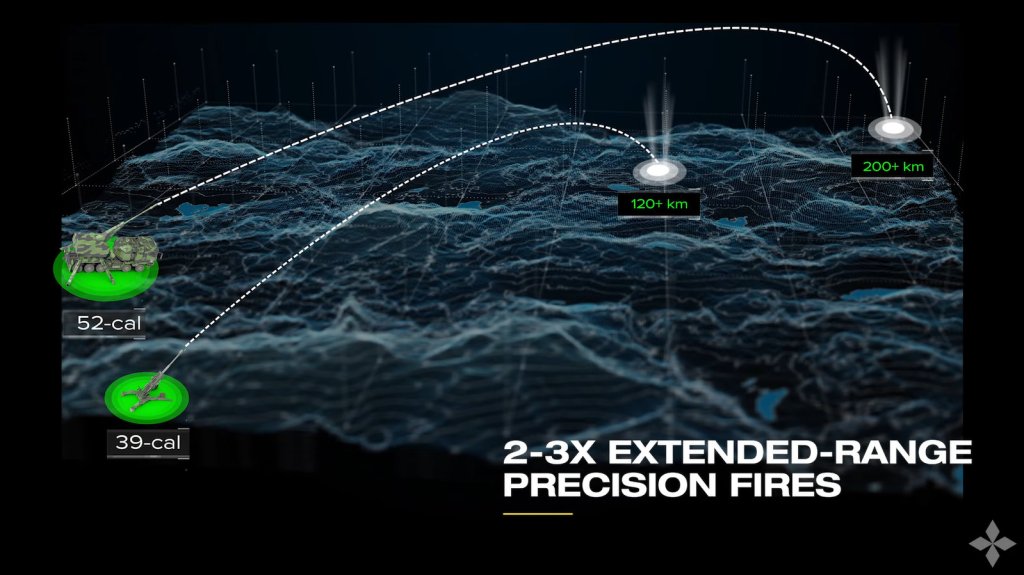
“The underlying artillery application provides the technical starting point (for the concept of submubition),” Rucker of General Atomics told us. “The deployable wings enable aerodynamic glide that multiplies the Vektrex’s range two to three times compared to conventional shells. Its capabilities include resilient navigation in degraded or GPS-denied environments.”
General Atomics previously predicted that the maximum range of a Vektrex round fired from a 155mm howitzer equipped with a 39-caliber gun would be greater than 74.5 miles (120 kilometers). The munition’s range extends further, to over 124 miles (200), when launched from a longer 155mm 52-caliber howitzer. For comparison, the maximum range of existing US Army 155mm 39-caliber howitzers is typically set at around 19 miles when firing non-rocket-guided shells and 25 miles when using of GPS-assisted M982 Excalibur precision-guided shells.
“The missile-carried submunition concept envisions a larger missile carrying and releasing multiple maneuvering projectiles derived from the Vektrex,” according to Rucker. “The concept expands potential delivery options for maneuvering precision payloads, giving potential customers a concrete configuration to evaluate against their requirements for range, payload, platform compatibility and affordability. These requirements would guide how we advance the concept.”
“For artillery users, the modernization opportunity is to expand capabilities while relying on existing launchers and supporting infrastructure. The transported missile concept explores a different application of this technology,” he added. “While much of the core technology is applicable, this configuration would require additional engineering and validation.”
As noted, General Atomics has already demonstrated a potential pair in the form of the AIM-174B loaded with seven submunitions. The US Navy officially unveiled the AIM-174B, also known as Gunslinger, in 2024. It is an air-launched version of the surface-launched Standard Missile-6 (SM-6). The SM-6 is a versatile weapon capable of engaging a variety of aerial targets, including ballistic missiles and even some hypersonic threats in the terminal stages of their flight. It can also be used in surface-to-surface mode.

The Navy currently describes the AIM-174B as a simple air-to-air missile. However, TWZ has already highlighted the Gunslinger’s potential to be used in air-to-ground mode, particularly given its lineage from the SM-6. A version loaded with hovering submunitions could open up new options for engaging multiple targets over a wider area, and at extended ranges, simply by launching a single missile.
The range of this particular pair could be particularly impressive given the surface-launched SM-6’s claimed range of well over 200 miles. Unlike the SM-6, which uses a rocket booster for initial launch, the AIM-174 benefits from the altitude and speed of the aircraft firing it. Although unconfirmed, the Gunslinger’s maximum range alone can reasonably be estimated at hundreds of kilometers. Vektrex-derived submunitions could easily add tens of kilometers of additional range, at least from their drop point.
A version of the AIM-174B in this configuration would allow striking targets deeper inside hostile territory while also helping to keep launch platforms away from enemy air defenses. A single missile could also target multiple ships within a surface action group hundreds of miles away. In all scenarios, this would also increase the total number of targets a single aircraft could attack in a single sortie.
General Atomics’ full rendering showing the submunition-laden Gunslinger also shows it being launched from an F/A-18E/F Super Hornet carrying another of these missiles. As such, the aircraft’s equipment would include 14 glide submunitions spread across just two stations. A Super Hornet could carry up to four of these missiles, for a total of 28 submunitions. In this case, the fighter is also shown carrying two Bullseye cruise missiles, two AIM-120 advanced medium-range air-to-air missiles, and two AIM-9X Sidewinder air-to-air missiles. Bullseye is a cooperative development between General Atomics and Israeli defense contractor Rafael.

This is also just one potential combination. Vektrex-derived submunitions capable of being dropped from an AIM-174B could also be loaded into surface-launched SM-6s. Today, within the US military itself, there are multiple options for firing SM-6s from ships, as well as from land-based launchers.
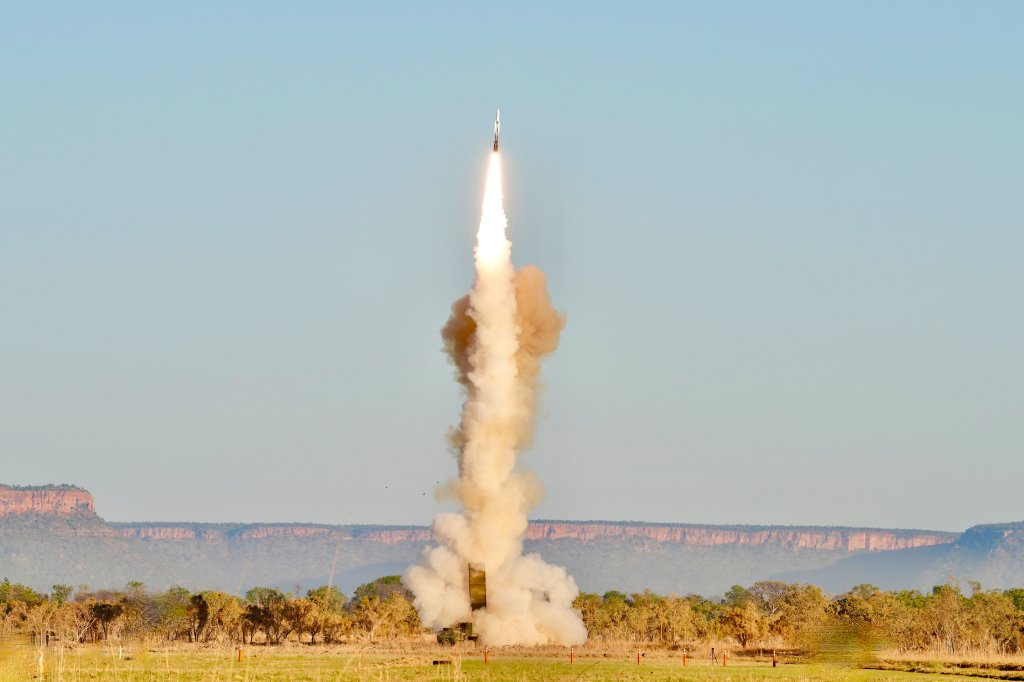
Based on the AIM-174B concept that has now been demonstrated, there are certainly other suitably sized missiles available today that could carry varying numbers of Vektrex-derived submunitions. In particular, the US military is already considering a future version of its short-range Precision Strike Missile (PrSM) ballistic missile, loaded with “enhanced” payloads, which could include submunitions and/or precision-guided drones.

Depending on the cost of submunitions, General Atomics’ Vektrex-based submunition concept could also offer greater magazine depth and supply chain benefits. The Vektrex, launched by a 155mm howitzer, is already designed with affordability and producibility in mind.
“Our goal is to develop capabilities that help U.S., allied, and partner forces expand their precision fires, maintain effectiveness when navigation is disrupted, and obtain munitions in the quantities they need,” GA-EMS’ Rucker told us. “Vektrex is one of the ways we are meeting these needs by improving the level of ammunition. »
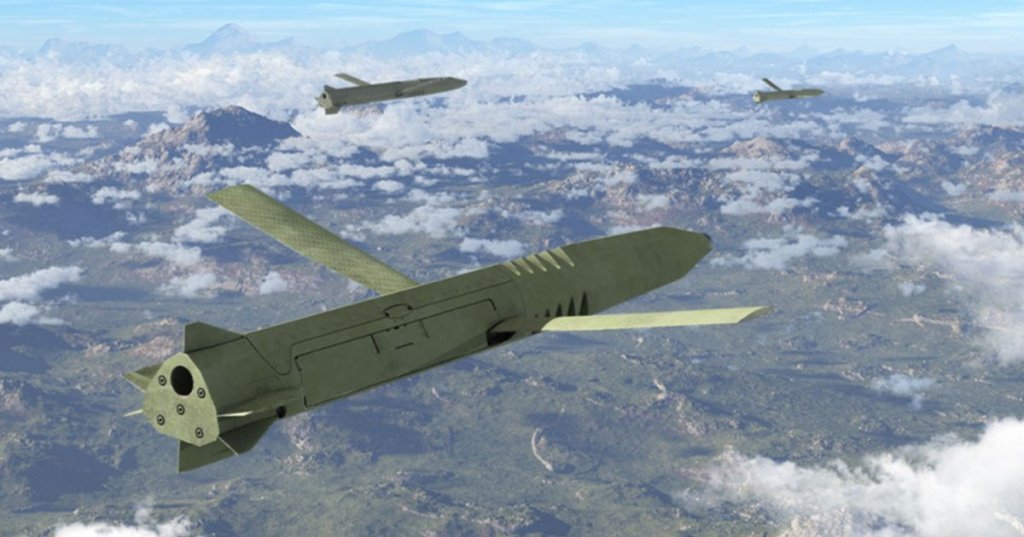
It is also worth noting here that in general, safely dropping submunitions from any missile, particularly one traveling at very high speeds, can present technical challenges. Payloads are subjected to physical and thermal stresses during the process, which seekers and other internal systems must also withstand. The basic design of the Vektrex has the advantage of being designed from the start to be fired from a howitzer, which imposes its own constraints on the projectile. A missile with a Vektrex-derived payload could also perform maneuvers to release its energy before launch.
That being said, General Atomics emphasized that the idea of Vektrex-derived submunitions loaded into AIM-174Bs or any other missiles is still in the conceptual stage.
“We are studying the concept of aerial submunitions internally, and we currently do not have any sponsoring customers,” Rucker of GA-EMS told us. “Our near-term goal is to advance Vektrex’s 155mm application toward customer supply, while evaluating additional applications against potential customers’ operational requirements.”
“This development effort is supported by established manufacturing investments,” he added. “As we announced in June, our operations in Mississippi include automated precision machining cells suitable for Vektrex components, as well as robotics, assembly and systems integration capabilities supporting advanced weapons programs.”
At the same time, General Atomics is clearly already looking toward the future of the Vektrex, which could go well beyond the primary cannon-launched variant.
Contact the author: joe@twz.com
Gn world

