
Just in case you need it, here’s another reason why you should avoid putting your nose or mouth near a bottle of glue, thanks to a recent case study.
Belgian doctors have detailed a man in his 40s who developed a strange lung lesion after accidentally inhaling superglue. Fortunately, the lesion was not cancerous as originally feared and did not appear to have caused any damage, but it remained stuck in his lungs for at least nine years.
“I was relieved when I was informed that the lesion was not malignant,” the man said in a patient’s perspective accompanying the article published this month in BMJ Case Reports.
A delicate but resolved situation
According to the report, the man initially went to the emergency room with severe abdominal pain.
He underwent a CT scan which revealed kidney stones. Imaging also revealed the presence of a nodule in his lungs, leading to additional testing. Although the man had no history of smoking, doctors were initially concerned that he might have lung cancer. However, upon further evaluation, the lesion was considered benign.
It turned out the man was suffering from a pneumatocele, a thin-walled cyst-like cavity filled with gas. Pneumatoceles mainly occur in infants, making this case already unusual. Even stranger, they tend to form in response to lung infections or injuries, neither of which humans have suffered recently. A few weeks before the emergency room visit, however, he remembers accidentally inhaling superglue.
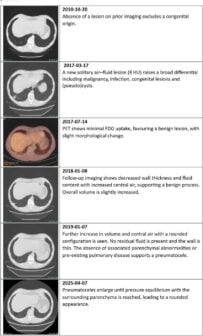
Given the lack of any other clear explanation, it is likely that the man’s injury was caused by the glue reaching his airway, known as pulmonary aspiration. Without a biopsy of lung tissue, it is not possible to definitively rule out other possibilities, the doctors wrote. Aspiration of food or other foreign substances into the lungs can sometimes cause serious problems, but the man seemed fine otherwise. However, they decided to keep an eye on the situation by regularly carrying out imaging tests.
Pneumatoceles usually shrink and disappear on their own. In this case, the man’s injury persisted for another nine years. Yet imaging also showed it remained harmless, confirming doctors’ diagnosis.
Although pneumatoceles are rare in adults, the authors hope their report shows that glue aspiration may be a potential cause. And they emphasize that the disease can be managed conservatively with monitoring. That said, personally, I’ll keep my mouth shut the next time I use superglue for a craft or home repair project.
Gn Health

