
The liminal space between sleep and wakefulness might be where the human brain conjures up strangeness.
It is there, in a state that is somehow both or neither, that the sleeping brain can extend its tendrils into consciousness, or the waking mind jostles uncomfortably at the edges of sleep.
Such overlaps, researchers have discovered, may be behind some of the strangest experiences reported by humans, from the terrors of sleep paralysis to the apparent ability to remove one’s mind from the body and wander around without it.
And, in turn, this might teach us something about the very nature of how we live in our bodies.
Not everything we experience is easy to explain. We understand itching, hunger and jealousy, for example; but some people report sensations or experiences that don’t match what we know the body is capable of.
Some people, for example, report sensations of floating or flying; others report intense terror and monstrous presences; while others still report the strange sensation of leaving their own body to wander physical or spiritual spaces.
Scientists refer to strange distortions in body perception as unusual bodily experiences, or UBEs.
They can occur during sleep paralysis, lucid dreams, and even when a person is awake.
And no one really knows why this happens.
But because these phenomena so often seem to occur at the border between sleep and wakefulness, neuroscientist Teresa Campillo-Ferrer of Radboud University in the Netherlands and her colleagues devised a clever plan to gather more information.
They recruited 35 people who had some experience with stranger stretches of consciousness through lucid dreaming or meditation, and recorded their brain activity as they ventured into the hazy boundaries between sleep and wakefulness – during meditation, while falling asleep, and even while dreaming.
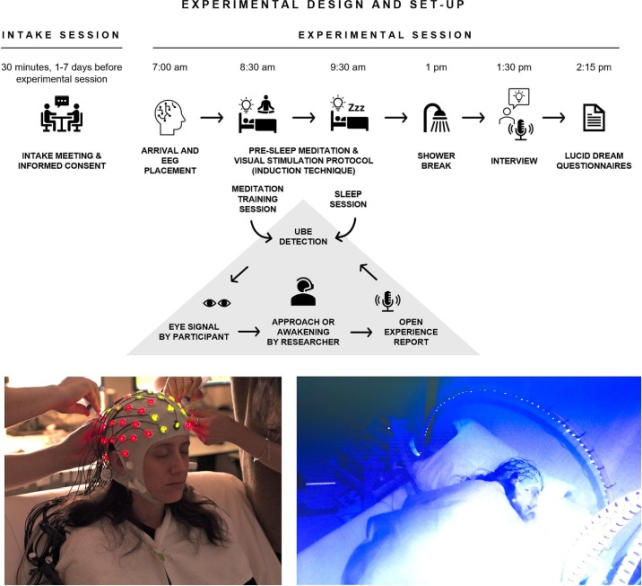
Their equipment was rather less mysterious: EEG headsets equipped with dozens of electrodes to record the brain’s electrical activity.
Caps donned, the travelers were sent off on their supernatural wanderings.
Each participant was guided through meditation exercises designed to help them relax and focus on their bodily sensations. The researchers also used flashes of light to encourage unusual experiences as participants fell asleep.
But there was a slight hitch. How do you tell a scientist that you are having an out-of-body experience when you sleep?
Researchers have found a clever solution. They asked participants to move their eyes in a deliberate left-right-left-right sequence whenever they felt something unusual.
Since eye movements can be detected even during sleep, this allowed the team to accurately determine when experiments were taking place in the EEG recordings.
Then, they interviewed the participants in detail about what they had felt, seen and experienced, allowing the researchers to match their subjective accounts to the electrical activity recorded in their brains.
Of the 35 participants, 20 reported 36 UBEs between them – the greatest number during meditation, but others during REM sleep, non-REM sleep, and sleep arousals – brief periods of awakening from sleep to wakefulness.
Some participants felt themselves floating, falling, or spinning, even though their bodies remained perfectly still. Others felt strange vibrations, pressures, or the sensation of being touched by something that wasn’t there.
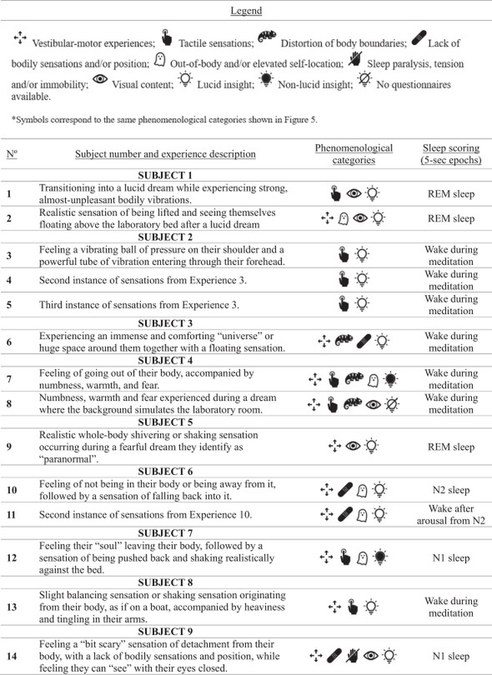
Some have lost the notion of the end of their body, or even its shape. Others have experienced paralysis, sometimes accompanied by frightening hallucinations. In 10 cases, participants reported the sensation of being outside the physical body, or of being elevated above it in some way.
And, in the brain activity of these experiments, an intriguing pattern emerged.
Compared to participants’ normal brain activity during sleep or meditation, UBEs were associated with a decrease in slower brain waves, called delta and theta waves, and an increase in faster beta and gamma waves.
The changes were particularly pronounced around the temporal regions of the brain, which help process sensory information and contribute to our perception of our own bodies.
This is where this model gets interesting. The slower brain wave activity appeared to fall somewhere between the patterns typically seen during sleep and wakefulness, while the faster activity more closely resembled that of an awake brain.
In short, the brain activity associated with these strange experiences appeared to combine features of both sleep and wakefulness, regardless of whether participants were technically asleep or awake.
Researchers think this could be because the brain involved has poor boundaries.
For a waking brain, this means that the sleeping brain is intruding on its territory; and for a sleeping brain, wakefulness seeps in around the edges.
Similar overlap has long been implicated in sleep paralysis – consciousness returns while the body remains temporarily paralyzed by sleep – but its role in other strange bodily experiences is less well understood.
“Taken together, our results suggest that UBEs do not depend on a specific sleep stage or wakefulness condition, but rather on a state of consciousness that blurs the boundaries between them,” the researchers wrote.
“This could explain why UBEs sometimes integrate elements of dream experiences with the external environment the participants are in, such as seeing one’s room while experiencing frightening hallucinations during episodes of sleep paralysis.”
There are still mysteries to unravel. EEG recordings cannot reveal whether the brain as a whole enters an intermediate state or whether different regions are simultaneously engaged in sleep and wake activities.
More research is needed to investigate these possibilities and determine exactly how the brain constructs illusory sensations that seem so real.
But the results could offer clues to something even more fundamental: how the brain establishes our sense of being deeply embedded in a body in the first place.
The research was published in Consciousness and cognition.
This article was fact-checked by Rebecca Dyer and edited by Rebecca Dyer. Although we are proud of our process, we are only human. If you spot an error, please let us know.
Gn Health

