
Just when you thought the sun was going to take a break, it unleashed another powerful flare – and the northern lights the forecasts became even more promising.
A fourth coronal mass ejection (CME) erupted from the sun on October 8, in a powerful M-class solar flare from the unrest sunspot region AR4549. This brings the number of CMEs potentially headed toward Earth to four, increasing the possibility of additional geomagnetic activity and aurora appearances over the coming days.
Initial analyzes suggest that the last CME could potentially catch up with the third CME en route to Earth.
Will the Northern Lights be visible in the United States?
NOAA’s aurora forecast suggests that auroral activity may be enhanced in northern North America. Exactly how far south the auroras might appear remains uncertain and depends on how incoming CMEs interact with Earth’s magnetic field.
G2 geomagnetic storm conditions are forecast for October 9 and during such storms auroras have already been observed as far south as New York and Idaho.
While the northern states of the United States currently have the best outlook, skywatchers further south shouldn’t completely discount their chances just yet. With several CMEs approaching Earth in rapid succession, there is still considerable uncertainty over changing geomagnetic conditions. If future flares interact favorably with Earth’s magnetic field, the auroras could potentially reach much further south than currently expected.

So if you’re in mid-latitudes, make sure the Northern Lights alerts are turned on and your camera batteries are charged. This could be an interesting few days for Northern Lights enthusiasts!
For real-time forecasts based on your location, consider using a space weather app. A great option is “My Aurora Forecasts & Alerts” (available for iOS And Android). For a deeper dive into space weather, “Space Weather Live” is another great choice (available for iOS And Android)
Aurora forecast for the Northern Hemisphere courtesy of the UK Met Office
When should you look for the Northern Lights?
The latest from NOAA 3 day forecast now places the strongest geomagnetic activity later on October 9 than expected.
Minor geomagnetic storm (G1) conditions are forecast between 8:00 a.m. and 2:00 p.m. EDT (12:00 p.m. and 6:00 p.m. GMT), with moderate conditions (G2) scheduled between 2:00 p.m. and 8:00 p.m. EDT (6:00 p.m. and midnight GMT).
Further activity is possible over the weekend, with NOAA currently forecasting minor conditions (G1) between 11 p.m. and 2 a.m. EDT on October 10-11 (03:00-06:00 GMT on October 11).
For those who want to catch a few auroras, the advice remains the same! Keep your aurora alerts on and check conditions whenever the sky is dark and clear. These forecast windows are not set in stone, especially when multiple CMEs are involved!
When could CMEs arrive?
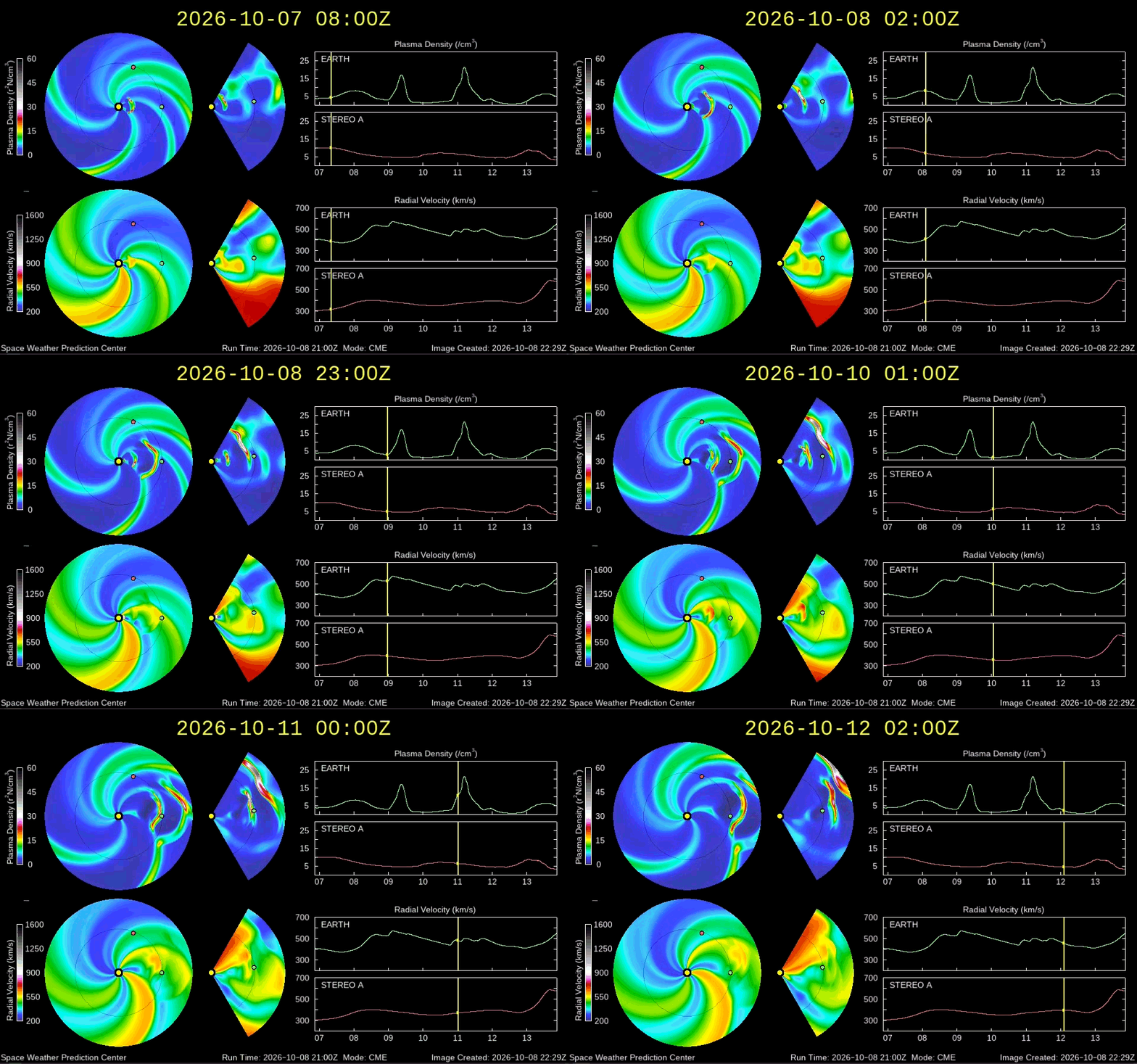
This is where things get complicated.
Current modeling suggests that the first CMEs could reach Earth on October 9.
Space weather physicist Notes by Tamitha Skov that the two CMEs on October 6 could reach Earth in relatively rapid succession, delivering a one-two punch to Earth’s magnetic field. However, their journey may be influenced by the surroundings. solar windwhich makes it difficult to determine precise arrival times.
The third CME could occur late October 10 or early October 11 (UTC), potentially extending unstable geomagnetic activity and prospects for the Northern Lights into the weekend.
And now there is a fourth CME to consider. Initial analyzes suggest that this latest flare is moving faster than some of its predecessors, suggesting it could catch up with the third CME before reaching Earth. The “cannibalistic CME” could further complicate the timing and strength of the resulting geomagnetic activity.
And remember, even an Earth-directed CME doesn’t guarantee a spectacular aurora display. Much will depend on how the magnetic fields carried by these eruptions interact with the Earth’s magnetic field when they arrive.
With AR4549 still magnetically complex and facing Earth, increased solar activity could be on the way. The sun is keeping us in suspense this week!
Editor’s note: This article has been updated to include a fourth coronal mass ejection (CME) that erupted from the sun on October 8, as well as the latest geomagnetic storm forecasts and revised arrival estimates.
Gn headline