
SpaceX’s attempt to get its entire ship back to the launch pad was thwarted when the booster malfunctioned and ended up in the water on Friday, but the spacecraft still rocketed into orbit in its most daring test yet.
LEARN MORE: SpaceX’s oversized spacecraft goes into orbit for the first time, but the flight ends early
Elon Musk’s company had to lower its expectations when the first part of the double catch failed.
Instead of returning to its base in Texas after liftoff, the first stage booster ended up in the Gulf of Mexico after an automatic abort. Despite the setback, the bullet-shaped spacecraft continued toward its orbit. He’ll head to the pad on Saturday for a similar catch, barring any additional issues.
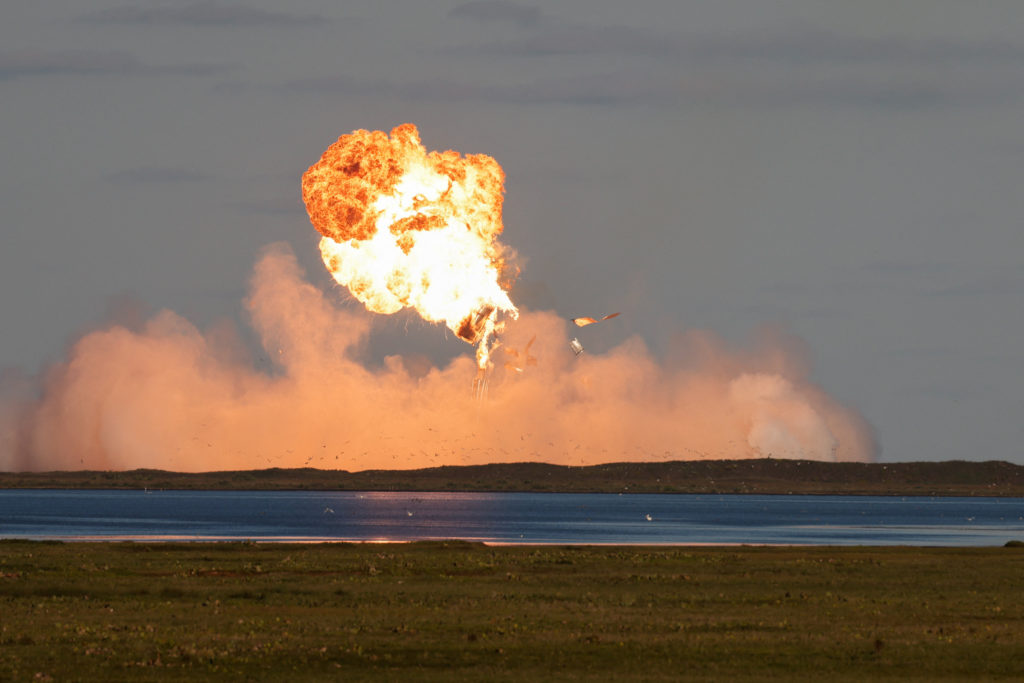
The Super Heavy v3 Booster 22 explodes after being diverted into the water as it returns from launching a Starship 42 during the 15th test flight from the SpaceX Launch Complex in Starbase, Texas, November 13, 2026. Photo by Joe Skipper/Reuters
This is the first time the spacecraft will attempt to return to the platform from orbit, only to be snatched mid-flight by mechanical arms attached to the launch tower. If all goes well, the flight will last 22 hours.
The initial goal was to recover every part of the rocket for future recycling, something that has not yet been achieved anywhere in the world. Musk sees this leading to the kind of rapid, consistent launch rates needed to build moon bases and send people to Mars.
Shortly after reaching orbit, Starship prepared to deliver 26 of the company’s most advanced Starlink satellites. The plan is for Starship to complete 15 laps around the world at an altitude of about 170 miles (275 kilometers) before returning to the launch site for Saturday’s grand finale.
SpaceX had already carried out three recalls to the company’s vast starbase near the US-Mexico border. This was the first attempt to capture the improved version that spans 72 meters – the production model for expeditions to the Moon and Mars. It will also be the first time the company attempts to catch the spacecraft, which spans 171 feet (52 meters). Together, they form the world’s largest and most powerful rocket, standing a staggering 407 feet (124 meters) tall.
The spacecraft portion of the previous 14 ships ended up in the ocean, either by design at the end of the flight or by accident in a stream of flaming wreckage. During the first large-scale test flight in 2023, several engines failed to ignite and the free-fall rocket’s self-destruct system was activated.
The last test, in September, was the first to reach orbit, but SpaceX did not attempt to recover any of the rocket’s stages.
SpaceX plans to start launching Starships from Florida within a few months and from Louisiana within a few years. Large-scale infrastructure, combined with full rocket reusability, is “how you go from zero launches to 10, 100, 1,000, 10,000, 100,000,” Kiko Dontchev, SpaceX’s vice president of launch, said at a NASA technology summit last week at the Kennedy Space Center in Florida.
SpaceX’s smaller Falcon rockets will continue to fly from Cape Canaveral, carrying astronauts to the International Space Station for NASA and from California with Starlinks. The satellites will also continue to hitch a ride with the Falcons for the time being. Musk wants Starships to eventually replace Falcons.
Falcon rockets “still aren’t fully reusable. We’re still throwing away that second stage on every flight. Starship, we’re going to grab both the first stage and the second stage,” Dontchev said.
NASA is paying SpaceX billions of dollars to land Artemis astronauts on the Moon with Starships. Jeff Bezos’ Blue Origin is the other major player. NASA expects to decide a year before the Artemis IV moon landing — the first by astronauts in more than half a century — whether to bring moonwalkers to the surface with Musk’s spacecraft or Bezos’ Blue Moon.
During next summer’s Artemis III mission, astronauts will practice docking their capsule with a Blue Moon and then with a spacecraft orbiting Earth. This will set the stage for an Artemis moon landing as early as 2028.
A free press is the cornerstone of a healthy democracy.
Support trusted journalism and civil dialogue.
Gn usa

