
During the 2026 election cycle, Republicans enacted a series of gerrymanders — a form of partisan redistricting — in a handful of states to give them a disproportionate advantage over Democrats in their congressional delegations. Democrats responded with a successful redistricting effort in California and a failed one in Virginia.
Gerrymandering has obvious implications for fairness and democracy, characterized by some as politicians choosing their voters, not voters choosing their politicians.
There is also a practical consideration for those who gerrymander: Efforts can fail if they overplay their hand.
By spreading their favorable voters across many districts, parties can create more seats that may lean in their direction. But if spread too thin, these efforts can backfire and win seats for the other party, especially in a “wave” election year that favors the other party. This unintended consequence is often referred to as a “dummymander.”
So, with such massive Democratic majorities about to enter the 120th Congress, did Republican attempts at gerrymandering really end up costing them a few seats in the House of Representatives?
The answer is not as clear as one might think.
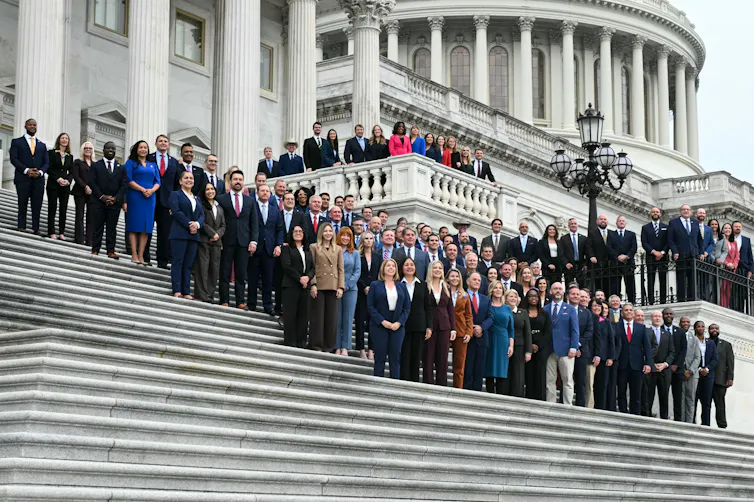
Jim Watson/AFP via Getty Images
Dummymanders in North Carolina and Ohio?
Republican legislatures in Ohio and North Carolina redrew their congressional maps in 2025, creating a set of districts they said would maximize the number of seats they could win in the House.
Although both states are traditionally competitive in statewide elections, their state legislatures picked up a series of seats that Republicans thought they would win: 12 of those 15 new seats in Ohio and 11 of 14 in North Carolina included a majority of voters who voted for Donald Trump in the 2024 presidential election.
But in 2026, Democrats across the country won dozens of seats that previously seemed out of reach, including districts Trump won by double digits in 2024. Many of those seats were in heavily hand-picked Republican seats.
In Ohio and North Carolina, the scale and scope of the midterm backlash against Trump and his party put many Republican-targeted seats in those states at risk, including those Trump won by as many as 20 points.
Ultimately, the Democratic wave defeated so many seats won by Trump in these states that their new congressional delegations might be more Democratic than they would have been without the gerrymanders.
Democrats held their ground in the Deep South
Texas and Florida also targeted a series of Democratic-held seats for flipping in 2026. Nine of those seats in those two states, along with a vulnerable seat held by Democratic U.S. Rep. Shomari Figures in Alabama, were targets of gerrymanders that created new districts that Trump won in 2024, all by 9 percentage points or more.
But once the 2026 Democratic wave swept through the Deep South, those gerrymanders were essentially undone. Despite the party’s projected gains, Republicans in these three states appear likely to enter the 120th Congress with delegations the same size as the 119th.
Other Republican attempts at gerrymandering have been successful, but only just. In Tennessee’s 9th District, the last remaining Democratic seat in the state was consolidated into a district that Donald Trump won by 21 points in 2024. Republicans held that seat as expected, but only by 2,500 votes, or just over a percentage point.
Gerrymanders that worked – and didn’t work
Many of these gerrymanders have not been maximally successful. But were they real fakes?
In North Carolina and Ohio, it appears Republicans overreached in relying on former Trump voters in a national environment that has proven so favorable to Democrats.
In Ohio, a gerrymander that aimed for a two-thirds Republican majority in its House delegation will net them less than half of that majority in the 120th Congress. This outcome ended up producing a more representative result, one that was roughly in line with both parties’ 2026 popular vote shares in the state.
North Carolina was more radical: Republicans aimed to design districts in which they would win seats representing nearly two-thirds of their congressional delegation. But the party is currently on track to hold, at best, less than a third of its state’s seats.
And California, which Democrats reshuffled in response to Republican efforts in other states, is a partisan success story. The state is expected to send just 8% of its House delegation as Republicans, despite voting 30% Republican statewide.
In Texas and Florida, the story is more complicated. Democrats in these states retained most of the seats they held and that their Republican legislatures targeted in their gerrymanders, thanks to historic shifts in Hispanic voters who voted for Trump in the 2024 election.
But gerrymanders can be effective beyond marginal, targeted districts. Overall, district lines in Texas and Florida were drawn so favorably to Republicans that even a Democratic tsunami only managed to keep those states’ delegations the same in the next Congress, since many other districts remained safe for Republicans.
In these states, Republicans still enjoy a larger proportion of House seats than their popular vote margin would reflect. And in a less Democratic election cycle, many of these cherry-picked seats could very well go to Republicans.
Failure of GOP gerrymanders would have produced an even bigger blue wave
As poor as the outcome of the 2026 midterm elections was for Republicans, it could have been even worse. In fact, some Republican states might consider themselves fortunate that their attempts at gerrymandering have failed as the midterm elections approach.
In traditionally Republican states like Missouri and Utah, courts have overturned gerrymanders that would have created a series of districts that Trump won by about 20 percentage points. Had the gerrymanders not been overturned, Democrats’ shocking successes in similar districts across the country could have brought them as many as five additional seats in those states.
A similar situation occurred in Indiana and South Carolina. The new maps proposed by Trump and which failed in their state legislatures were intended to produce even more lopsided Republican gains. But the Cook Political Report’s analysis found that those maps could have given Democrats as many as six of South Carolina’s seven House seats and eight of Indiana’s nine seats. Instead, Democrats appear likely to end up with just two seats in each state.
What’s next in the gerrymandering wars?
The 2026 election cycle demonstrates that gerrymandering is a far more complex and dynamic proposition than it is often treated by pundits and parties.
Election waves of this magnitude can often overcome the intended effects of three-dimensional maps, but subsequent elections may find them much more effective. Additionally, parties often draw three-dimensional maps based on the results of previous presidential elections – a measure that may be less reliable as voters continue to make more unexpected choices.
Additionally, red and blue states are facing the consequences of the Supreme Court’s ruling Louisiana v. Callais, who made gerrymandering of racial groups easier to accomplish without court intervention. Over the next two years, Republicans may attempt to implement even more new maps in many new states, particularly in the South. These new districts will likely aim to dilute majority-black districts that are no longer protected by the Voting Rights Act.
Meanwhile, Democratic state governments appear poised to continue their opposition to last cycle’s Republican efforts with gerrymanders of their own over the next two years.
But Republican redistricting failures in the 2026 cycle, including near-misses, should prompt both parties to be cautious about future attempts.
Gn headline

