This illustration provided by NASA depicts Voyager 1.
AP/NASA
hide caption
AP/NASA
NASA’s Voyager 1 has traveled further than anything humans have launched into space. On Wednesday, it should take a new step: reaching a distance that is one light day from Earth.
NASA is celebrating the occasion with the “Shine brightly for Voyager’s day of light.Calling it a symbolic celebration, NASA is asking the public Tuesday evening to send Voyager’s call sign VGR into the sky in Morse code. Use a flashlight, phone light or anything that can flash a sequence.
If you would like to participate:
V – Three quick flashes, one long flash
G – Two long flashes, one fast flash
R – One quick flash, one long flash, one quick flash
What exactly is a light day?
A light day is the distance traveled by light in 24 hours, or more than 16 billion kilometers.
This NASA spacecraft traveled for almost 50 years and was launched on September 5, 1977.
During its mission, Voyager 1 conducted flybys of Jupiter and Saturn. In 1979, she discovered a faint ring system on Jupiter. In 1980, the spacecraft took detailed photos of Saturn’s rings and moons.
During its journey, on February 17, 1998, Voyager 1 passed the American space probe Pioneer 10, becoming the most distant man-made object in existence. It and its twin, Voyager 2, are the only spacecraft to have operated outside the heliosphere, which acts as a protective shield of the solar system.
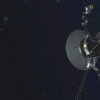
Voyager 1 reached the interstellar frontier in 2012. Its interstellar mission continues to map and measure magnetic fields, particles and plasma waves outside the solar heliosphere and the atmospheres of other stars.
Earlier this year, NASA chose to shut down Voyager 1’s Low-energy Charged Particles experiment (LECP), which helped scientists map the structure of space, in order to save energy. Scientists said this could keep the probe alive for longer.
Voyager 1 still has two operating scientific instruments: one that measures magnetic fields and another that listens for plasma waves.
Additionally, the Voyager spacecraft carries the Golden Record – an interstellar “time capsule” intended to communicate Earth’s history to extraterrestrials.

This undated image provided by NASA shows the Voyager Golden Record album.
NASA/JPL-Caltech/via AP
hide caption
NASA/JPL-Caltech/via AP
The gold-plated disc contains 115 images, natural sounds such as waves, wind and animals, as well as greetings spoken in 35 different languages. Instructions are included, in symbol form, on how to read the disk and the origin of the probe.
Voyager 1 is estimated to reach “light day status” at 5:16 a.m. ET on Wednesday, after 49 years, two months and 11 days of travel.
Gn headline