John Malkovich is so distinctive that he’s almost in his own genre. His unique personality shines through in each of the characters he plays, even if this soft-spoken 72-year-old grandfather has nothing in common with his gallery of villains: the murderous Cyrus the Virus in “Con Air”; the deceitful seducer Valmont in “Dangerous Liaisons”; and the would-be assassin he played with such chilling precision in “In the Line of Fire.” For more than five decades now, Malkovich’s performances have been as nuanced as they are mysterious; even he doesn’t know how he does it.
We spoke with him at Greenwich Village’s legendary, recently restored Cherry Lane Theater, where he first performed in New York in 1982. He was 28 years old and had just come from Chicago and the famous Steppenwolf Theater Company to star in Sam Shepard’s fierce two-act play, “True West,” with his friend Gary Sinise.
John Malkovich: Sometimes on Saturday nights, just to excite Gary on one level and amuse him on the other, I’d get a six-pack and I’d ch– the refrigerator would be right over there and I’d drink them, one at a time, one, two, three, four, five, six, okay, just like that, all the way down the drain.
Ariel Levy: I mean, you must have been as trashed as the set.
John Malkovich: I think I was pretty trashed. And we had a lot of fun doing it.
60 minutes 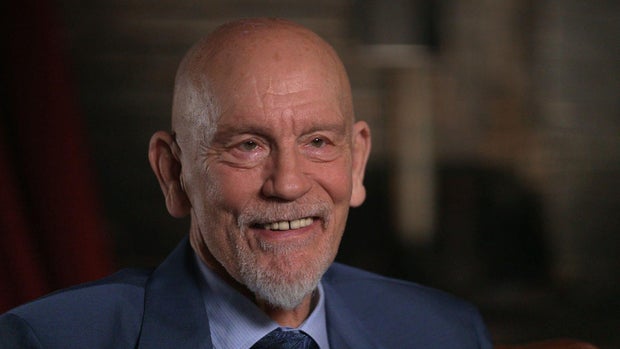
Malkovich played Lee, a charismatic bully, in Sam Shepard’s dark comedy about sibling rivalry. Her stunning performance became the talk of the town. Everyone who was anyone in New York came to see him at Cherry Lane.
John Malkovich: You know, every night there was Antonioni or Mick Jagger or David Bowie or Jackie O. It was wild.
Ariel Levy: Did you see them when you were on stage. You would say, “Oh, my God…”
John Malkovich: They are there. You do anything. You look and it’s Jackie O. You can’t say much to that.
His stage triumph was a catalyst for Malkovich’s entry into film, first as an American photojournalist covering wartime Cambodia from the battlefields, then alongside Sally Field in “Places in the Heart.”
That 1984 performance, as a blind World War I veteran who becomes the family’s unlikely protector, earned Malkovich his first Academy Award nomination.
Ariel Levy: Early in your career, you were sort of the opposite of method. You’d be there instantly without, you know, a lot of what other people would call preparation. Cinema must have suited you?
John Malkovich: That’s very good.
Ariel Levy: You can just take it piece by piece.
John Malkovich: Yeah, yeah. I’m not someone who sits around and goes through that. I must be a particular way. When the play begins, I must not think, but act.
He returns to the stage in “Death of a Salesman”. sharing the bill with Dustin Hoffman on Broadway in 1984.
John Malkovich: When you do a play, it’s the whole play. You don’t just do a little bit and say, “Do you like that?” That’s all. It’s in front of you. So it’s with you. Then it’s behind you every night. And there is momentum. There is no momentum in the films.
Malkovich says acting in a movie is like “being in someone else’s dream.” You shoot scenes out of order. You rarely have any say in the final product. It’s one of the reasons he returned to the theater again and again throughout his 50-year career, performing in and directing dozens of plays all over the world, including the original 1987 production of Lanford Wilson’s “Burn This.”
60 minutes 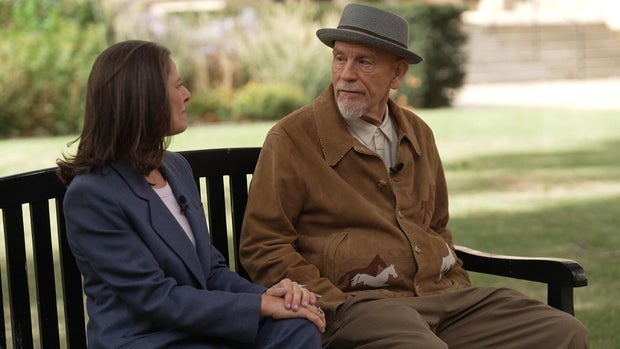
Ariel Levy: After seeing your performance in this play, director Stephen Frears comes backstage to talk to you.
John Malkovich: Uh-huh. Yeah. He asked me why I was never good at movies. He may have said “Cinema”.
Ariel Levy: Surely there was a benefit to that too? “You’re good at plays…”
John Malkovich: That benefit didn’t happen. But I realized that it doesn’t have much to do with me, but rather with the way films are made. And we discussed, for the purposes of “Dangerous Liaisons”, how that might apply to how we were going to go about making it happen.
Malkovich’s lothario, Viscount de Valmont, was introduced to audiences in 1988 in the iconic adaptation of the 18th-century novel. He says it’s one of the few truly great scripts he’s read in his career.
Ariel Levy: What attracted you to “Liaisons”?
John Malkovich: Great characters and a fantastic adaptation by Christopher Hampton, who I wrote and still greatly respect. So, for me, there was almost nothing. There was really no downside.
He credits other films with interesting ideas with great roles, like the aspiring assassin he played in Wolfgang Petersen’s “In the Line of Fire,” where Malkovich’s performance earned him his second Academy Award nomination.
He played a different type of killer in “Con Air,” a film that introduced Malkovich to the general public.
Ariel Levy: What was your first impression of the “Con Air” script?
John Malkovich: Honestly, 500 million was my first impression. I knew it was Jerry Bruckheimer. I knew Nicolas Cage was in it. I looked at the title page for names of people named after poets from the Victorian era. And I just thought, “Okay. This represents around 500 convicts on a plane, 500 million dollars…
Ariel Levy: You do the math
John Malkovich: Yeah, do the math
“Con Air” grossed more than $200 million at the box office. Although Malkovich is considered an intellectual – and is in fact a man who has designed fashion, produced pinot noir in France and traveled the world collaborating with classical musicians – he is not a snob.
He has directed over 100 films and claims to enjoy acting in blockbusters as much as arthouse films.
John Malkovich: Everyone brings their own gifts. It really is. I don’t care if it’s Proust, or Faulkner, or “Conair.”
60 minutes 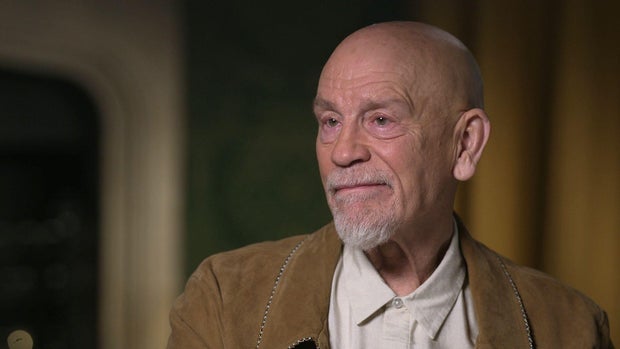
Malkovich’s democratic approach to material and clear outlook on life proved instrumental when he lost his entire life savings to Bernie Madoff’s Ponzi scheme in 2008.
John Malkovich: I found out… I had directed a play in Mexico and then I came back from there. And I saw this picture of Bernie Madoff in handcuffs and I thought, “Oh. Well, that… that might turn out to be interesting.” And I went in and I told my wife, “You know, I’m just going to go around the corner, buy a pack of cigarettes. I said we have a little problem, Bernie Madoff just got arrested.”
Ariel Levy: I guess you weren’t smoking when you told him that.
John Malkovich: I had stopped. Yeah, for a while, you know, that was pretty much all I did.
Even more remarkable than Malkovich’s loss was his accelerated recovery.
John Malkovich: And you know, you seem guilty. You’re going to do this and that. And then you realize, “Look. Why don’t you shut up? Whatever you’ve lost, most people who are born will never have a tenth of it, no matter what they do, no matter what they do. Get on with your life. And that’s it.”
John Malkovich grew up in the Midwest. His mother’s family owned the daily newspaper in Benton, Illinois, and his father was a conservationist. For Malkovich, the idea of becoming a movie star – or doing anything to attract attention to himself – was inconceivable. Malkovich, one of five children, says his parents never found him particularly impressive.
John Malkovich: It’s just not a family where you… you could never have been praised for anything. If you built a rocket in the backyard that would take you to space and back, people would sort of say, “We were wondering where you were.” » But that wouldn’t go much further.
This fanatical modesty was one of the reasons Malkovich initially resisted directing the unforgettable comedy “Being John Malkovich” with director Spike Jonze, a surreal journey through an imaginary portal into the actor’s brain.
John Malkovich: I loved Spike. I found it hilarious.
Ariel Levy: It was an incredible film. There is no such thing.
John Malkovich: I can’t think of anything that has been more original and voiced. It was truly a cinematic universe, as we use the term for Marvel. In fact, it was one.
Ariel Levy: What was John Malkovich’s part in “Being John Malkovich?”
John Malkovich: None.
Ariel Lévy: None?
John Malkovich: I’ll let Spike Jonze say it best. I did it… so we were rehearsing, one day, I don’t remember what it was, and Spike said, “That’s fine, but John Malkovich wouldn’t do it that way.” And I just thought that was a fantastic score.
Before directing the film in 1998, Malkovich tried to convince screenwriter Charlie Kaufman to use another actor. He thought “Being Tom Cruise” might work well, but Kaufman refused. There is no other actor with a more distinctive personality than Malkovich. And then there’s that unmistakable way of speaking parodied by Bill Hader on “Saturday Night Live.”
One of Malkovich’s favorites is the Coen brothers’ “Burn After Reading,” in which he plays the recently fired Spicy. CIA officer Osborne Cox.
He is now back at the CIA in Martin McDonagh’s latest film, “Wild Horse Nine”, a black comedy set on Easter Island in Chile, shortly before the coup d’état in 1973. Malkovich plays Chris, a spy haunted by…
Gn entert