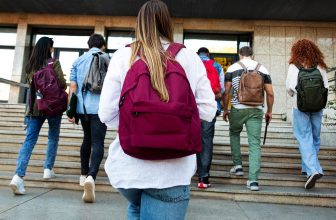
Fewer international students are studying at U.S. universities as the Trump administration cracks down on immigration and reshapes higher education, according to data released Monday.
Overall, U.S. campuses saw a 9% decrease in international enrollment this fall compared to last year, according to a survey by the Institute of International Education. And the number of new students entering the United States for the first time fell by 15%.
“No one aspires to send their children to be educated in the United States,” said Veena Dubal, general counsel for the American Association of University Professors, whose father traveled from India to attend Tuskegee University, and then Tuskegee Institute, in the late 1960s on a student visa.
“This seems like a dangerous place to be. That’s the message the Trump administration is sending to families around the world and they are listening.”
Last year’s decline in enrollment was partially offset by a large number of students remaining in the United States to work temporarily after graduating. But after months of speculation, the Department of Homeland Security (DHS) proposed requiring schools to pay a $70,000 fee for each student participating in the optional hands-on training program.
Although the rule has not been finalized, participation in the program, known as OPT, fell 6% this fall, according to the survey.
The proposed rule, which is expected to face legal challenges, is part of broader DHS efforts that include stripping the legal status of thousands of international students, as well as detaining and deporting many of them.
And this summer, the administration finalized a rule that will prevent international students from staying in the United States for more than four years without federal approval, although a judge temporarily blocked it.
DHS Secretary Markwayne Mullin said the changes were aimed at closing loopholes that international students were exploiting by extending their studies.
Although the United States remains the top destination for international students in the world, the changes are having an effect, university leaders told IIE.
Among more than 800 U.S. colleges and universities surveyed this fall, 88% blamed declining enrollment on the visa application process and 70% on travel restrictions. And while OPT options are limited, 95% of schools predict that international students will likely look elsewhere, according to the survey, which offers a first look at trends before full data is released next year.
Politics isn’t the only reason students look elsewhere, said Mirka Martel, head of research, assessment and learning at the institute. Its survey found increased global competition for international students and the rising cost of a U.S. degree also contributed.
Fanta Aw, executive director and CEO of Nafsa, an association that represents international education, said students also worry about research funding. Last year, the Trump administration began dismantling the federal grant-making process and attempting to exert more political influence over funded projects.
“They’re like, ‘There’s too much uncertainty in the United States. It’s too difficult, and you know, more importantly, we have a lot more choices today than we did 10 years ago. Why subject ourselves to that?'” Aw said, noting that students are going to countries like China.
Nafsa, in partnership with global education technology company JB International, found that due to declining enrollment, international students’ contribution to the U.S. economy fell by $2.4 billion this fall.
American colleges and universities are heavily recruiting international students as a source of tuition revenue. So the declines have created big holes in tuition revenue at some schools.
At Cleveland State University, international enrollment fell 46% in two years, from 1,542 in fall 2025 to 828 this fall. And fewer than 50 new international students started this fall, said Dean Nigamanth Sridhar, who estimated the budget impact ranges from $2 million to $4 million.
Decades ago, he arrived in the United States on an F1 student visa and participated in OPT. Eventually, he went through the process to become a naturalized citizen.
“I’m here in this position, in this job, because I had the opportunity to come to the United States as an international graduate student, and then I decided to stay here and build a career,” said Sridhar, a native of India. “So international education is personal for me. »
The largest declines were recorded at the graduate level. Data from this fall shows a 15% decline in international graduate enrollment, compared to a 3% decrease at the undergraduate level. The report also reveals a decline in the number of international students from India, which sends more students to the United States to study than any other country.
Sarah Spreitzer, vice president of the American Council on Education, which represents college and university presidents, said major immigration bills are unlikely as long as Donald Trump remains president. But she said congressional oversight after Trump’s Republican Party suffered heavy losses in the Nov. 3 midterm elections could stop new policies targeting international students.
“Those kinds of things could give more certainty to our international students that there won’t be sudden or inexplicable changes,” Spreitzer said.
Gn usa