

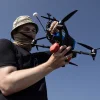
An armed robot developed by Turkish defense companies is demonstrated at a facility in Duzce, Turkey, April 29.
Omer Urer/Anadolu via Getty Images
hide caption
Omer Urer/Anadolu via Getty Images
GENEVA — Negotiations on possible rules for the use of deadly autonomous weapons, also known as “killer robots,” are underway at the United Nations in Geneva.
Proponents of autonomous weapons control say the U.N. Conference on Certain Conventional Weapons (or CCW), which meets this week once every five years, is the last chance to reach agreement on rules before it is too late.
Warfare technology has advanced rapidly in recent years, with some experts warning that the world will be just months away from having weapons that can autonomously choose targets and make decisions to kill.
In Ukraine and Gaza, AI-assisted weapons have already been used to eliminate targets, with Ukrainian civilians reporting being “stalked” by drones while shopping or going to school. But these are still controlled remotely by humans.
Humanitarian organizations say the decision to kill – and responsibility for that choice – must remain in human hands. Ahead of this week’s meeting, the United Nations, the International Committee of the Red Cross and the Pope have all called for legally binding rules. UN Secretary-General Antonio Guterres has warned that allowing fully autonomous weapons to kill would be “crossing a moral red line”.
What are the risks?
The Red Cross is particularly concerned that the existing rules of war – the Geneva Conventions – cannot be fully respected by autonomous weapons. War is often chaotic and confusing, and the situation can change quickly. Under the Conventions, wounded or surrendering soldiers can no longer be targeted.
Georgia Haines, legal counsel at the Red Cross, worries that autonomous weapons will not be able to distinguish between a soldier who continues to fight, a wounded soldier and a soldier who wants to surrender.
“The risk is that, based on the technology we’re seeing, they won’t be able to understand contextual cues in the same way a human can.” The risks of misidentifying a target are therefore incredibly high.
Meanwhile, human rights groups warn that the technology behind AI-assisted weapons is becoming increasingly less cheap and easy to use. The more it is adopted by the military, the greater the risk of proliferation and use by terrorist groups or law enforcement in repressive regimes. In theory, a swarm of autonomous drones could be programmed to kill anyone wearing a red sweater, anyone carrying a poster, or even anyone speaking a certain language.
Many countries currently meeting in Geneva take these concerns very seriously. At least 50 countries, including Ireland, Italy, Brazil, Mexico, France and Germany, are calling for a strict timetable to agree binding rules governing autonomous weapons.
But among states that are already developing and using semi-autonomous weapons, there is reluctance. The United States, Russia and Israel have indicated they would oppose legally binding rules, with Washington instead proposing a five-year timetable to draft non-binding guidelines.
The United States is traditionally a late adopter of international treaties. It has not ratified the Ottawa Convention on landmines, for example, even though it has gradually stopped deploying them and reduced its stockpiles.
Under President Trump, doubts about international law have increased. Washington has imposed draconian sanctions on the International Criminal Court and just this weekend, Secretary of State Marco Rubio, in a speech to the Federalist Society, warned against “quoting laws to men with swords.”
The problem for the states meeting in Geneva is that UN negotiations on limiting specific weapons are supposed to be conducted by consensus. That goal was achieved in 1995, when countries agreed to ban blinding lasers, but further agreements have proven elusive. In the case of landmines, countries frustrated by the delay ultimately took negotiations outside the UN process to create the Ottawa Convention.
This week, there could be a compromise: a longer, even indefinite, negotiation period to arrive at rules that each state can adopt as binding or non-binding. For diplomats in favor of such a solution, it is a way to ensure at least some progress. For campaigners, this is far from ideal, with some comparing it to a very dangerous kick in the road.
Gn headline