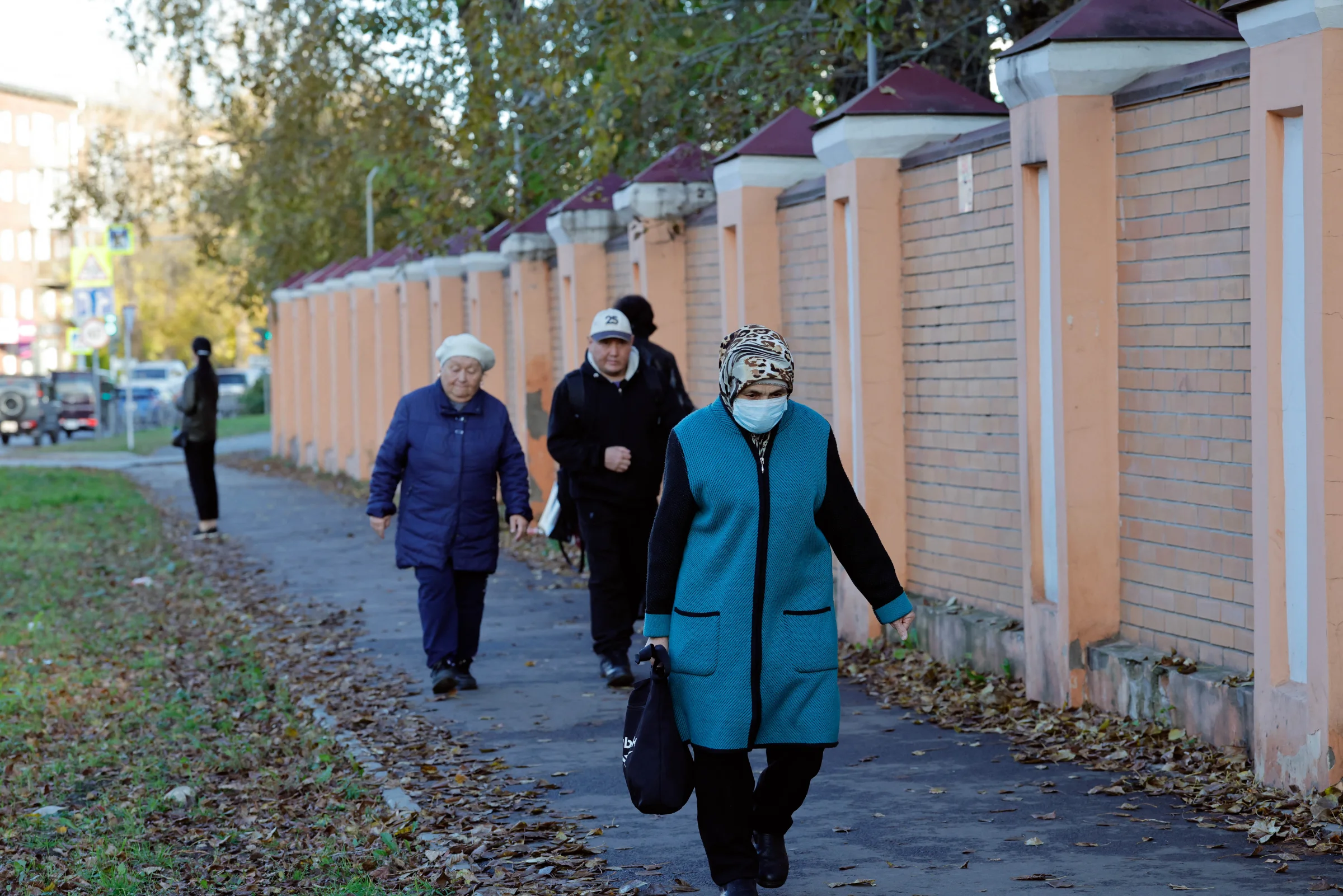
A woman wearing a mask walks past the Irkutsk Anti-Plague Research Institute of Siberia and the Far East, founded in the 1930s to monitor strains of dangerous pathogens.
Tatiana Makeyeva/AFP/via Getty Images
hide caption
Tatiana Makeyeva/AFP/via Getty Images
A 28-year-old woman died in Russia last week, and since then speculation about the case has ricocheted around the world.
The woman was a laboratory technician at a Russian research institute that studies plague. As unverified rumors swirl that she may have contracted the disease from a lab leak, President Trump, the World Health Organization and other leaders are demanding more information.

A security guard wearing a face mask looks on from the door of an infectious diseases hospital in the town of Shelekhov, where an employee of the Irkutsk Anti-Plague Research Institute died.
Tatiana Makeyeva/AFP/via Getty Images
hide caption
Tatiana Makeyeva/AFP/via Getty Images
Russia insisted it was not a health emergency and said its health authorities had not found any dangerous pathogens in any of the dead woman’s contacts.
But there are still many more questions than answers.
That uncertainty has world leaders and health experts turning to a law that requires countries, including Russia, to share exactly this type of information. We call it the International Health Regulations or RSI.
At a WHO press conference on Wednesday, Director-General Tedros Adhanom Ghebreyesus invoked the IHR as the best way to determine the current situation in Russia and determine the appropriate response.
“We don’t yet have a complete picture of this event,” he said. “Timely, comprehensive and transparent information sharing within international regulations is essential to clarify conflicting reports and enable accurate assessment of potential public health risks.”
Here are the key things to know about RSI and how it applies in today’s world.
Rooted in the 19th century
This law requires countries to share health information that may have international implications. It dates back to the 1850s, with cholera outbreaks in Europe, which led to the creation of guidelines for sharing information about diseases.
“It’s a very, very long time for international law,” says Alexandra Phélanassociate professor at the Johns Hopkins Bloomberg School of Public Health and senior fellow at the Johns Hopkins Center for Health Security. “Look at the negotiating documents and they debate: is cholera caused by bacteria or miasma (a bad smell)? As if we are really in the middle of germ theory.”
Then, when the WHO was founded in 1948, these regulations – then called the International Health Regulations – were adopted. This was one of the first steps taken by the organization. The law has since been amended and updated, notably after the outbreak of SARS or severe acute respiratory syndrome in 2003 and more recently due to the COVID-19 pandemic.
A country is supposed to inform the WHO if the health event is likely to cause an international health emergency.
Today, the IHR is among the most widely ratified international treaties, with 197 signatories, including the United States and Russia. (Even though the Trump administration claims to have withdrawn from the WHO, the United States is still bound by the IHR, except for a few recent amendments.)
One of the law’s core obligations “is that parties or states must notify WHO within 24 hours of detecting a (serious) event,” says Phelan.
Certain events – such as a case of smallpox or a new type of flu – should trigger notification immediately. In other situations, a checklist helps a country assess whether notification is necessary.
Every year, she says, WHO receives thousands of notifications from around the world and most turn out to be useless.
The situation in Russia
Some people fear that the Russian woman – who died on October 2 – had pneumonic plague. It is one of the diseases “explicitly listed” under the IHR, Phelan explains, as something to be assessed and reported to the WHO.

However, Russia did not inform the WHO of the woman’s death. Instead, the WHO learned about it through the media and then, on October 3, traveled to Russia to obtain verification and additional information.
“First, Russia’s response was delayed,” says Phelan. “But it wasn’t exhaustive either.”
It took several days for Russia to react. On October 6, health officials told the WHO that there were no cases of plague in the region and that the woman had been hospitalized with severe pneumonia of unknown origin before she died. They also explained that health authorities had placed around 200 contacts in quarantine.
The WHO has asked Russia for more information, including on the laboratory tests carried out, public health measures and the health status of the woman’s contacts. However, as with many international laws, there is no mechanism to force countries to comply with the law and share information.
Phelan says the next few days and weeks will be crucial in understanding how much information Russia will share. If they are not completely transparent, she hopes that pressure from other countries will convince Russia to comply with the IHR or, at least, help maintain the standard of other countries in complying with the IHR and informing the WHO of future health events.
This type of notification is essential if the world is to be prepared to respond and contain future outbreaks, says Laurent Gostinwho directs the WHO Center on Global Health Law and is a professor at Georgetown University.
“This case shows the good, the bad and the ugly of RSI,” he says.
“Legally, it’s the only thing that holds Russia accountable,” says Gostin. And yet, “you have countries that are hiding the ball”.
He believes that the risk posed by the current situation in Russia to the general population is probably very low. But, for him, the fact that countries can ignore the reporting requirements of the IHR is a “sounding siren indicating how unprepared we are” to quickly control health threats.
For stories about life in our changing world, Subscribe to NPR’s Global Health newsletter.
Gn headline