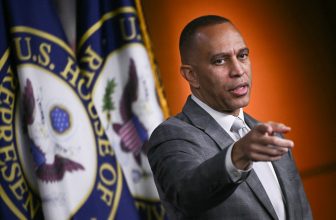
Acting U.S. Navy Secretary Hung Cao acknowledged that the war in Iran is straining the maritime service, as bipartisan senators questioned him on extended ship deployments, dwindling weapons stockpiles and shifting resources from the Asia-Pacific.
Testifying before the Senate Armed Services Committee on Tuesday during his confirmation hearing to lead the military branch, Cao faced sharp bipartisan criticism over the mounting human and material costs of the U.S.-Israeli war against Iran, now in its ninth month.
Recommended Stories
list of 4 elementsend of list
“This war, again, I know it’s putting a strain on our navy,” Cao said, while insisting that the joint military efforts have “really put China on its heels.”
Cao, a retired U.S. Navy captain and former Republican Party candidate for Virginia Senate, has served as acting secretary of the Navy since April 2026 after serving as deputy secretary.
The candidate, backed by US President Donald Trump, is now seeking US Senate confirmation for the top permanent civilian post.
The hearing comes amid growing political fallout from the prolonged quagmire with Iran, which recently saw the failure of the U.S. House of Representatives’ attempt to impeach Defense Secretary Pete Hegseth over his handling of the war.
Voters’ frustration with the war — and its economic consequences — proved decisive in November’s midterm elections, which were widely seen as a rejection of the war and ultimately cost Republicans control of the House and Senate.
The 120th Congress, controlled by Democrats, is scheduled to be sworn in on January 3, 2027.
Heated exchange in the Senate
As the ranking Democrat on the committee, Sen. Jack Reed of Rhode Island questioned Cao during the nearly two-hour hearing, saying he was frankly troubled by his performance so far.
“Frankly, I am concerned about your leadership as acting secretary,” said Reed, who called on the acting secretary of the U.S. Navy to address Hegseth’s ongoing and planned layoffs of numerous Navy officers over the past year, pressing Cao to ask him whether he would “defend military leaders against partisan interference in their careers in the future.”
Democratic lawmakers then criticized the U.S. Navy for circumventing standard congressional notification after quietly relieving the entire leadership team — the commander, executive officer and command chief — of the nuclear-powered attack submarine USS South Dakota following an underwater collision with the seabed in October.
“We take commanders down for everything from negligence to simple fraternization or, you know, harassment,” Cao said, arguing against the U.S. Navy’s traditional policy of publicly announcing the removal of commanders. “I want to make sure we protect their livelihoods afterwards as well.”
His stated intention to protect individuals’ careers was quickly rebuked by Reed, who argued that privacy did not justify shielding information from congressional control.
“The squadron commodore (of the USS South Dakota) felt that he did not live up to his honor, his courage and his philosophy of commitment, and therefore, he relieved the commander, the executive officer and the command chief,” Cao replied.
Cao’s record on sailors’ mental health criticized
The US Navy’s top nominee also faced intense questions from lawmakers over low crew morale, severe supply shortages and mental health issues aboard the USS Abraham Lincoln following its record 265-day deployment to the Pacific Ocean, South China Sea, Indian Ocean and Arabian Sea.
The ship returned to Naval Air Station North Island in San Diego, California, in early October after the USS George Washington arrived to relieve it. With the recently arrived USS George HW Bush and USS Theodore Roosevelt, the United States is temporarily consolidating three carrier strike groups to strengthen regional maritime security and reinforce the months-long naval blockade against Iran.
Last week, Trump said further military strikes against Iran were “fairly unlikely” and declared the military component of the war was “effectively over” following discussions with Qatar Prime Minister Sheikh Mohammed bin Abdulrahman bin Jassim Al Thani. He noted, however, that the U.S. military remains “locked and loaded” if conditions change.
At Tuesday’s hearing, Sen. Richard Blumenthal, a Connecticut Democrat, said Cao was “failing these sailors and their families,” and noted that his “confrontation with them leaves me with the clear impression that you don’t care.”
Cao hit back, saying he did not control the deployment length of U.S. Navy ships, which are gradually moving closer to a full year at sea — from a norm of six to eight months during the U.S.’s so-called “war on terror.”
“Sustained investment in our workforce will increase readiness, improve retention and recruitment, and enable our ability to support national goals,” Cao said.
Asked about suicide attempts aboard ships, Cao told Blumenthal that what he considered “as eight suicide attempts, I consider as eight mitigations of suicide.”
Cao faces rare hurdle in waiver for top spot
In his opening statement, Republican Senate Armed Services Committee Chairman Roger Wicker expressed support for Cao’s nomination to lead the U.S. Navy, noting that while the military faces significant challenges in a particularly volatile time, it also has major opportunities.
Beyond the tough questions lawmakers asked Tuesday about the strain the war with Iran is putting on the fleet’s readiness, Cao remains facing a complex confirmation path to become permanent secretary of the Navy, requiring a rare congressional waiver.
Because he left active duty in October 2021, he did not comply with the seven-year separation period mandated by federal law to preserve civilian control of the military.
Obtaining this exemption represents a steep political climb for Cao, who must clear the hurdle by reaching a threshold of 60 votes, which can be tricky in a polarized Washington.
Cao will ultimately need cross-party support, from Democrats and independents alike, to avoid a filibuster while winning over war-skeptical Republicans.
Gn usa