The Knesset voted 66-52 Tuesday night to elect MK Yashar Matan Kahana as the new speaker after six hours of filibustering by lawmakers from Prime Minister Benjamin Netanyahu’s bloc, who sought to delay the takeover of the powerful parliamentary post by the bloc led by Yashar leader Gadi Eisenkot.
Kahana, number 5 on Yashar’s list, defeated Likud MK Ofir Katz with the support of all four parties in the bloc led by Yashar Chairman Gadi Eisenkot, including MK Avigdor Liberman’s hawkish secular Yisrael Beytenu, former Prime Minister Naftali Bennett B’Yachad’s center-right and former IDF deputy chief Yair Golan’s left-wing Democrats, as well as the majority Arabic. Raam and Joint List parties.
The vote took place in two separate rounds: first for Kahana, then for Likud candidate Ofir Katz.
The six parties that supported Kahana hold 67 of the Knesset’s 120 seats – 48 held by Eisenkot’s bloc and 19 by the two Arab parties. Only a simple majority of votes cast, rather than an absolute majority of 61 lawmakers, was required to elect the president. An opposition MP, Raam MP Yasser Hujirat, was absent during the vote.
Katz had the support of 52 of the Netanyahu bloc’s 53 lawmakers, in the absence of Likud’s Nir Barkat. The ultra-Orthodox United Torah Judaism party voted in favor of Katz after speculation that he would abstain.
The vote marked a significant step in the Eisenkot-led bloc’s efforts to assert control over the Knesset after Netanyahu lost his parliamentary majority in last month’s election, even as negotiations to form a new government remain ongoing.
The Speaker of the Knesset plays a central role in determining the legislative agenda of the parliament, alongside the vice-speakers of the Knesset Presidium, which sets the plenum’s agenda and approves parliamentary business, including the introduction of private members’ bills.
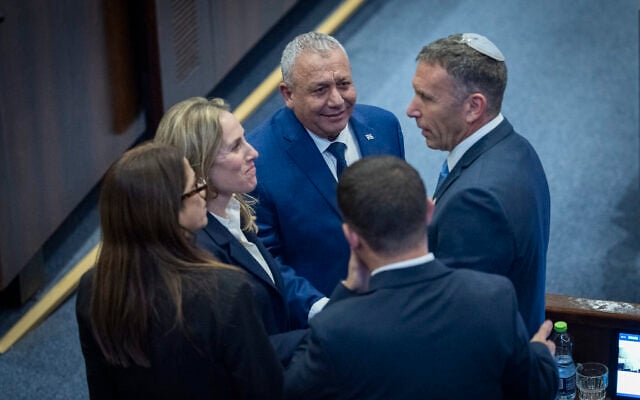
With Kahana now replacing Likud MK Amir Ohana as president, the Eisenkot-led bloc was expected to begin advancing legislation as early as Wednesday to repeal key elements of the previous Knesset’s judicial overhaul, even if Netanyahu remains prime minister while efforts to form a new government continue.
However, Ynet reported that the Eisenkot bloc had promised not to advance the repeal of the judicial review laws until Monday, in exchange for the Netanyahu bloc agreeing not to further extend the filibuster delaying the president’s election.
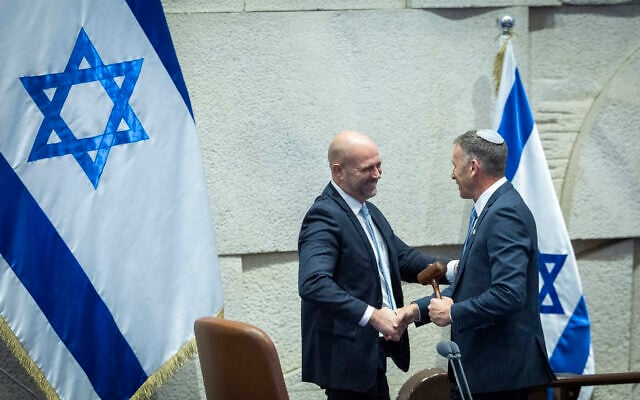
Kahana took his place overlooking the plenum after a smiling transition with Ohana, who handed him the speaker’s gavel, to the applause of his allies and the jeers of his rivals. Otzma Yehudit Tally Gotliv and Likud MKs Almog Cohen were repeatedly called to order during and after the vote, as they repeatedly accused the Eisenkot-led bloc of relying on “supporters of terrorism” – referring to the Joint List and Ra’am parties.
“With great respect, I now accept the role of speaker of the Knesset of Israel,” Kahana said in his first speech as president.
“The Knesset is the home of all citizens of the State of Israel, regardless of religion, race or gender,” Kahana continued. “And I intend to be a spokesperson for all of them.”
“I have every hope that the government that is formed will work toward the necessary amendments to the system of checks and balances with broad consensus, but in the meantime, the Knesset will undoubtedly obey the Court’s rulings,” he said, in an open reference to the outgoing coalition’s frequent defiance of High Court rulings and legislative pressure for a broad judicial overhaul.
“In recent years, we have repeatedly caused Israeli citizens to look down in embarrassment,” he added, saying it was the Knesset’s responsibility to move away from the “extremism, hatred and division” that fill social media algorithms, and embrace the Hillel House Jewish school of thought, whose supporters “made a concerted effort to understand those with whom they disagreed.”
Turning to Eisenkot, Kahana said, “I have come to know you as a man as honest as a leader, with a backbone of values cast in steel. Gadi, I know you will turn over every stone to establish a government that will unite and protect us.”
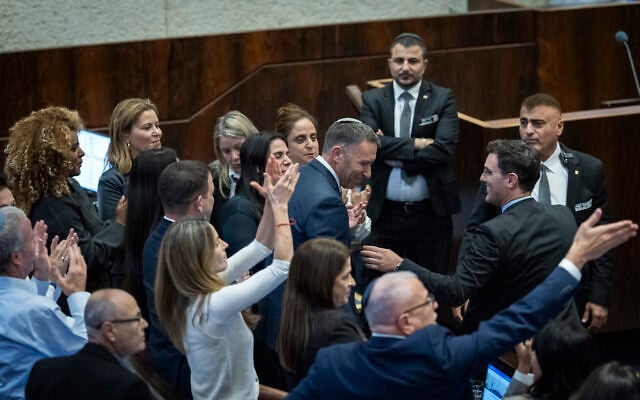
After electing Kahana, the Knesset reconvened to select nine vice presidents, with lawmakers voting 38-15 to nominate B’Yachad MK Eitan Ginzburg, Democratic MK Yaya Fink, Yisrael Beytenu MK Oder Forer, Ra’am MK Walid Taha, Joint List MK Ahmad Tibi, United Torah Judaism MK Yitzhak Pindrus, Likud MK Jacob Bardugo, Shas MK Michael Malkieli and Limor MK Otzma Yehudit, son Har-Melech.
Eisenkot celebrated Kahana’s election as president, declaring that under him, “the Knesset will once again become the house of the people, of all the people.”
“A new chapter has opened for the Knesset,” Eisenkot added, saying the parliament will act “as an effective and strong oversight body, an important and critical rule in these sensitive times.”
Bennett praised Kahana as “an Israeli patriot,” highlighting their service in the army together as well as the government he led between 2021 and 2022.
Defeated Netanyahu bloc denounces ‘eternal shame’
Netanyahu’s Likud party and its allies have called Kahana’s election as president an “eternal shame.”
A Likud statement said Kahana was “unilaterally appointed with the votes of supporters of terrorism,” while denouncing the vote “as a low point in the history of the Knesset.”
“The people of Israel oppose handing over the keys of this country’s government to those who denigrate the national anthem. The people of Israel want unity,” the statement continued, asserting that Netanyahu’s rivals “preferred supporters of terrorism over national unity. History will remember this.”
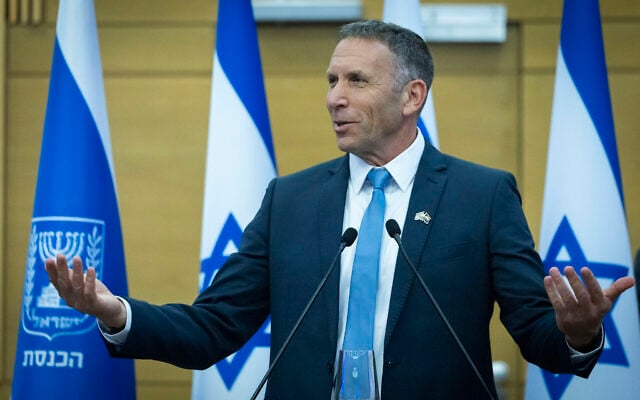
Finance Minister Bezalel Smotrich, head of the ultranationalist Religious Zionism party, published a brief article on
“Shame,” tweeted far-right National Security Minister Itamar Ben Gvir, leader of Otzma Yehudit.
The election follows days of bitter exchanges between the rival blocs over Kahana’s reliance on Arab lawmakers, with Likud, Religious Zionism and their allies accusing Eisenkot’s bloc of siding with “supporters of terrorism” and choosing “Arabs over Jews” by accepting support from Ra’am and the Joint List.
Before the vote, Joint List Chairman Yousef Jabareen reaffirmed his faction’s support for Kahana, saying: “We promised to be decisive, we promised to bring change for our voters, and we are keeping our promises.” »
Jabareen said his party would continue to serve as a “safety net” for those seeking to replace Netanyahu’s government, while Raam said he would “return statehood to the Knesset,” according to Channel 12.
On Monday, Smotrich offered to support Kahana alongside Likud if he agreed not to appoint vice presidents from Arab parties. Kahana dismissed the conditions as “anti-state”, prompting Smotrich to accuse him of choosing “Arabs over Jews” and the “Muslim Brotherhood over brothers in arms”.
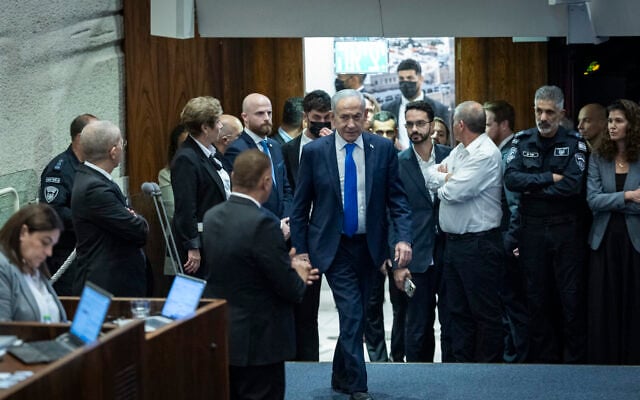
The attacks on Kahana and Arab parties come as part of a broader effort by Netanyahu’s bloc to delegitimize cooperation with Arab parties, whose support could prove decisive in Eisenkot’s efforts to form a government without Likud.
Since losing their parliamentary majority and without a clear path to forming a government, Netanyahu and his allies have repeatedly called for a national unity government with Yashar and other Jewish parties in the bloc, while continuing to vehemently attack them.
Eisenkot, meanwhile, continued negotiations with Likud over a possible unity government, despite opposition from some of his potential coalition partners to serving alongside Netanyahu.
Gn world