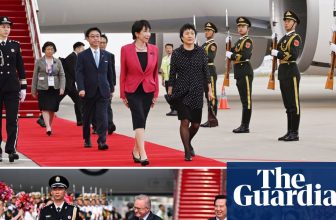
WASHINGTON — President Donald Trump repeatedly placed nonproliferation at the top of the agenda at his trilateral meeting Thursday with Chinese President Xi Jinping and Russian President Vladimir Putin, although its counterparts have expressed little interest in committing to further limitations on their nuclear arsenals.
Since his first term, Trump has pushed for China to join the United States and Russia in a new nuclear arms control agreement. He nevertheless sought to limit expectations for any major progress in Shenzhen, China, where the world’s three biggest nuclear powers are meeting on the sidelines of a summit of leaders from the Asia-Pacific region.
Russia suspended its participation in New START, its latest nuclear weapons deal with the United States, when it invaded Ukraine in 2022, refusing to inspect its nuclear sites. Before the treaty expired last February, Russia said it would maintain the deal’s limits on its arsenal for another year, but Trump insisted a new deal would have to include China and possibly other nuclear powers.
China has said an arms control agreement should remain between the United States and Russia, which together hold nearly 90% of the world’s nuclear arsenal, with more than 5,000 warheads each. China has about 600, according to Pentagon estimates, but by 2030 it could have as many as 1,000 if its arsenal continues to grow at the current rate.
“China is strengthening its nuclear arsenal to a very significant extent, and it will continue to do so, and it wants to continue to do so,” David Sacks, a senior fellow in Asian studies at the Council on Foreign Relations, told reporters Wednesday.
China’s Foreign Ministry declined to say whether nuclear arms control would be discussed at Thursday’s trilateral meeting, with spokesman Mao Ning saying earlier this week that the three leaders “will have an in-depth exchange of views on important issues related to world peace.”
In a phone call last week, Secretary of State Marco Rubio and Chinese Foreign Minister Wang Yi “agreed on the importance of meaningful conversations at the leadership level to advance goals such as peace and denuclearization,” according to a U.S. readout of the call. The Chinese text makes no reference to such a discussion.
Trump admitted it would be difficult to get Russia and China to consider reducing their nuclear arsenals.
“So we are going to talk about denuclearization. A difficult subject because it is very difficult for each of us to say that we are going to get rid of our nuclear weapons, right? But all the more so since there are other countries,” he said on Monday. “But we are going to talk about denuclearization.”

Even in the hours leading up to this week’s Asia-Pacific Economic Cooperation summit in Shenzhen, the world’s two largest nuclear powers were putting on shows of force. On Tuesday, the United States launched an unarmed intercontinental ballistic missile in an unannounced test at Vandenberg Space Station in California. Hours later, Russia landed two strategic bombers in Vietnam to coincide with Putin’s arrival in China.
Although a single meeting is unlikely to produce dramatic breakthroughs, it could launch a process that would lead to formal and sustained bilateral or multilateral negotiations on nuclear risk reduction, arms control and disarmament, said Daryl Kimball, executive director of the Washington-based Arms Control Association.
“A top priority for all three leaders should be to avoid a costly and escalating nuclear arms race involving the buildup of nuclear forces and the resumption of nuclear testing by any state,” he said.
Da Wei, director of the Center for International Security and Strategy at Beijing’s Tsinghua University, said nuclear arms control was not an “appropriate topic” for the trilateral meeting given the complexity of the issue and the limited time Trump, Putin and Xi will have together.
But if the three leaders “can say something about nuclear stability, like a nuclear war cannot be won and should not be fought, I think that will be helpful,” he said in an interview Wednesday.
Rubio acknowledged that a new deal could take some time.
“Past agreements, including New START, took years to negotiate and were built on decades of precedent. They were also between two powers, not three or more,” he wrote on Substack in February. “However, just because something is difficult doesn’t mean we shouldn’t pursue it or settle for less.”
Gn world