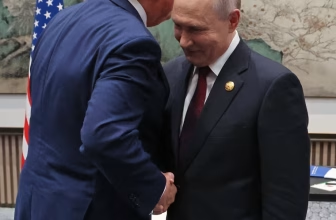
When Vladimir Putin posed for cameras with US President Donald Trump and Chinese leader Xi Jinping, it marked a rare moment of international recognition for the Russian leader since he ordered the full-scale invasion of Ukraine in 2022.
On the other hand, Ukrainian President Volodymyr Zelensky will find himself on Thursday in a heterogeneous assembly of small and medium-sized countries, convened by two weak European leaders and a recruit without a mandate.
The so-called Coalition of the Willing, an alliance of more than 35 countries supporting kyiv, will meet in Berlin to try to find a way to help Zelensky guide his country through another winter of brutal Russian bombing and freezing temperatures.
But some diplomats and officials among Ukraine’s allies fear that group has suffered from a lack of leadership and faltering momentum in recent months, and that it could be wiped out by any deal Trump might concoct with Putin.
Four European government officials told POLITICO that the political authority of the coalition co-chairs — France, Germany and the United Kingdom — is crucial to Ukraine’s success, but it is also weaker than it has been in years. “Leadership is shaky in France and Germany,” said a European official who, like others cited in this article, was granted anonymity to speak candidly. “In the UK, (new Prime Minister) Andy Burnham seems to be quite firm on Ukraine, but he’s still finding his way, so we’re waiting.”
German Chancellor Friedrich Merz barely hung on to his job this fall after a surge in support for far-right populists led to what he acknowledged was an electoral “disaster” for his center-right Christian Democrats. Emmanuel Macron, the French president, is historically unpopular and risks being wiped out by his centrist allies amid a wave of support for another far-right leader, Marine Le Pen, in next year’s presidential election.
Only Burnham has a solid majority in Parliament – but he has generally sought to focus on domestic politics since succeeding Keir Starmer in July without winning a general election, and remains relatively untested on the world stage.
The crisis coalition
The Coalition of the Willing emerged on March 2, 2025, days after Trump and his vice president JD Vance unleashed a torrent of criticism against Zelensky in the Oval Office for allegedly not being grateful enough to the United States for its support.
In the ornate setting of Lancaster House in London, which served as a filming location for the Netflix series The Crown, Starmer told a gathering of 18 leaders that he would put Britain’s “boots on the ground and planes in the air” if necessary to secure any peace deal that emerged for Ukraine. Macron has made similar military commitments.
Over the next year, the number of countries making up the group doubled and Merz officially joined the group as co-chair of the format.
A year ago, when Trump appeared poised to try to force Ukraine to accept what Europeans saw as a toxic peace plan, the coalition became a key bulwark in Zelensky’s defenses, a European diplomat said.
This meant that Ukraine supporters had concrete evidence demonstrating to Trump that the Europeans were willing to put their own soldiers, equipment and money on the line to secure a peace deal. The hope was that this would mean any settlement would be fair.

But momentum from peace talks and coalition meetings waned after the United States and Israel embarked on war with Iran in the spring. Thursday’s meeting will be the first meeting of coalition leaders since August.
It coincides with the coalition’s first military exercise, held in Poland, where thousands of troops are rehearsing how to maintain potential peace in Ukraine, although that prospect still remains elusive.
Britain’s new kid
Burnham is a newcomer to the world stage and was not expected to make foreign policy a central part of his premiership in the way Starmer did.
He countered that expectation to some extent by holding a series of meetings with world leaders after securing the keys to Number 10 and reopening a very heated debate over the future of the UK’s relationship with the EU.
Nevertheless, some careful observers say that upheavals at the top of government inevitably mean a setback at the highest levels of diplomacy. Ed Arnold of the British Foreign Policy Group said “momentum has been lost with the change of prime minister”, while a British minister pointed out that this was also true for the UK’s new defense secretary, Wes Streeting.
A British official strongly denied that Burnham would have less energy than his predecessor to form a coalition or to support Ukraine. He is “really focused” on maintaining British support for Ukraine, the official said, pointing to recently announced sanctions and assistance in developing long-range missiles. “The importance of the coalition of the willing does not diminish in any way,” the official added.
Burnham himself has sought to dissolve the distinction between foreign and domestic policy, saying in a speech on Monday: “The world is so interconnected now that it is impossible to separate decisions made in Moscow from what is happening on the ground at (his constituency seat) Makerfield.” »
Trump’s peace campaign
The coalition leaders’ renewed engagement comes amid renewed pressure from Trump to reach a peace deal.
The main objectives of Thursday’s meeting are to develop plans for strong, legally binding security guarantees for Ukraine, including a multinational military force to guarantee a ceasefire; commit additional funds to kyiv’s war effort over the next year; provide military support – particularly air defenses against jet drones and long-range strike capabilities; and coordinate views on the ongoing peace negotiations mediated by the Trump team.
On Wednesday, the European Commission proposed a loan of 45 billion euros of additional financial support to Ukraine for 2027. Commission President Ursula von der Leyen said she was seeking more contributions from countries outside the EU, adding: “We will also discuss the proposal with our partners in the coalition of willing countries.” »
Another question preoccupying officials and diplomats as they prepared for the Berlin meeting was whether Trump would support Putin’s demands to reshape European security and NATO’s role on the continent amid the Ukraine peace process.
Many European governments are already concerned about the withdrawal of U.S. troops from Europe and some worry that Trump’s criticism of NATO members will weaken the alliance’s ability to deter Russian aggression.
Yalta fears
It was with these concerns in mind that officials in Brussels and European capitals were closely monitoring meetings between Trump, Xi and Putin in Shenzhen, southeast China.
“The danger for Ukraine is that Trump uses this summit (in China) to try to advance his notion of peace, including giving Russia territory that it has failed to seize by force,” said Bronwen Maddox, director of the Chatham House think tank in London. “Ukraine will be able to hold on, but only with European help.”

A German official said the outcome of the war in Ukraine is expected to shape Europe’s security architecture for years to come, and that will also be part of the group’s discussions on Thursday. A French official said that far from acceding to Putin’s demands, Paris wanted Ukraine to join an expanded NATO.
In kyiv, Zelensky’s government is desperate to secure as much support as possible from its donors, particularly regarding F-16 fighter jets, air defense and money. But Ukrainians also understand that, with the transatlantic alliance now fractured because of Trump’s policies over the past two years, an imperfect group such as the Coalition of the Willing is better than nothing and can be as good as it can be.
“They are doing a lot for Ukraine in terms of capabilities,” a senior Ukrainian official told POLITICO. “Burnham is a great guy, he makes a lot of good decisions. We are very happy to work with him. Merz and Macron are also doing everything they can. In terms of support, Germany is the leader. France is a strong ally.”
And the real test of the coalition, the Ukrainian official said, may come only when the war ends and someone has to send troops to protect the peace.
Veronika Melkozerova, Hans von der Burchard, Sérène Nourrisson, Bjarke Smith-Meyer, James Angelos, Victor Jack and Nicholas Vinocur contributed to this report.
Gn world