This is the little space probe that could do it: Nearly 50 years after its launch, NASA’s Voyager 1 on Wednesday became the first man-made object to travel a light day — or 10 billion miles — from Earth.
“To put it in perspective, the Sun is about eight light minutes from Earth,” said Jason Rhodes, chief astrophysics scientist at NASA’s Jet Propulsion Laboratory.
Voyager 1 and its sister ship, Voyager 2, embarked in 1977 on their mission to explore the solar system’s giant planets – Jupiter, Saturn, Uranus and Neptune – and their moons. A rare planetary alignment at the time allowed NASA to plot a flight path requiring minimal fuel, using the gravity of the planets to launch the probes to their destinations.
The twin spacecraft returned dazzling, never-before-seen photos of the outer planets to Earth and revealed many of their secrets for the first time, such as the discovery that Jupiter’s Great Red Spot is a massive storm system.
The two Voyagers separated in 1980 after exploring Saturn. While Voyager 2 studied Uranus and Neptune, Voyager 1 began its long journey out of the solar system, a journey it continues to this day.
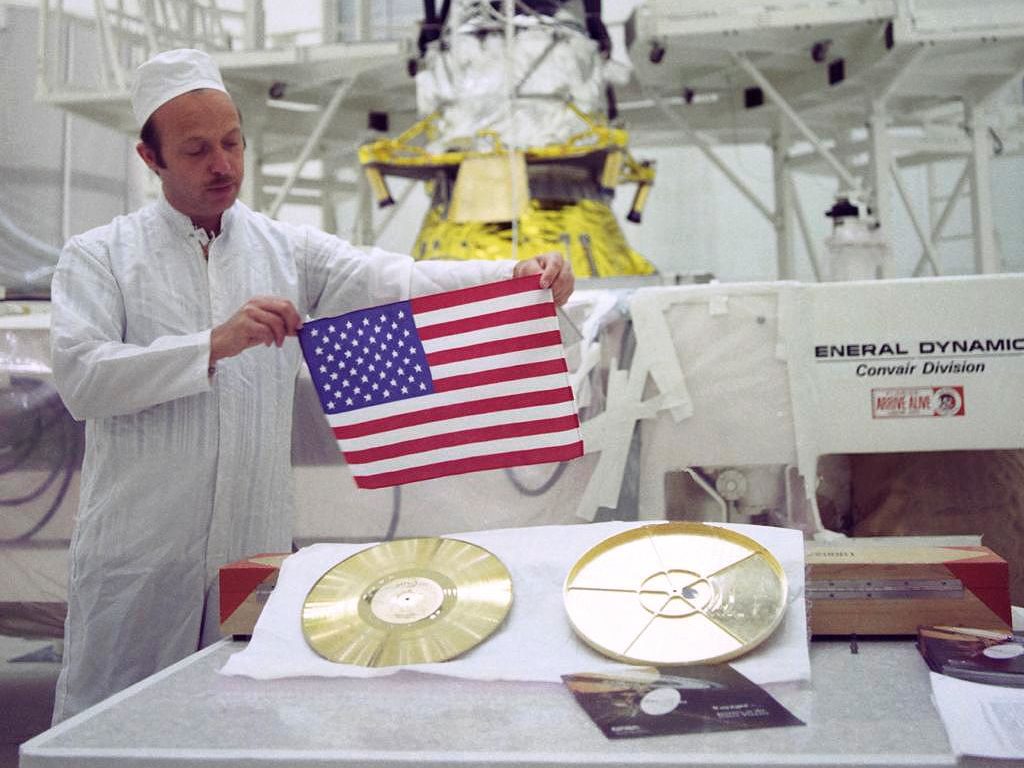
John Casani, Voyager project manager, holds a small American flag that was folded and sewn into the thermal blankets of the Voyager spacecraft before its launch, at Cape Canaveral, Florida, on August 4, 1977. Below him is one of two Golden Records, 12-inch phonograph records filled with the sights and sounds of Earth, carried into space by each of the probes. Photo provided by NASA/JPL-Caltech
In 1990, at the request of astronomer Carl Sagan nearly a decade earlier, Voyager 1 took the famous “Pale Blue Dot” photo of Earth minutes before its cameras shut down for good. This image inspired Sagan’s book of the same name.
The decades-long Voyager mission has inspired generations of scientists, including Rhodes, whose current projects include NASA’s groundbreaking Nancy Grace Roman Space Telescope.
WATCH: How NASA’s new space telescope could help solve the mysteries of dark energy and dark matter
“I grew up in Iowa watching these Voyager spacecraft take these iconic images,” he said, adding that “it’s kind of a dream come true” to work at the place that built them.
A testimony of engineering
About the size of a subcompact car, Voyager 1 travels more than 37,000 mph through interstellar space to the farthest reaches of our solar system.
At a distance of one light day from Earth, it will now take an entire day for the intrepid explorer to telephone home via radio signals and an entire day for scientists to respond. NASA uses a series of giant antennas known as the Deep Space Network, located in California, Spain and Australia, to communicate with Voyager.
“The fact that a spacecraft launched almost 50 years ago continues to function is a true testament to Voyager’s engineering,” Rhodes said. “And it’s not just about operating, but also about making groundbreaking scientific discoveries.”
In 2012, Voyager 1 was the first spacecraft to cross the heliopause, a point in space where the influence of the sun’s magnetic field gives way to the influence of distant galaxies. (After leaving Neptune, Voyager 2 reached the heliopause in 2018.)
“We didn’t know exactly where this heliopause was, and we didn’t know what it would look like physically in terms of magnetic fields and particle interaction,” Rhodes said. The scientific measurements returned by Voyager have helped scientists gain new understanding of the complexities of interstellar space.
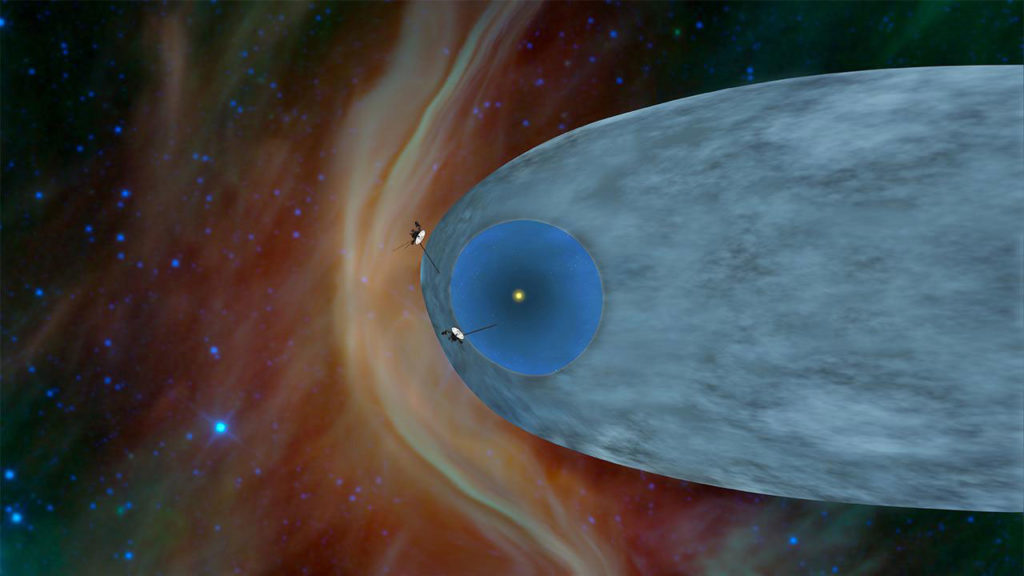
An artist’s concept showing the general locations of NASA’s two Voyager spacecraft prior to Voyager 2’s crossing into interstellar space. Voyager 1 (top) traveled beyond the heliosphere into interstellar space, the space between the stars. Image provided by NASA/JPL-Caltech
Over the years, the Voyager team has had to remotely turn off cameras and various instruments aboard both spacecraft in order to save power. Three of the 11 experiments on each probe remain active today, according to NASA.
LEARN MORE: NASA turns off scientific instrument on Voyager 2 to extend spacecraft’s life
For those spacecraft that have long exceeded the expectations of their original mission, NASA’s goal is to continue making engineering modifications in the vastness of space to keep them operating as long as possible, Rhodes said.
“Voyager is not about to finish telling us about the universe,” he said.
A free press is the cornerstone of a healthy democracy.
Support trusted journalism and civil dialogue.
Gn headline