WWe made it to the very end of Quentin Tarantino’s previous film, Once Upon a Time in Hollywood, without knowing exactly how, why, or if Brad Pitt’s stunt double, Cliff Booth, murdered his wife. This was a question only addressed in Tarantino’s novel based on the film. And throughout the 140 minutes of this scandalous sugar rush sequel – written by Tarantino and directed by David Fincher – this subject is tactfully glossed over, the only point that detracts from our perception of Cliff’s amiable, cowpoke good nature.
Cliff is the guy who climaxed in the previous frame by assisting in a dramatic rescue; afterward, that is, having valiantly refused an age-gap relationship with Margaret Qualley’s jailbait teenager. Well, we may not get the full picture of Cliff’s marital circumstances until Tarantino’s next crossover novel, Cliff Booth, with which this film is to form a sort of multimedia narrative event. But there is nonetheless a tremendous amount of energy, fun and scabrous black comedy, provocative bad taste and cinematic style to be found here.
Like Tarantino’s Kill Bill: Volume 2, The Further Misadventures of Cliff Booth repeats the ideas and characters of the first film in a somewhat pedantic way, admittedly, and the ending is rather truncated – again, I think, due to the spread of the story through the film and the book. But he maintains an unbridled madness with a flair so few can approach. It’s a film that once again gives us the brutality and filth of Ed Bunker, the urban crime pastoral of Elmore Leonard, and of course the classic Tarantino trope of two tough guys rolling around in a car, a little before the appointed time, but in time for some chatter and bickering. (Here, some loathsome hitmen discuss the illogical sequence of house numbering on Mulholland Drive in Los Angeles.) Fincher’s direction perhaps speeds things up in scene transitions, quicker than the chapter-by-chapter prolixity that Tarantino would have favored. Female characters also tend to keep their shoes and socks on.
The setting is now almost 10 years after the first film, the Los Angeles of 1977, the time and place of Paul Thomas Anderson’s Boogie Nights, in fact, and also the presidency of Jimmy Carter, although it’s only Nixon who gets a name check. Sharon Tate makes a television commercial for cigarettes. Cliff grew a mustache and quit the stunt business, after suffering an injury that left him with a slight limp; his old pal Rick Dalton is apparently making a TV show in Australia.
These days, Cliff has moved out of his trailer and lives with his cantankerous old pawn shop owner father Gus (Peter Weller) and presides over a portfolio of side businesses. He’s a movie projectionist (like Pitt’s character in Fight Club) at Los Angeles’ historic New Beverly Cinema, a coyly proprietary touch on the part of the screenwriter and the theater’s current owner. Cliff tends bar at various bars on different nights of the week, performs a gig at a demolition derby, and has unofficial ties to the film world, leading people to recognize him all over town.
Above all, he is a discreet intermediary for influential people who are being extorted. Cliff is perplexed to be contacted out of the blue by smart, talented agent Karen Crosby (Elizabeth Debicki), a former film critic formerly mentored by Pauline Kael, and this would appear to be how Tarantino got his idea for a film critic character who was going to be the subject of his “final” film. (Personally, I was disappointed that Kevin Thomas of the LA Times wasn’t the one to take Karen under his wing.)
Karen, with whom Cliff falls passionately in love, introduces him to her client Charlie Peters (Scott Caan), who is currently starring in a TV show with blaxploitation star “Hot” Rod Harrison (Yahya Abdul-Mateen II). We get a very funny pastiche montage of Charlie’s B-picture and TV credits, like Rick Dalton’s in the first frame. Charlie is fascinated by Cliff’s military record during World War II, and Cliff agrees to take a difficult job for him, his heart softened by the fact that he once had a fondness for Charlie’s socialite wife, Toni (Carla Cugino). So, Cliff enters, or re-enters, or perhaps just sinks deeper into a world of violent crime.
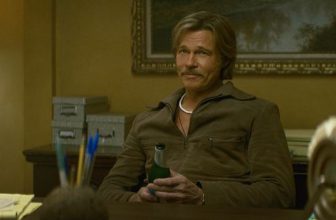
The film can only work with the drawling, imperturbable good humor of Brad Pitt as Cliff. His performance is watchable and endlessly entertaining, but also enigmatic, in that Cliff’s seasoned world experience has left him with a shell of laid-back calm. Cliff is essentially surprised by nothing, affected by nothing; it’s a function of Cliff’s character and Pitt’s almost sphinx-like skill on camera. It is Cliff’s inability to be seriously shaken by anything that gives the ironic twist and charge to the film. This is Pitt’s great comic creation.
Gn entert