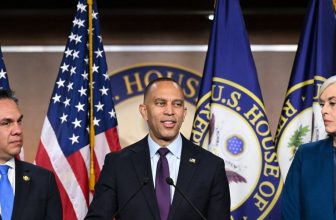
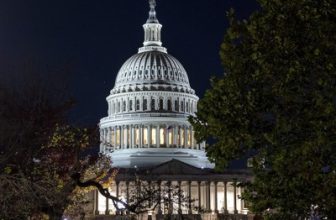
In one of Republicans’ final weeks in office, GOP leaders failed to convince enough of their members to return to Washington to vote on their own bills — and Rep. Greg Murphy was furious.
Murphy, who just lost his eastern North Carolina seat in one of the biggest upsets of the midterms, lashed out at fellow Republicans in a closed-door meeting Wednesday, urging leaders to cut the salaries of lawmakers who don’t show up, according to several people in the room.
“Look, I lost. I’m still here. I’m still here,” Murphy later told CNN of his frustration with the delinquency of some of his colleagues. “If they’re not there, they shouldn’t be paid.”
After their historic midterm rout, Republicans are increasingly exasperated with their otherwise healthy Republican colleagues who refuse to return to Washington after their election defeats.
Speaker Mike Johnson and his GOP leadership team have privately rebuked those who chose not to return, including one member who told the president they did not return because they were worried about a CNN report on the prospect of an Iranian “dirty bomb” plot in Washington. (Johnson, after learning the reason for the member’s absence, reminded the member that his staff worked in Washington, according to a person familiar with the discussions.)
“Participation is a big frustration for me right now,” Johnson said Thursday. “We had 14 absences yesterday, so it’s not possible for us to move forward with a rule and advance our legislative agenda unless members are here to do their jobs. … We want to go through the tape and finish strong, but we can only do that if people are there to work.”
It’s a glaring — and familiar — problem for Hill’s GOP leaders, who have struggled all year trying to keep a small, record majority in line. And it comes as Republicans were already struggling to achieve most of President Donald Trump’s agenda before being pushed deep into the minority in January.
Republican leaders are under pressure to replenish Pentagon funding after months of war with Iran, but they don’t have the votes. They want to use their Republican trio to raise the debt ceiling to avoid a Democratic showdown with Trump next year. And they want to accomplish important legacy projects, like authorizing reform, before being forced to start over with Democrats in charge.
House Republicans say the best way to carry out Trump’s wishes — particularly regarding the debt ceiling and Pentagon war funding — is to bypass Democrats completely and craft a bill that conforms to the party line. But any party-line bill poses a logistical challenge in the Senate, where Majority Leader John Thune has paused his party’s efforts to take that route.
Now, Hill’s Republicans increasingly fear losing their final days in office, with absences further complicating an already difficult December puzzle. Some Republican leaders privately fear that the only thing Republicans will accomplish in December is dedicate government funds into the new year — perhaps in conjunction with an expansion of the country’s expired spying powers, according to several people familiar with the discussions.
They also worry about political theater that could distract from the agenda, with Republican Rep. Thomas Massie of Kentucky, a frequent leadership challenger, forcing votes on the Epstein files and ending the war in Iran.
Already, there is talk of sending the House home after passing a stopgap bill before the Dec. 11 funding deadline — and canceling votes scheduled for the following weeks — because Republicans won’t have the votes to do more, according to several of these people.
“There’s a possibility we could waste it if we don’t get our members back here,” senior GOP Rep. Mike Simpson said of the remaining days of Republican control. “What do we do to these guys who won’t come back?
Rep. Jim Jordan, the new Republican minority leader in the House of Representatives, is among the Republicans pushing to use this party-line process — known as reconciliation — to implement Trump’s priorities before Democrats take power.
“I’m in favor of doing as much as possible,” Jordan told CNN when asked about his preference for a Republican-only bill, adding that he wants to see “all kinds of important things, like the debt ceiling issue, like the defense issue.”
Asked if this would include funding for Iran, Jordan added: “It’s certainly important. »
Thune, for his part, said Thursday that they likely won’t move forward on a party-line bill until Thanksgiving — when both chambers have just three weeks left. Many Republicans see this as a tacit acknowledgment that the party won’t do anything substantial before handing over the gavels.
In the Senate, Republicans are single-mindedly focused on confirming more of Trump’s judges, passing a long-awaited licensing reform bill and finding a way to get money to the Pentagon.
Sen. John Hoeven of North Dakota said he and others still hope Democrats will be willing to help pass some of that Pentagon funding — even as an emboldened Senate Democratic caucus makes clear it won’t approve more money for the Iran war.
“They can vote against the military and tell everyone why they’re doing it,” Hoeven said of Democrats. “We’re trying to give them the opportunity to join us and do the right thing, which is vote to support our military.”
If that doesn’t work, Hoeven acknowledged that Republicans will have to try cross-party reconciliation again, despite its difficulties.
But Republican Sen. John Cornyn of Texas was blunt about the bill’s prospects: “Everyone recognizes that it’s going to be a Herculean effort to try to get the House and the Senate to agree on the scope and the process.” »
And Murphy, the North Carolina Republican chastising his colleagues for their absences, added: “It will be difficult if people don’t show up to their jobs. »