Prime Minister Benjamin Netanyahu insisted he would be the only one to serve as prime minister in a possible unity government with Yashar party leader Gadi Eisenkot, Israeli media reported Friday, over a list of demands from his Likud party that underscored the gulf between the parties.
The list was reportedly presented by Michael Rabello, Netanyahu’s former personal lawyer, when Likud and Yashar representatives met earlier this week to discuss a possible unity government.
These demands represent Likud’s starting position in negotiations over a possible unity government, according to Channel 12, which along with other media outlets reported the party’s terms as follows:
1. Netanyahu will be prime minister for four years – meaning there will be no rotation framework for Eisenkot to serve as prime minister.
2. All parties will be part of the government, from the far-right Otzma Yehudit of Minister of National Security Itamar Ben Gvir to the left-wing Democrats, not counting the two Arab-led parties.
3. Coalition partners will need to provide full support for a new offensive against Iran.
4. Judicial reform legislation will remain in force until consensus is reached.
5. A political commission of inquiry into the Hamas terrorist attack of October 7, 2023 will be created, instead of a state commission.
6. A Haredi bill based on that presented by the outgoing government will be advanced.
7. No changes will be made to the living conditions of Hamas Nukhba fighters, despite allegations of human rights violations.
8. No withdrawal from the current IDF lines in Gaza until the threat from Hamas has been lifted.
9. Coalition partners will be required to sign a declaration opposing the creation of a Palestinian state.
10. Coalition partners will be required to sign a declaration recognizing Israel as the nation-state of the Jewish people.
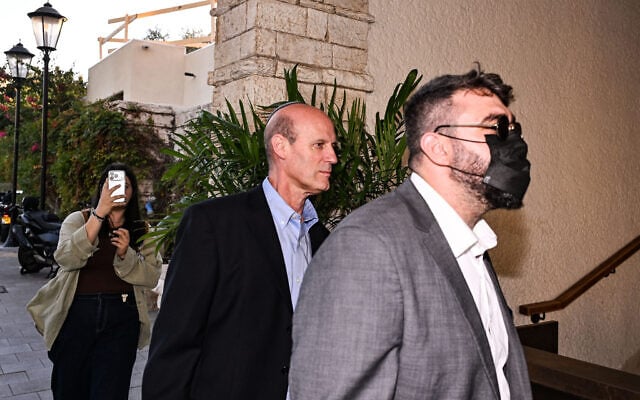
The reports do not clearly show how Yashar representatives responded to these demands. Sources in the Zionist party bloc led by Eisenkot were quoted by the Haaretz daily as saying that the proposal was clearly not aimed at forming a unity government and called it a “manipulation” by Netanyahu, while pointing out the major discrepancies between these demands and their own positions.
In response, Likud claimed that “the three claims regarding a commission of inquiry, judicial reform and conscription are false”, without responding to other reported demands.
Eisenkot, who is currently tasked with forming a government, ruled out joining a Netanyahu-led coalition but said he was open to a possible unity government with Likud. He also discussed a potential coalition with ultra-Orthodox parties, while signaling that he would seek to establish a minority government drawing on the support of the Knesset’s two Arab parties – Ra’am and the Joint List – if his efforts to muster a ruling majority fail.
Eisenkot has said the foundation of any government he forms would include the four anti-Netanyahu Jewish parties – Yashar, B’Yachad, The Democrats and Yisrael Beytenu – but the latter party’s chairman, Avigdor Liberman, has pledged to vote against a minority government backed by the Joint List and Raam, which Netanyahu has repeatedly called “supporters of terrorism” who pose a threat to Israel’s national security.
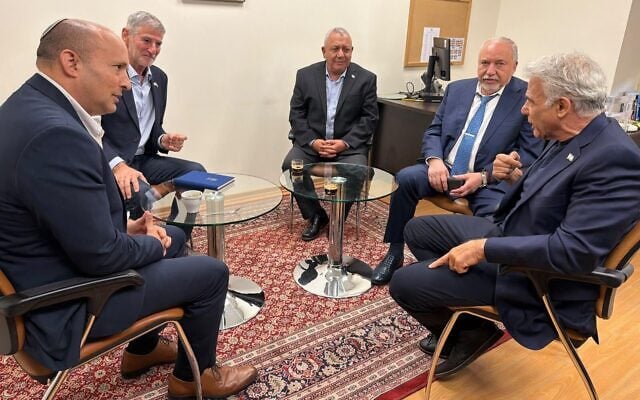
Liberman reiterated this position in an interview with Channel 12 broadcast Friday, calling on the Yashar-led bloc to join the ultra-Orthodox Shas and United Torah Judaism, which would be enough to secure a simple majority of 61 seats in the 120-member Knesset.
UTJ, however, denied reported progress in coalition talks with the Eseinkot bloc, while Shas signaled its reluctance to part ways with its long-time ally Likud.
Yisrael Beytenu leader predicted that forming a coalition drawing on Ra’am and the Joint List would have an electoral boomerang effect and “put Bibi back on steroids”, using Netanyahu’s nickname.
“Whoever forms a minority government relying on the abstention of Arab parties simply crowns Bibi with 70 seats in a short time,” Liberman said. “Ultimately, you can only bring down Netanyahu from the right, not the left. »
He stressed that he would vote against such a government if a Knesset vote were held, adding that he “also heard MKs from other parties in the Change bloc” say they would do the same.
“If you think it’s just Yisrael Beytenu, I can count ten other MPs from other parties for you,” Liberman said.
He also came out strongly against a possible unity government in which Netanyahu would serve as runner-up under a rotation deal. “For me, the most important goal is to end the Netanyahu era of Israeli politics. »
Liberman insisted to Channel 12 that he felt “100 percent positive” that they would ultimately form a government with the Haredi parties, with whom he acknowledged he had not spoken, but said he had “enough tools to see” that would happen.
“All the conditions are met and it is really possible to conclude the negotiations in a short time,” he said.


Gn world