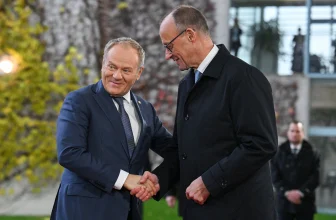
German Chancellor Friedrich Merz, Ukrainian President Volodymyr Zelensky, French President Emmanuel Macron, British Prime Minister Andy Burnham and U.S. envoy Steve Witkoff pose for a group photo during the Coalition of the Willing meeting in Berlin, Germany, November 19, 2026. (Michael Kappeler/photo alliance via Getty Images)
Europe is finally ready to start negotiations with Russia.
Following this week’s meeting of the Coalition of the Willing in Berlin, European countries are expected to be represented at the negotiating table alongside Ukraine, Russia and the United States.
The continent will be represented by the E5 – Germany, France, UK, Italy and Poland – as well as representation from NATO and the EU.
Above all, they will need to speak with one voice. This is particularly important given recent attacks on Europeans by President Trump’s son-in-law and chief negotiator Jared Kushner during negotiations in Abu Dhabi, where European representatives were relegated to the sidelines.
The date and format of the next “quad” meeting have yet to be confirmed, but securing Europe’s place at the negotiating table is progress, especially as Russia continues to demand a fundamental overhaul of the European security architecture.
Future negotiations will have to build on the modest results of previous negotiations in Saudi Arabia and the subsequent diplomatic exchanges of American envoys with the Russians.
It remains to be seen whether Moscow has demonstrated a real willingness to compromise.
The exact results of Steve Witkoff and Jared Kushner’s visit to Moscow on November 12 remain unknown, as do the details of what they conveyed to President Volodymyr Zelensky in Dublin. But just hearing the excerpts from the meeting in the Kremlin, which were almost certainly deliberately made public, makes it clear that Putin has not strayed an inch from his maximalist demands.
All of the demands formulated during the Istanbul negotiations in March 2022 remain unchanged: no foreign troops, disarmament of Ukraine, neutral status and total exposure to Russian occupation without external interference.
In November 2026, the negotiations come full circle.
It is not surprising that Zelensky insists that Russia is not ready to make peace. Besides, as the Russian proverb says, “the appetite comes during the meal”.
It can be argued that Putin has not simply walked back his demands from the first months of the invasion; he returned to those he made to former US President Joe Biden in 2021.

Putting the issue of “European security architecture” on the negotiating table – especially since the Europeans themselves are not at that table – only proves what Ukraine has been trying to make for almost five years of full-scale invasion: if you don’t stop Putin in Ukraine, he will go to Europe.
Undoubtedly, it was Europe’s firm determination to support Ukraine, while the United States refused to provide them with military and financial aid, that provoked an allergic reaction in the Kremlin.
Furthermore, Europe’s new determination to strengthen its own defense and deterrence capabilities has sent a strong signal to Russia: it is time for Europe to accelerate, not stop now.
“We are back in the world of predators.”
Many important steps have already been taken: Europe is no longer dependent on Russian oil and gas and is no longer willing to put its business ahead of its security.
After witnessing Russia’s brutal war against Ukraine for nearly five years and facing uncertainty over the once indisputably reliable transatlantic alliance, the EU has made a fundamental shift – moving from a primarily economic community to one whose geopolitical agency and defense preparedness are one of its top priorities.
“We are back in the world of predators,” as Klaus Welle, former secretary general of the European Parliament and now advisor to the European Commissioner for Defense, said. Europe understood that it had to become stronger to survive in this world.
Brussels has begun actively discussing the future of the European security architecture, with Ukraine at its center, and ways to operationalize Article 42.7 of the Treaty on European Union – the EU’s own mutual assistance clause similar to NATO’s Article 5.
It has also increased its defense spending in the multiannual financial framework, created a dedicated security and defense committee in the European Parliament and is trying to better align national defense industries to improve interoperability, thereby translating industrial capacity into common capability planning.
Furthermore, to move away from crippling veto power and toward qualified majority voting in decision-making (think Hungary), Europe is considering creating an entirely new intergovernmental arrangement parallel to the EU, such as a European Defense Union with a European Security Council as its governing body.
Ukraine is seen as one of its most critical members, which will shape a new military doctrine for NATO’s European pillar.

Naturally, these progressive but unprecedented steps within the EU have ruffled some feathers in the Kremlin, prompting it to bring the question of European security architecture up for debate.
The Europeans, aware that they must restore their capacity to act to guarantee an acceptable end to the war on their continent, are now seeking to be more widely represented in negotiations with Russia.
The fact that the EU has now assumed a greater share of financial support for Ukraine gives it a valid argument with the Americans, and the $300 billion in Russian sovereign assets held in Belgium adds some leverage over the Russians.
There is even talk of appointing a permanent EU envoy to Russia. A clear mandate for the position, as well as the application itself, has yet to be developed, with many names being thrown into the ring, but the willingness to take more initiative is reassuring.
Europe should get involved in the ceasefire negotiations in Ukraine, because it will be European troops who will observe this ceasefire.
British, French and European troops are preparing for this mission, notably through exercises in Poland. But even more, Ukraine has now become an indispensable part of the European community.
This awareness has finally become irreversible, not only in kyiv but also in Brussels.
As Ukraine moves toward formal EU membership, many discussions in Brussels focus on how to bring Ukraine closer together more quickly.
“The perception of Ukraine is shifting from aid recipient to the continent’s internet security provider.”
There have been several attempts to float the idea of associate membership, which naturally provoked a painful reaction in Ukraine, with fears of being cheated – in all the new senses of the word – but, behind closed doors, European officials assure that it is instead a way to integrate the war-torn country into European structures earlier.
Others suggest replacing the word “associate” with “progressive member.”
Such puns may seem insignificant to an outsider, but in the corridors of the EU they can significantly change the dynamic for an aspiring member.

Regardless, the perception of Ukraine is shifting from aid recipient to the continent’s internet security provider.
Europe has now accepted that its best chance of achieving strategic defense self-sufficiency is to build on Ukraine’s battlefield experience and defense innovation.
Naturally, Ukrainian drone innovation takes center stage, but perhaps even more valuable is the new military doctrine taking shape in Ukraine. It’s not just about cheaper, more agile hardware, but also smart, sophisticated ways to deploy it – an array of terrain navigation, electronic warfare, application of AI-driven C4ISR, anticipation of Russia’s next move and denial of action – ultimately, the most successful operationalization of battlefield data in modern history.
Ukraine’s value lies in the tactics, techniques, and procedures (TTPs) it has developed rather than the hardware itself.
Once a lasting ceasefire is in place, experienced Ukrainian units could contribute to a future European Defense Force or serve alongside NATO’s high-readiness forces. Current proposals envisage Ukraine providing up to 50,000 of its combat-experienced soldiers alongside another 50,000 from other European contingents to effectively form a new European army.
All this demonstrates how NATO’s European pillar will become increasingly dependent on Ukraine.
And while transatlantic relations are unlikely to return to what they were before Trump 2.0 – with Europe’s diminished trust in Washington and America’s aggressive insistence that Europe do its part – Ukraine will be a decisive factor in the evolution of both sides of that relationship and, potentially, the entire NATO 3.0.
Editor’s note: The views expressed in the opinion section are those of the authors and do not purport to reflect the views of the Kyiv Independent.
Gn world